

- Clashes intensify along Sittwe-Ponnagyun border as Arakan Army captures military outposts
- Heavy fighting erupts in Laymyethna as junta launches offensive against Arakan Army-held territory
- El Niño threatens Arakan State with extreme heat, drought and water shortages
- Min Aung Hlaing seeks renewed ties with US, West in TIME interview
- Over 2,000 arrested in Myanmar for online activity since 2022: D4M
DMG Editorial: Bombing the Defenceless, When War Crosses Every Red Line in Arakan
Since losing control of most of Arakan State, the military regime has increasingly turned the sky into its last instrument of power. Airstrikes have replaced governance. Bombs have replaced law. Where the junta can no longer rule on the ground, it punishes from above.
26 Jan 2026
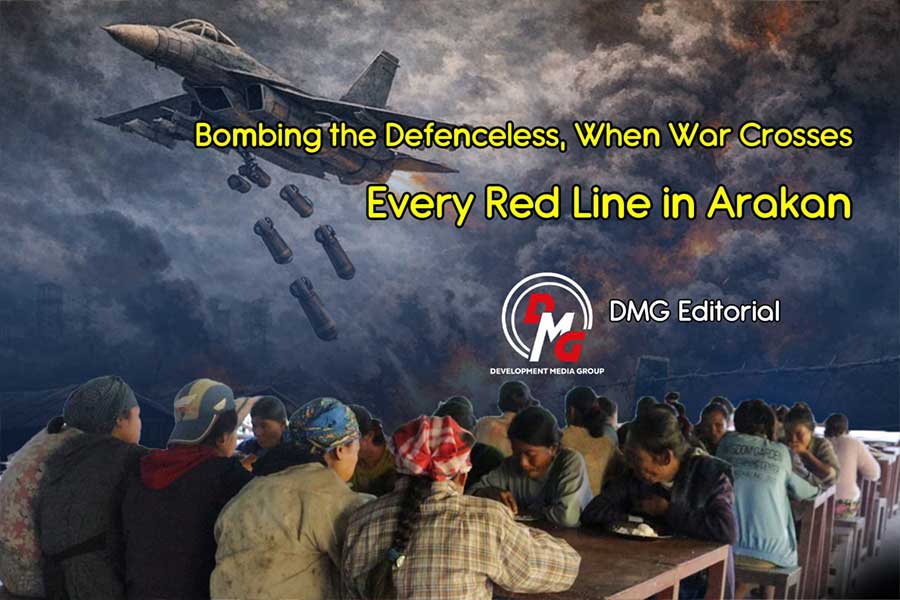
The January 20 airstrike on the Chaungtu detention centre in Kyauktaw Township marks another grim milestone in Myanmar’s war against its own people. Twenty-one prisoners of war and family members were killed, and dozens more injured, when junta aircraft dropped bombs on a site known to house detainees, women, children, and the wounded. This was not a battlefield. It was not an accident. It was a deliberate attack on people who were already defenceless.
For Arakan, this was not an isolated incident. It was the latest chapter in a pattern that is now impossible to deny.
Since losing control of most of Arakan State, the military regime has increasingly turned the sky into its last instrument of power. Airstrikes have replaced governance. Bombs have replaced law. Where the junta can no longer rule on the ground, it punishes from above.
A Pattern of Atrocity
The Kyauktaw attack follows at least three other mass-casualty airstrikes on detention camps since late 2024 in Pauktaw, Maungdaw, and Mrauk-U. In each case, the targets were not active combat units but prisoners of war, detainees, and their families.
These attacks share a clear pattern: detention camps hit at night, clinics and dormitories struck, and casualties dominated by women, children, the injured, and the elderly.
Under international humanitarian law, prisoners of war and civilians under detention must be protected. Targeting them is a grave breach. When such attacks recur across multiple locations and months, claims of military necessity collapse. What remains is intent.
This is why political analysts and civil society voices in Arakan increasingly describe these attacks as war crimes and crimes against humanity.
War Against Surrender
What makes these airstrikes especially chilling is the message they send. Thousands of junta soldiers have surrendered during the Arakan Army’s offensive. Some have been released; others are being held temporarily with their families.
By bombing detention camps, the military sends a brutal signal not only to its enemies, but to its own troops: surrender will not save you. Your family will not be spared. There is no safety outside the junta’s collapsing chain of command.
This is warfare driven not by strategy, but by vengeance.
Arakan Under a New Reality
Arakan today is governed by a new reality. The military has lost territorial control, but not its capacity for destruction. The Arakan Army now administers large parts of the state, including detention facilities, healthcare access, and civilian order. Yet none of this shields the population from air power wielded without restraint.
For civilians, daily life is shaped by fear not only of ground clashes, but of sudden death from the sky. Detention centres, hospitals, schools, and markets have all been hit in recent months. No space carries moral protection.
The Moral Collapse of the Regime
Bombing prisoners and their families is not a sign of strength. It is evidence of moral collapse.
A state that targets the captured, the wounded, and children has forfeited any remaining claim to legitimacy. A military that bombs clinics and dormitories has abandoned the most basic rules of war.
This is not only about Arakan. It is about what Myanmar has become under military rule, a system sustained by terror, where accountability is replaced by impunity.
A Line That Must Be Drawn
Despite mounting evidence, international responses remain muted. Statements are issued. Concerns are noted. But the aircraft keep flying.
For the people of Arakan, this silence is not neutral. It is felt as abandonment.
The bombing of POW detention camps crosses every red line, legal, moral, and human. It demands more than documentation. It demands action. Protecting civilians now means confronting the reality of air power used without restraint and holding perpetrators accountable not at some distant future tribunal, but through real political pressure today.
For Arakan’s people, prisoners and civilians alike survival should not depend on whether the sky is quiet.
DMG will continue to document these crimes, because silence is what the bombs rely on most.

Opinion
UN at a Crossroads: Six Priorities for a Shared Future
By Admin 23 Sep 2026
.jpg)
How Can Myanmar’s Political Crisis Be Brought to an End?
By Admin 13 Sep 2026

By Cutting Trees, We Are Killing Ourselves
By Admin 06 Sep 2026
A Modern August We Must Never Forget
By Admin 31 Aug 2026
Arakan’s Political Shifts and the Debate Over Rights and Governance
By Admin 27 Aug 2026
POLITICS


BUSINESS

Industry to manufacture finished goods from coconut starting in early 2020
By Aung Kaung Zaw 20 Nov 2019