

- High airfares leave low-income families stranded in blockaded Sittwe
- MSF rrges civilian protection after Sittwe shelling kills two, injures 17
- ULA warns Arakan residents of airstrike risks during Thadingyut festival
- Months-long internet blackout drives up costs for residents of Thandwe and Gwa
- At least five injured in junta Y-12 airstrikes on Werathani villages
Fuel shortages could have major economic and social impacts in Myanmar: ISP-Myanmar
Fuel shortages could have significant impacts on Myanmar’s economic and social sectors, according to a report released on March 11 by the Institute for Strategy and Policy – Myanmar (ISP-Myanmar).
11 Mar 2026
DMG Newsroom
11 March 2026, Yangon
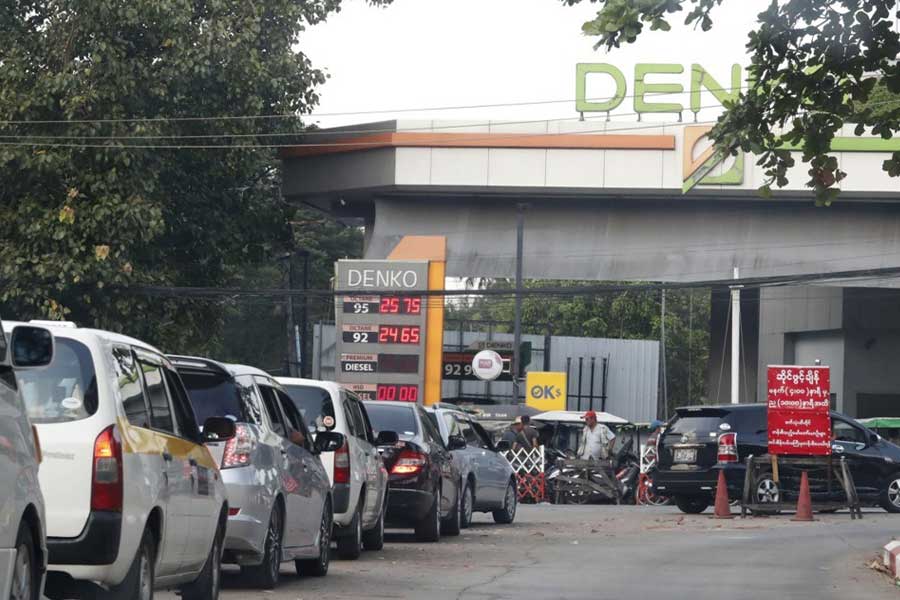
Fuel shortages could have significant impacts on Myanmar’s economic and social sectors, according to a report released on March 11 by the Institute for Strategy and Policy – Myanmar (ISP-Myanmar).
The report notes that about 95 percent of fuel used in Myanmar is imported, while domestic production accounts for only around 5 percent.
ISP-Myanmar said the current global fuel crisis linked to the ongoing conflict involving Iran could disrupt fuel imports and distribution in Myanmar, potentially leading to domestic shortages.
Citing efforts to conserve fuel and ensure supply, the military regime has imposed restrictions on the use of private vehicles, commercial vehicles and transport trucks since March 7.
Under the measures, private vehicles are allowed to operate only on alternating days based on an even-odd license plate system, creating daily difficulties for people’s travel and livelihoods.
“There are many problems with this even-odd system. For those who have to go to school or work, if their car has an even number but they need to travel on an odd day, it delays their commute. If there is an emergency at home and the car does not match the designated day, this system becomes completely impractical,” said a Yangon resident.
ISP-Myanmar warned that fuel shortages could disrupt transportation services, manufacturing and businesses, potentially leading to further increases in commodity prices.
The report also said Myanmar’s current reserves of gasoline and diesel are estimated to be sufficient for only about 40 days. As supplies tighten, the transportation sector is expected to be the first to feel the impact.
It added that global energy markets are shifting toward gas-fired power generation as an alternative, but increasing reliance on such options could bring additional challenges for Myanmar amid rising gas prices.
Fuel remains a critical sector for the public, and failure to resolve the current crisis could have serious consequences for the country.
“In 2007, the Saffron Revolution was triggered by fuel issues. It began with rising petrol prices, so fuel plays a vital role for us. If this is not handled properly, it could become a very dangerous situation. We have to wait and see how the military regime manages it,” said an economic analyst.
ISP-Myanmar recommended studying fuel distribution policies from neighboring countries, diversifying import sources rather than relying on a single country, and expanding strategic fuel reserves to prevent shortages.
The Middle East remains a key hub for global oil exports, and the ongoing conflict involving the United States, Israel and Iran has contributed to a global fuel crisis.

Top News
High airfares leave low-income families stranded in blockaded Sittwe
By Admin 25 Oct 2026
MSF rrges civilian protection after Sittwe shelling kills two, injures 17
By Admin 25 Oct 2026
ULA warns Arakan residents of airstrike risks during Thadingyut festival
By Admin 24 Oct 2026
Months-long internet blackout drives up costs for residents of Thandwe and Gwa
By Admin 24 Oct 2026
At least five injured in junta Y-12 airstrikes on Werathani villages
By Admin 24 Oct 2026