
- Heavy artillery exchanges intensify along Sittwe-Werathani border
- Sittwe High School No. 4 closed for one week following junta artillery strike
- Historical heritage losses mount as junta destroys ancient pagodas in Arakan State
- Junta offensive dubbed ‘Operation 4926’ stalls on multiple Arakan fronts
- Fighting remains intense along Sittwe-Ponnagyun border
We Must Remove What Is No Longer Needed
What we call conservatism does not arise suddenly. It is rooted in a desire to preserve social stability and tradition. As a result, conservative customs and local practices exist in many communities. In villages, these are often formalized as “village rules,” or gama-panyat, norms that define what must and must not be done.
24 Apr 2026
Written By Lu Zaw
In every society, there are long-held beliefs and attachments that people carry over time. These are often difficult to change in ways that align with the present era. However, some must be reconsidered and removed as times evolve. While certain customs and village-level practices have already adapted alongside social and material development, others continue to persist.
What we call conservatism does not arise suddenly. It is rooted in a desire to preserve social stability and tradition. As a result, conservative customs and local practices exist in many communities. In villages, these are often formalized as “village rules,” or gama-panyat, norms that define what must and must not be done.
These rules vary across regions and communities. In Arakan, almost every village has its own set. At their core, they define what is “allowed” and “not allowed,” particularly in social and ceremonial matters such as funerals and communal events. Some remain reasonable, but others are no longer appropriate in today’s context.
For example, when a person dies due to external causes such as accidents, drowning, or suicide it is often classified as an “unnatural death.” In such cases, the body is not brought into the village but kept outside and buried immediately. This practice, to some extent, may be understandable due to concerns about hygiene and public health.
However, similar rules are also applied to those who die of illness outside the village such as from a stroke or heart attack or while receiving treatment in hospitals. In these cases, the body is still not allowed into the village and must be buried immediately. This is deeply problematic. While keeping the body outside may not be the issue, forcing immediate burial without allowing time for relatives to gather reflects a lack of compassion for grieving families. In some cases, even close relatives arriving just hours later are unable to pay their respects.
In recent times, as large numbers of displaced people have fled to areas under Arakan control, such harmful practices have become more visible. There are reports of displaced people being denied access to village water sources due to fears of shortage. Some are not allowed to bury their dead in village cemeteries. These situations are deeply troubling.
Even more distressing are reports of pregnant displaced women being forced to give birth outside villages, in makeshift shelters, because they are not permitted to deliver within the village. Across the world, childbirth is considered a blessing. In Arakan as well, it has long been celebrated with ceremonies and communal joy.
Yet it is deeply concerning that women who have already fled war and hardship are denied the dignity of giving birth safely within a community. Childbirth itself is physically and emotionally demanding, especially within traditional practices that impose restrictions on mothers. Forcing women into unsafe conditions raises serious risks to their lives and well-being.
There are also harmful social labels. In some villages, individuals who have lost their spouse are referred to with derogatory terms implying misfortune or blame. This not only deepens their grief but also subjects them to social stigma. In some cases, they are excluded from entering other households for a month, further isolating them and even affecting their ability to sustain their livelihoods.
Such practices are often justified as tradition, but tradition alone does not make them right. Even if they are long-standing, they must be re-evaluated and reformed if they cause harm.
Some beliefs are particularly irrational for instance, the idea that improving the road to a cemetery will bring more deaths, or that funeral processions must avoid certain routes. As a result, in some villages, there are no proper paths to cemeteries, forcing people to carry bodies through difficult terrain, especially during the rainy season.
These are only a few examples among many. Similar beliefs exist in other societies as well. However, when such practices become harmful, other countries have taken steps even legal measures to abolish them.
For example, in India, the ancient practice of Sati where a widow was forced to immolate herself on her husband’s funeral pyre was outlawed in 1829 and later reinforced with stricter laws. Today, it has been eradicated.
In our society, we often hold onto the idea that traditions must never be abandoned. But if something no longer serves a meaningful purpose or worse, causes harm should it not be removed?
Consider the human body: when an organ becomes diseased and threatens life, it must be surgically removed. Likewise, if a limb becomes severely damaged, it may need to be amputated to save the person’s life. Losing a part is painful, but it allows survival.
In the same way, harmful beliefs and practices within society must be removed for the greater good.
Today, across Arakan, people are facing immense suffering due to ongoing airstrikes. Civilians, children, women, and the elderly are losing their lives, and communities are deeply traumatized. In such circumstances, is it justifiable to impose rigid, outdated rules that ignore the pain of survivors?
Most people in our society follow Buddhism, a philosophy that teaches compassion and rejects discrimination. It is therefore essential that we reflect critically on traditions and practices whose origins may be unclear but whose impacts are harmful.
If childbirth were truly “impure,” then what would that imply for hospitals where countless women give birth every day? If funeral processions bring misfortune, what does that mean for large cities where such events occur regularly?
These contradictions highlight the need for reflection.
At a time when people are already struggling with survival, security, and dignity, we must cultivate compassion and mutual support. Just as harmful elements are removed from the body to preserve life, so too must we remove harmful beliefs from society.
We must collectively encourage the abandonment of outdated and harmful practices.
Just as a sculptor creates a beautiful statue by removing unnecessary parts from a rough block of wood, a peaceful and humane society can only emerge when we remove what no longer serves the well-being of the people.

Opinion
By Cutting Trees, We Are Killing Ourselves
By Admin 06 Sep 2026
A Modern August We Must Never Forget
By Admin 31 Aug 2026
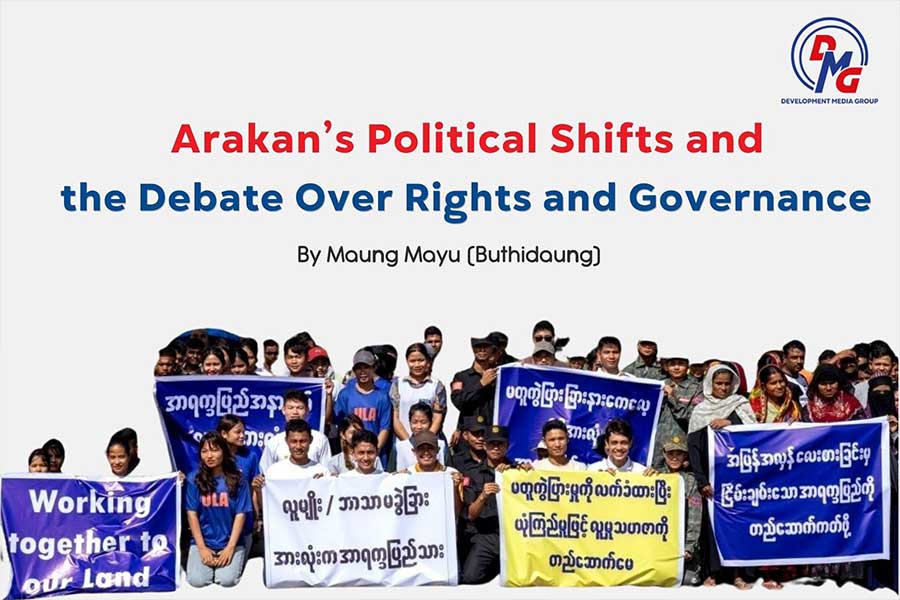
Arakan’s Political Shifts and the Debate Over Rights and Governance
By Admin 27 Aug 2026
Securing Rights for Bangladesh's Indigenous Peoples is Indispensable
By Admin 09 Aug 2026
Reflections on the Arakanese (Rakhine) Language Curriculum
By Admin 14 Jul 2026
POLITICS
BUSINESS
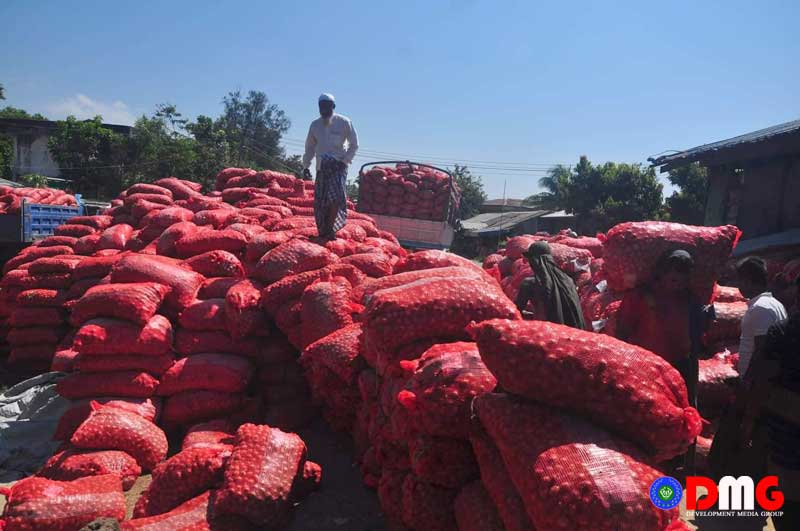
Industry to manufacture finished goods from coconut starting in early 2020
By Aung Kaung Zaw 20 Nov 2019