
- Junta intensifies offensive against resistance-held territory in strategic Sagaing town
- Fighting escalates in Sittwe as Arakan Army captures junta outposts
- Survivors of deadly Kyauktaw airstrike urgently need medical, humanitarian aid
- Junta seeks foothold on strategic island in Kaladan River as Arakan Army counterattacks
- Begging nearly doubles amid livelihood crisis in southern Arakan
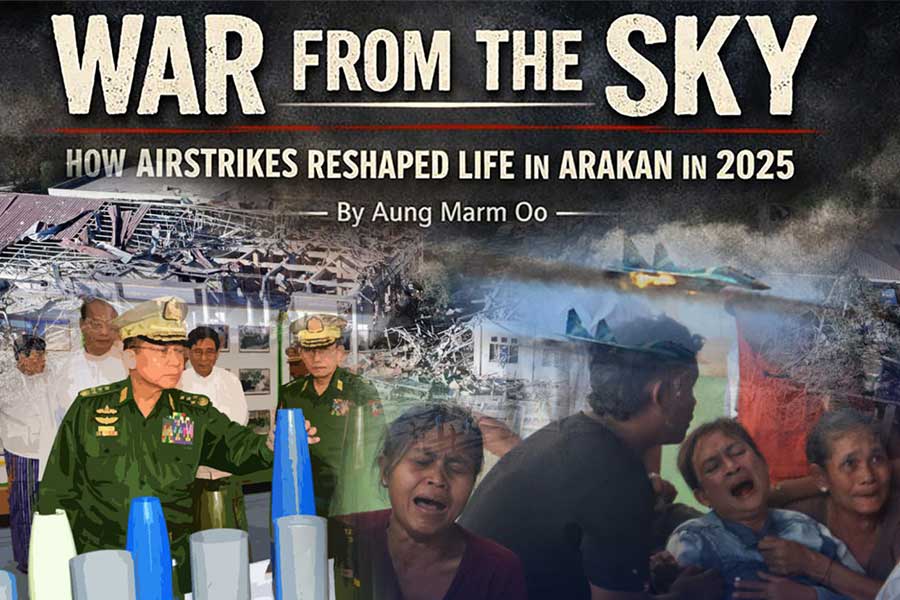
War from the Sky: How Airstrikes Reshaped Life in Arakan in 2025
The sound of aircraft engines and the sudden thunder of bombs became part of daily life for civilians who had little warning, nowhere to hide, and no meaningful protection.
22 Jan 2026
Written by Aung Marm Oo
In 2025, the war in Arakan (Rakhine State) was no longer confined to front lines or contested hills. It came from above. The sound of aircraft engines and the sudden thunder of bombs became part of daily life for civilians who had little warning, nowhere to hide, and no meaningful protection. Airstrikes were not simply a military tactic; they became a defining feature of how power was exercised, and how civilian life was dismantled.
For people in Arakan, the sky itself turned hostile.
Civilian Losses and the Normalization of Fear
Airstrikes in 2025 caused repeated civilian casualties across Arakan, including women, children, students, farmers, and market-goers. Schools, villages, and residential areas were struck or hit in close proximity, erasing any meaningful distinction between combat zones and civilian space. Even when casualty figures could not be fully verified due to communication blackouts and access restrictions, communities understood the reality through loss: empty classrooms, destroyed homes, and funerals that never reached international headlines.
One of the most devastating examples occurred at Thayet Ta Pin Private School in Kyauktaw Township, where an airstrike struck a civilian educational compound. Students, children who should have been learning in safety were among those killed and injured. The attack sent shockwaves far beyond the school itself. Across Arakan, parents began pulling children out of classrooms, not because education had lost value, but because survival had become the overriding priority.
The most damaging effect was not only death, but the normalization of fear. Daily decisions were no longer shaped by opportunity or need, but by a single question: Will the sky be safe today?
Air Power as Political Strategy
In 2025, airstrikes in Arakan increasingly functioned as a political instrument rather than a purely military one. As control on the ground became fragmented and contested, air power was used to punish areas beyond effective junta control, disrupt emerging local governance structures, and signal dominance where territorial authority was weakening.
This had immediate political consequences. Local administration already fragile was pushed into permanent crisis mode. Civil governance gave way to emergency survival. Community meetings, local dispute resolution mechanisms, and basic public services became difficult or impossible to sustain. Civic space shrank, not through formal decrees alone, but through terror.
Airstrikes sent a clear message: even where authority on the ground shifts, control of the sky can still dictate civilian life.
Humanitarian Impact: When Hospitals Are No Longer Safe
By 2025, humanitarian needs in Arakan had sharply increased due to displacement, food insecurity, and the collapse of basic services. Yet airstrikes made humanitarian response slower, riskier, and less predictable, sometimes fatally so.
A stark example was the airstrike on Mrauk-U General Hospital, one of the most important medical facilities serving civilians across northern Arakan. The attack damaged critical infrastructure and intensified fear among patients, health workers, and displaced civilians seeking treatment. When hospitals themselves become targets or unsafe zones, the very foundation of humanitarian protection collapses.
Aid workers faced unsafe roads and unpredictable air attacks. Clinics struggled to operate when staff and patients feared gathering in one place. Emergency referrals were delayed or abandoned altogether. In some cases, the fear of airstrikes deterred people from seeking medical care until it was too late.
These were not failures of capacity, but failures of access created by violence from above. Humanitarian suffering in Arakan in 2025 was not merely the result of scarcity, but of deliberate insecurity.
Social Trauma and a Generation at Risk
The social impact of airstrikes extended far beyond immediate casualties. Children grew up associating learning with danger. Many experienced repeated displacement, interrupted education, and untreated psychological trauma. Nightmares, anxiety, and chronic stress became widespread but largely invisible injuries.
The destruction of schools like Thayet Tapin, combined with the insecurity surrounding hospitals such as Mrauk-U General Hospital, sent a devastating message to civilians: neither learning nor healing could be guaranteed. This erosion of social stability will outlast the bombs themselves.
A generation raised under constant aerial threat carries wounds that cannot be repaired by reconstruction alone. In Arakan, airstrikes did not just destroy buildings, they damaged trust, memory, and the sense of future.
Economic Breakdown from Above
Arakan’s economy depends heavily on agriculture, small trade, and local markets. Airstrikes disrupted all three. Fear of attack reduced working days. Transport routes became unreliable. Prices fluctuated wildly as information, goods, and people could no longer move safely.
Even where infrastructure was not directly destroyed, the risk environment created by airstrikes discouraged production and trade. Farmers left land untended. Traders reduced stock. Households depleted savings simply to survive periods of inactivity. This was economic harm without formal sanctions, poverty imposed by terror.
Information Blackouts and the Silencing of Reality
Airstrikes in 2025 occurred alongside severe communication restrictions. Internet and phone shutdowns meant that many attacks went undocumented, delayed, or reduced to rumor. In this vacuum, misinformation spread easily, while victims struggled to have their suffering acknowledged.
Independent local journalists worked under extreme risk to report what they could. Yet even they faced barriers: no signal to send reports, no safe routes to reach sources, and constant threat from both air and ground.
When bombs fall and information is cut, accountability disappears.
The Larger Cost: A Society Held Hostage
What made airstrikes in Arakan in 2025 especially destructive was their compound effect. They intersected with displacement, economic collapse, humanitarian access restrictions, and information blackouts to create a society held hostage by fear.
This was not incidental damage. It was a system of pressure, one that targeted civilian life as a means of control.
A Call Beyond the Battlefield
Airstrikes do not bring stability. They do not win legitimacy. In Arakan, they deepened resentment, prolonged suffering, and hollowed out the foundations of social life. The idea that peace can be enforced from the sky has proven not only false, but catastrophically costly.
If there is to be any future for Arakan, it cannot be built under falling bombs. Civilians need protection, access to aid, schools without fear, hospitals that are safe, and skies that no longer signal death.
War from the sky has failed Arakan. The question now is whether the world will continue to look away while the bombs keep falling.

Opinion
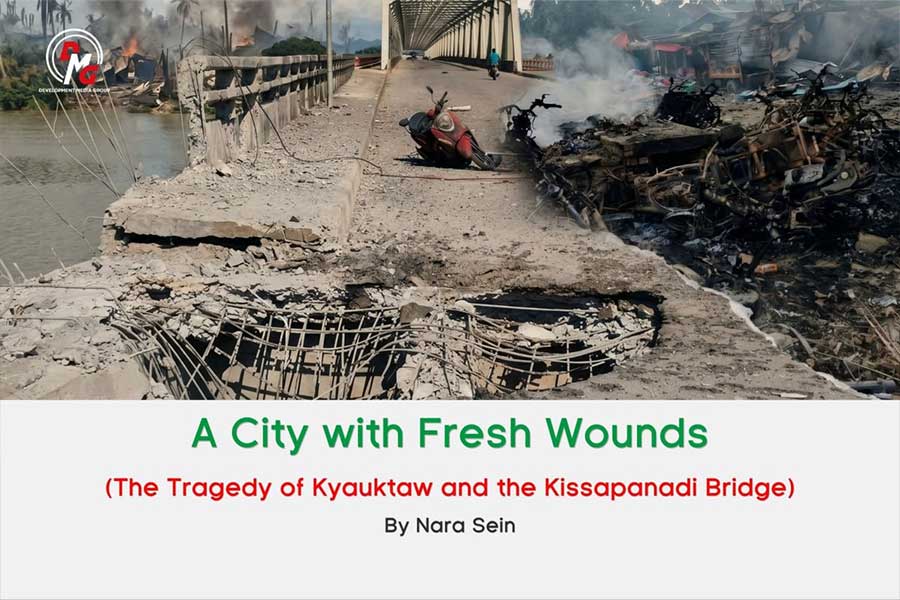
A City with Fresh Wounds (The Tragedy of Kyauktaw and the Kissapanadi Bridge)
By Admin 01 Oct 2026
Arakan Army’s Gains and the Changing Geopolitics of Arakan
By Admin 29 Sep 2026
Beyond Military Victory: What Is Myanmar’s Ultimate Political Objective?
By Admin 26 Sep 2026
UN at a Crossroads: Six Priorities for a Shared Future
By Admin 23 Sep 2026
.jpg)
How Can Myanmar’s Political Crisis Be Brought to an End?
By Admin 13 Sep 2026
POLITICS

BUSINESS
Industry to manufacture finished goods from coconut starting in early 2020
By Aung Kaung Zaw 20 Nov 2019