
- Myanmar junta accused of disguising aviation fuel imports as diesel: JFM
- Arakan records most junta airstrikes as 214 civilians killed across Myanmar: BNI
- High airfares leave low-income families stranded in blockaded Sittwe
- MSF rrges civilian protection after Sittwe shelling kills two, injures 17
- ULA warns Arakan residents of airstrike risks during Thadingyut festival
SCEF, Arakan Army talks seen as step toward stronger revolutionary alliance
The Steering Council for the Emergence of a Federal Democratic Union (SCEF) and the United League of Arakan/Arakan Army (ULA/AA) held online talks on July 23, according to an official statement.
27 Jul 2026
DMG Newsroom
27 July 2026, Mrauk-U
The Steering Council for the Emergence of a Federal Democratic Union (SCEF) and the United League of Arakan/Arakan Army (ULA/AA) held online talks on July 23, according to an official statement.
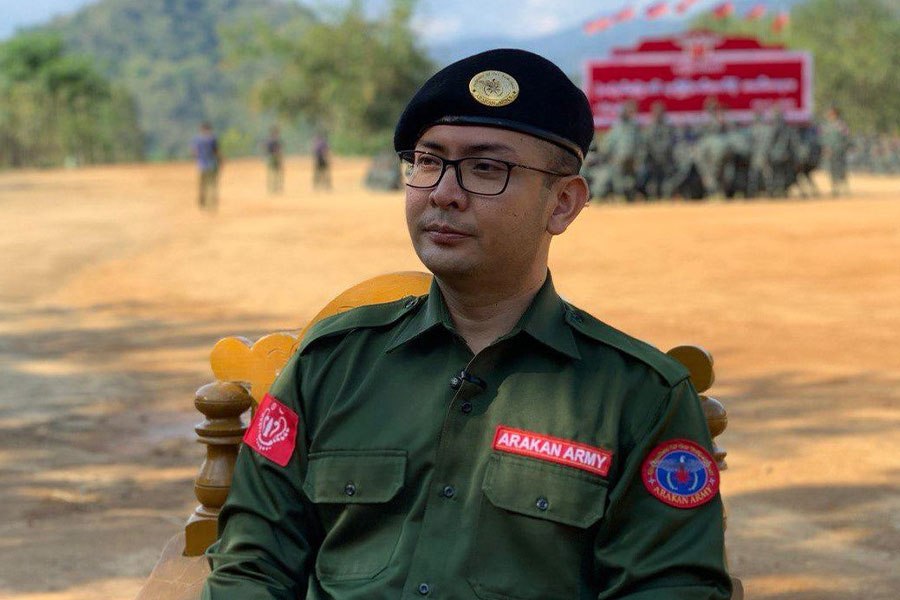
The SCEF delegation included Rotating Chairman Khu Oo Reh, Union Prime Minister Mahn Win Khaing Than, a member of the Strategic and Policy Steering Committee, and Arakan Army Chief Major-General Twan Mrat Naing, along with senior officials from both organizations, according to a statement released by SCEF on July 26.
The statement said the discussions covered current political developments, future political processes, and rehabilitation efforts for flood victims in Arakan State, but did not provide further details.
Political and military analysts described the meeting between SCEF and the ULA/AA as a significant step toward strengthening political and military cooperation among revolutionary forces and a potential move toward greater coordination against the military junta.
"If this meeting leads to further cooperation, whether the Arakan Army joins SCEF or establishes a formal partnership with it, it will unite or consolidate the revolutionary forces fighting the regime," said Captain Zin Yaw, a military defector and analyst. "We interpret this as an indication that they may soon carry out joint military and political operations as official allies."
The talks took place as the military junta continues discussions with select Ethnic Armed Organizations (EAOs) under its 100-day peace initiative.
Chin political analyst Ko Khai Sar said the meeting places significant political and military pressure on the junta while representing an important achievement for SCEF.
"It is fair to say that the Arakan Army is currently the most impactful, successful, and prominent force in the nationwide revolution," Ko Khai Sar said. "If discussions between SCEF and the Arakan Army can be successfully implemented into active cooperation, it will mark a major success for SCEF."
However, Ko Khai Sar noted that political differences among Myanmar's revolutionary forces, including groups with different international alignments, could pose challenges for SCEF in building broader cooperation.
SCEF members include the National Unity Government (NUG), the Committee Representing Pyidaungsu Hluttaw (CRPH), the Karen National Union (KNU), Karenni representatives, the Kachin Independence Organization (KIO), and the Chin National Front (CNF).
The KIO, KNU, CNF, and Karenni organizations are currently conducting joint offensives against the military junta alongside People's Defence Force (PDF) units under the NUG and other allied revolutionary forces.
"Most member groups within SCEF are already engaged in intense fighting, primarily east of the Ayeyarwady River," Captain Zin Yaw said. "The Arakan Army operates west of the Ayeyarwady River. This dialogue opens up possibilities for bridging operations on both sides of the river, coordinating eastern and western fronts before eventually advancing toward Naypyidaw."
The ULA/AA is currently conducting military operations in Arakan State, as well as Magway, Bago, and Ayeyarwady regions and Chin State. Analysts said its engagement with SCEF represents a strategic development that could have significant implications for the junta.
In July, SCEF also held separate meetings with the Pa-O National Liberation Organization/Pa-O National Liberation Army (PNLO/PNLA), New Mon State Party (Anti-Military Dictatorship) (NMSP-AD), Mon State Federal Council (MSFC), and Spring Revolution Alliance (SRA).

Top News
Myanmar junta accused of disguising aviation fuel imports as diesel: JFM
By Admin 26 Oct 2026
Arakan records most junta airstrikes as 214 civilians killed across Myanmar: BNI
By Admin 26 Oct 2026
High airfares leave low-income families stranded in blockaded Sittwe
By Admin 25 Oct 2026
MSF rrges civilian protection after Sittwe shelling kills two, injures 17
By Admin 25 Oct 2026
ULA warns Arakan residents of airstrike risks during Thadingyut festival
By Admin 24 Oct 2026