

Victim, locals question ULA court verdict in Kyauktaw gold theft case
Local residents are questioning a ruling issued by the Kyauktaw Township Court established by the United League of Arakan (ULA) regarding a gold theft case in Pihtu Village, Kyauktaw Township, an area controlled by the Arakan Army.
02 Sep 2026
DMG Newsroom
2 September 2026, Kyauktaw
Local residents are questioning a ruling issued by the Kyauktaw Township Court established by the United League of Arakan (ULA) regarding a gold theft case in Pihtu Village, Kyauktaw Township, an area controlled by the Arakan Army.
On the night of June 4, 2025, more than 10 ticals of gold items and other valuables belonging to Daw Khin Than Myint, a displaced woman from Kyitel Village in Sittwe Township who was sheltering in Pihtu Village, were stolen.
The following morning, a clothes box was found near the house. After calling the village administrator to inspect it, the victim discovered that more than 10 ticals of gold items stored inside, along with two citizenship scrutiny cards, a household registration certificate, a land grant, an inheritance contract valued at K2 million, two high school completion certificates, a birth record notebook, and a medical certificate were missing.
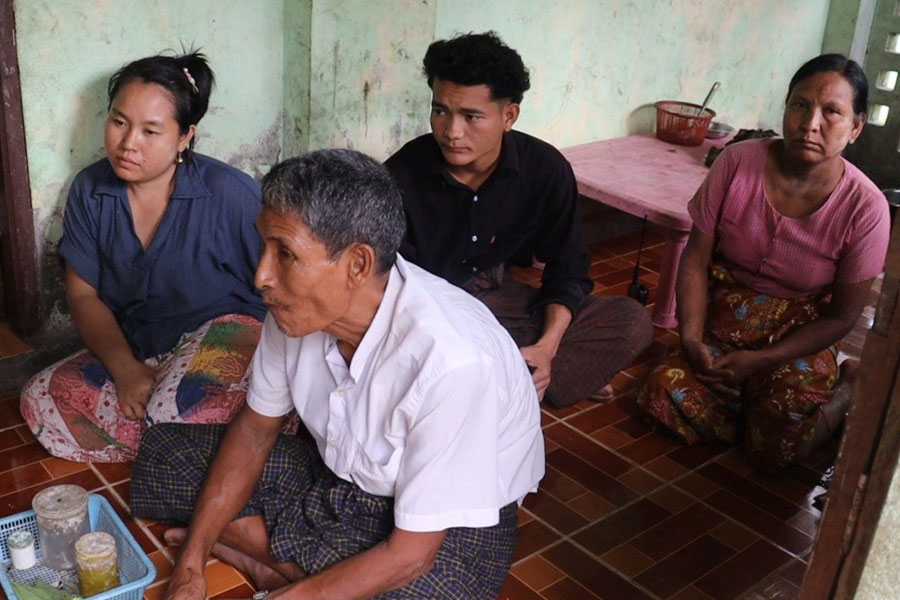
“When the items first went missing, we searched on our own. We didn't dare accuse anyone, nor did we suspect the person who came to sleep over as a companion. Unable to find them, we reported it to the village administrator. When questioned by police, the girl confessed that she took them and that her father opened the padlock,” said victim Daw Khin Than Myint.
On the night of June 4, Daw Khin Than Myint's husband had traveled to Ponnagyun Township on business, prompting a neighbour, Ma Aye Sein Than, to stay overnight as a companion.
Daw Khin Than Myint stated that at around 3:00 AM on June 4, she discovered the bedroom door open and subsequently realized that the clothes box containing the gold items was missing.
Following a complaint filed at the local Department of Law Enforcement and Public Security (DLEPS) station, authorities detained suspects Ma Aye Sein Than and her father, U Sein Hla, for questioning but initially released them, citing a lack of evidence.
During a second interrogation, Ma Aye Sein Than confessed to the theft. Consequently, four individuals, including U Sein Hla, Than Maung, and Maung Soe Shwe, were charged under Sections 380 and 401 of the Penal Code.
Following more than a year of court proceedings, the township court discharged all defendants on July 27 under Section 253(1) of the Code of Criminal Procedure, ruling that the evidence was insufficient to frame formal charges.
“After we filed the case, only the prosecution side was examined under oath. The defence side was not cross-examined at all before being released, and we lost the case. The court's handling is completely inconsistent. If possible, we want intelligence units to step in and help recover our property,” said U Khin Than Maung, husband of Daw Khin Than Myint.
According to DLEPS records, Ma Aye Sein Than confessed during questioning that she hid the stolen items behind a bamboo grove to the north and rear of her residence.
When DLEPS officers searched the specified location without finding the items, further questioning led Ma Aye Sein Than to claim that she had handed them over to additional suspects Than Maung and Maung Soe Shwe. However, searches of both individuals failed to recover the physical evidence.
The court's decision to discharge the defendants due to the absence of recovered physical evidence, despite the suspect's confession to DLEPS, has sparked widespread public criticism.
“As the case was dismissed before formal charges were framed, the prosecution lawyer had no opportunity to cross-examine the defendants. It is rare for police-filed cases to end in discharge without charges. Formal charges should have been framed, as the verdict was premature. The only missing element was the physical evidence, while other aspects were firmly established. Discharging them so early causes immense harm and leaves significant disappointment in the judicial ruling,” said a source close to the court.
During the trial, approximately 20 villagers, including the village administrator and community elders, signed and submitted a petition to the court regarding the misconduct and poor character history of suspect Ma Aye Sein Than's family.
Pihtu villagers expressed deep disappointment over the verdict after expecting the judicial system to deliver justice for the victims.
“I view this as a clear lack of justice. In a court of law, prosecution and defense lawyers are supposed to present competing arguments. I cannot comprehend why this action was taken, and I am deeply dissatisfied with the court's performance,” said village administrator U Zaw Zaw Win.
Having lost their lifelong savings along with the court case, the victim's family faces severe economic hardship and uncertainty about their future.
Believing the judicial decision to be unfair, the family filed a criminal revision application with the District Court to continue legal proceedings.
However, U Khin Than Maung noted that after incurring heavy expenses during the year-long trial, the family lacks the financial means to pursue the case at the district level.
“With three children in school, I no longer have the financial means to continue fighting this case. We do not know when we can return home or how we will survive in the future. We appeal to the ULA officials to re-examine this case to ensure true justice is served,” U Khin Than Maung said.
In Arakan State, criminal matters including theft, brawls, land disputes, narcotics cases, rape, and homicide are formally reported to and handled by the ULA Judicial Department.
However, local residents frequently face shortcomings in the legal system, as perpetrators sometimes receive leniency due to various factors, while access to distant court facilities remains limited.
Coordination gaps within DLEPS security forces also contribute to weaknesses in judicial administration, according to a research paper titled “Post-Dominance Challenges in ULA/AA Governance” published this month by the Institute for Strategy and Policy - Myanmar (ISP-Myanmar).

Top News

Clashes intensify at three locations near Sittwe ROC
By Admin 19 Oct 2026
Junta extends martial law in 55 townships, including AA-held areas
By Admin 19 Oct 2026

Financial hardship limits access to healthcare in Arakan
By Admin 19 Oct 2026

Rice shortages worsen in Taungup as prices soar
By Admin 19 Oct 2026

Junta airstrike kills at least seven, injures many in Paletwa Twsp
By Admin 19 Oct 2026