
- Heavy artillery exchanges intensify along Sittwe-Werathani border
- Sittwe High School No. 4 closed for one week following junta artillery strike
- Historical heritage losses mount as junta destroys ancient pagodas in Arakan State
- Junta offensive dubbed ‘Operation 4926’ stalls on multiple Arakan fronts
- Fighting remains intense along Sittwe-Ponnagyun border
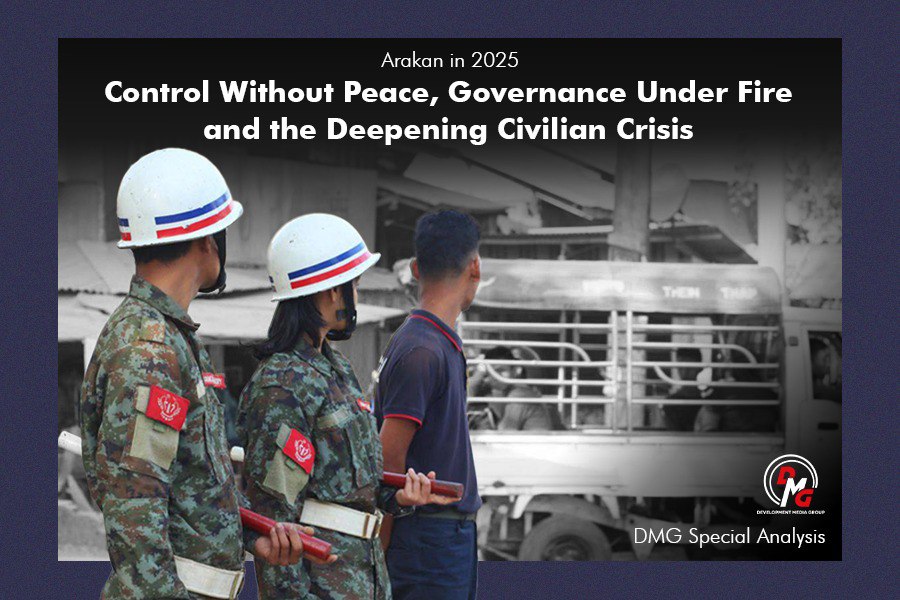
Arakan in 2025: Control Without Peace, Governance Under Fire, and the Deepening Civilian Crisis
The year 2025 did not deliver a decisive military breakthrough in Arakan (Rakhine) State, but it fundamentally reshaped the conflict's character. What emerged was a landscape defined less by rapid battlefield advances and more by territorial consolidation, prolonged sieges, junta airpower dominance, and a deepening humanitarian and governance crisis.
15 Jan 2026
DMG Special Analysis | 2025
Executive Overview
The year 2025 did not deliver a decisive military breakthrough in Arakan (Rakhine) State, but it fundamentally reshaped the conflict's character. What emerged was a landscape defined less by rapid battlefield advances and more by territorial consolidation, prolonged sieges, junta airpower dominance, and a deepening humanitarian and governance crisis.
For the people of Arakan, 2025 became a year of attrition rather than transition. While control continued to shift away from Naypyidaw on the ground, peace, safety, and economic normalcy remained out of reach. The war's center of gravity moved from territorial seizure to administration, survival, and legitimacy, with civilians bearing the heaviest burden.
1. Military Reality: Territorial Control Without Decisive Resolution
By 2025, the Arakan Army (AA) maintained effective control over most of Arakan State, excluding Sittwe, Kyaukphyu, and Manaung, following sweeping gains between late 2023 and late 2024. This dominance marked a strategic milestone but also exposed new vulnerabilities.
Unlike earlier phases of the war, 2025 saw no large-scale city captures. Instead, fighting in Sittwe and Kyaukphyu assumed a siege-like character, defined by blockades, artillery exchanges, and heavy reliance on airpower by the Myanmar military council.
The Kyaukphyu campaign illustrated this shift. While AA units initially advanced to the outskirts of key military installations, sustained aerial bombardment and reinforced counteroffensives forced partial withdrawals. The strategic message was clear: the junta could no longer dominate territory, but it could still deny stability through air superiority.
This stalemate extended across Arakan. As one observer noted, 2025 was not about dramatic victories, but about maintaining pressure, holding ground, and preventing reversal.
2. Airpower as Strategy: Civilian Spaces as the New Frontline
If 2025 lacked decisive ground battles, it was defined by relentless air attacks on civilian infrastructure.
The December 10 bombing of Mrauk-U Public Hospital marked a watershed moment. The strike killed at least 33 civilians, injured dozens more, and destroyed nearly the entire facility. It also underscored a broader pattern: healthcare facilities, schools, religious sites, and displacement shelters increasingly became targets or high-risk collateral zones.
DMG's documentation shows that in 2025 alone:
- 880 civilians were killed or injured
- Six mass-casualty airstrike incidents killed 10 or more civilians each
- Children and women made up a significant proportion of the dead
This was not incidental damage. It reflected a systematic reliance on airpower to compensate for the junta's loss of ground control, punish civilian populations, and undermine emerging governance capacity in AA-held areas.
3. Governance Pressure: Administration Under War Conditions
Despite sustained attacks, the AA demonstrated the capacity to retain administrative control over most of Arakan throughout 2025. This included:
- Managing internal security
- Facilitating limited cross-border trade
- Restarting vaccination programs
- Regulating movement under emergency provisions (NDEP)
Yet governance under bombardment has clear limits. Restrictions on youth movement, while framed as security measures, exposed social strains particularly among families dependent on migration and remittances. At the same time, frequent clashes with armed groups such as the Arakan Rohingya Salvation Army (ARSA) and the Rohingya Solidarity Organisation (RSO) along the Bangladesh border added further instability.
Crucially, territorial control did not translate into civilian protection from airstrikes revealing the central dilemma of 2025: authority on the ground without control of the skies.
4. Economic Fragmentation: Trade Without Stability
Economically, Arakan in 2025 remained under siege.
Two years of junta-imposed land and maritime blockades devastated supply chains. While AA-facilitated India-Arakan and later Bangladesh-Arakan trade briefly eased pressure, renewed restrictions particularly from Bangladesh in mid-2025 collapsed those gains.
The result was a dual economy:
- In AA-controlled rural areas, favorable rainfall improved rice yields and lowered prices locally
- In junta-held Sittwe, food and fuel prices surged sharply
- Fisheries, a backbone of Arakan's economy, remained crippled by naval shelling
Farmers faced a paradox of high yields but low prices and weak demand, while urban residents struggled with inflation and scarcity.
5. Displacement and Survival: Repeated Flight, Diminishing Aid
By the end of 2025, nearly 600,000 people were displaced inside Arakan.
Kyaukphyu alone saw more than 17 villages emptied in November. In townships such as Ponnagyun, displacement intersected with water scarcity, forcing families to drink unsafe groundwater and triggering disease outbreaks.
Aid access remained limited, dangerous, and inconsistent. Airstrikes even reached displacement zones, reinforcing a pervasive sense that nowhere was truly safe.
6. Education and the "Lost Generation" Risk
Education was among the hardest-hit sectors in 2025.
Despite AA plans for higher-education pathways, airstrikes on schools, repeated closures, and displacement dismantled any sense of continuity. The September 12 bombing of a private high school in Kyauktaw killing 21 students became emblematic of a broader collapse.
For many children and youth, schooling became intermittent, mobile, or impossible, raising fears of a long-term "lost generation" in Arakan.
7. Political Signals: Talks Without Outcomes
Politically, 2025 offered movement without momentum.
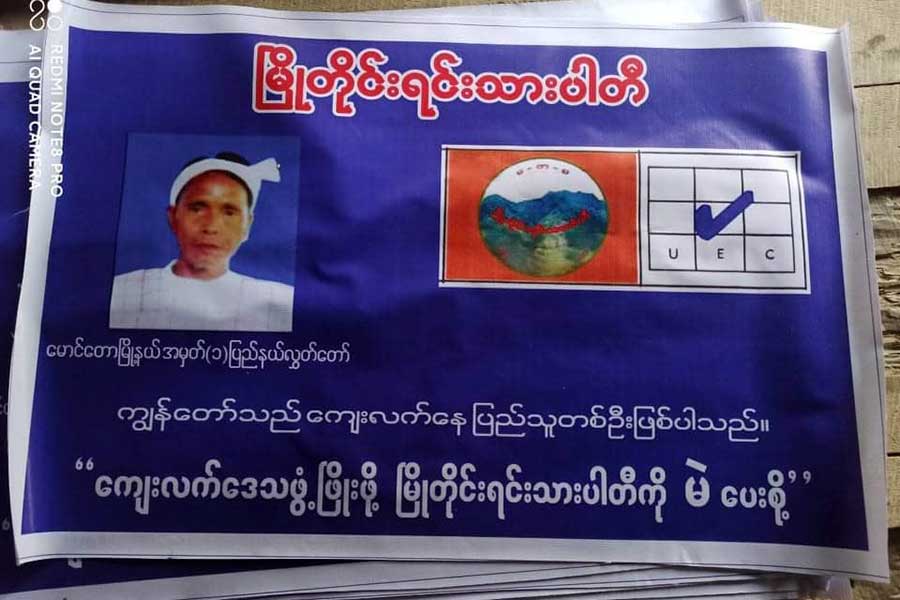
China-facilitated talks between the junta and the AA reportedly took place, but produced no visible outcomes. Meanwhile, the junta's broader national push toward a managed election further entrenched skepticism among Arakanese communities, who increasingly view electoral processes conducted under airstrikes as hollow and illegitimate.
Conclusion: Control Is Not Peace
Arakan's defining reality in 2025 was this: the war did not escalate dramatically but it did not ease at all.
The AA consolidated territorial and governance capacity, while the junta consolidated its reliance on airpower and civilian punishment. Between these dynamics, civilians endured a year marked by displacement, fear, and resilience.
2025 demonstrated that:
- Territorial control alone cannot protect civilians
- Air dominance without legitimacy cannot restore authority
- Humanitarian collapse has become a strategic variable, not a side effect
As Arakan moves into 2026, the central question is no longer who controls the ground but whether any actor can deliver safety, dignity, and survival to a population exhausted by a war without end.

Opinion
By Cutting Trees, We Are Killing Ourselves
By Admin 06 Sep 2026
A Modern August We Must Never Forget
By Admin 31 Aug 2026
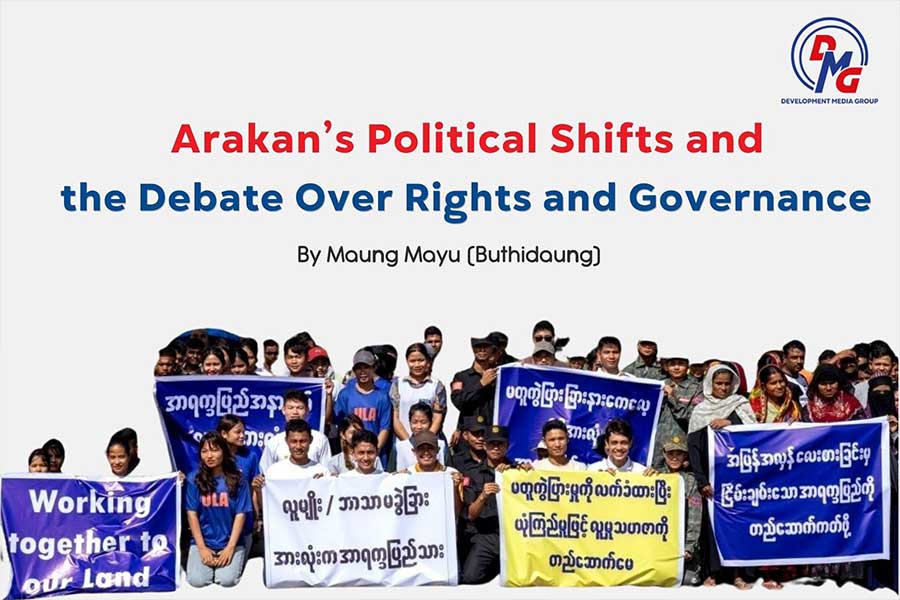
Arakan’s Political Shifts and the Debate Over Rights and Governance
By Admin 27 Aug 2026
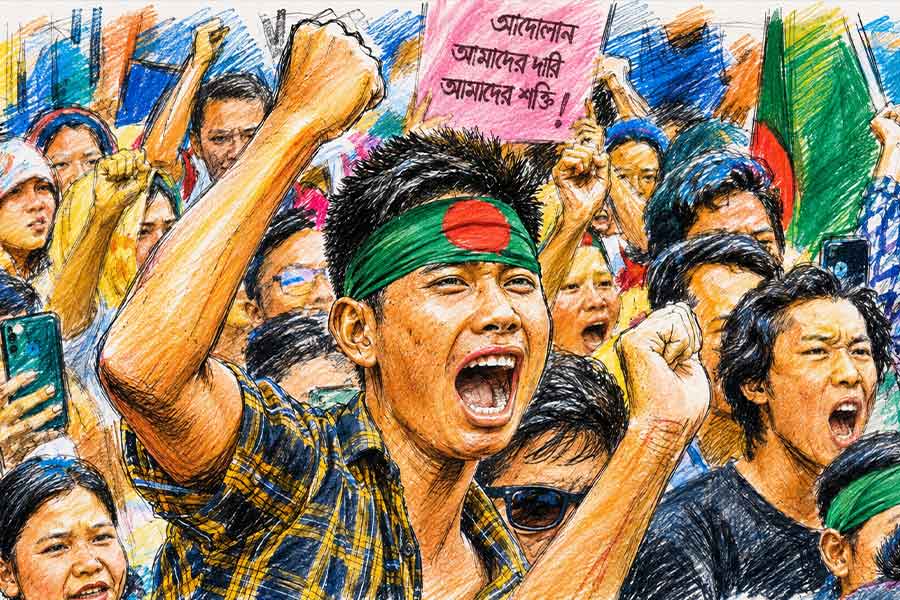
Securing Rights for Bangladesh's Indigenous Peoples is Indispensable
By Admin 09 Aug 2026

Reflections on the Arakanese (Rakhine) Language Curriculum
By Admin 14 Jul 2026
POLITICS

BUSINESS
Industry to manufacture finished goods from coconut starting in early 2020
By Aung Kaung Zaw 20 Nov 2019