


- Magway records most airstrikes since new military chief took command: ISP-Myanmar
- Junta warship destroys two fishing boats, seizes another off Werathani
- Junta jet fighters drop 500-pound bombs on former junta battalions in Mrauk-U
- Junta deploys fighter jets to bomb Ponnagyun
- Rathedaung villagers set up night watches amid Sittwe clashes, ARSA threat
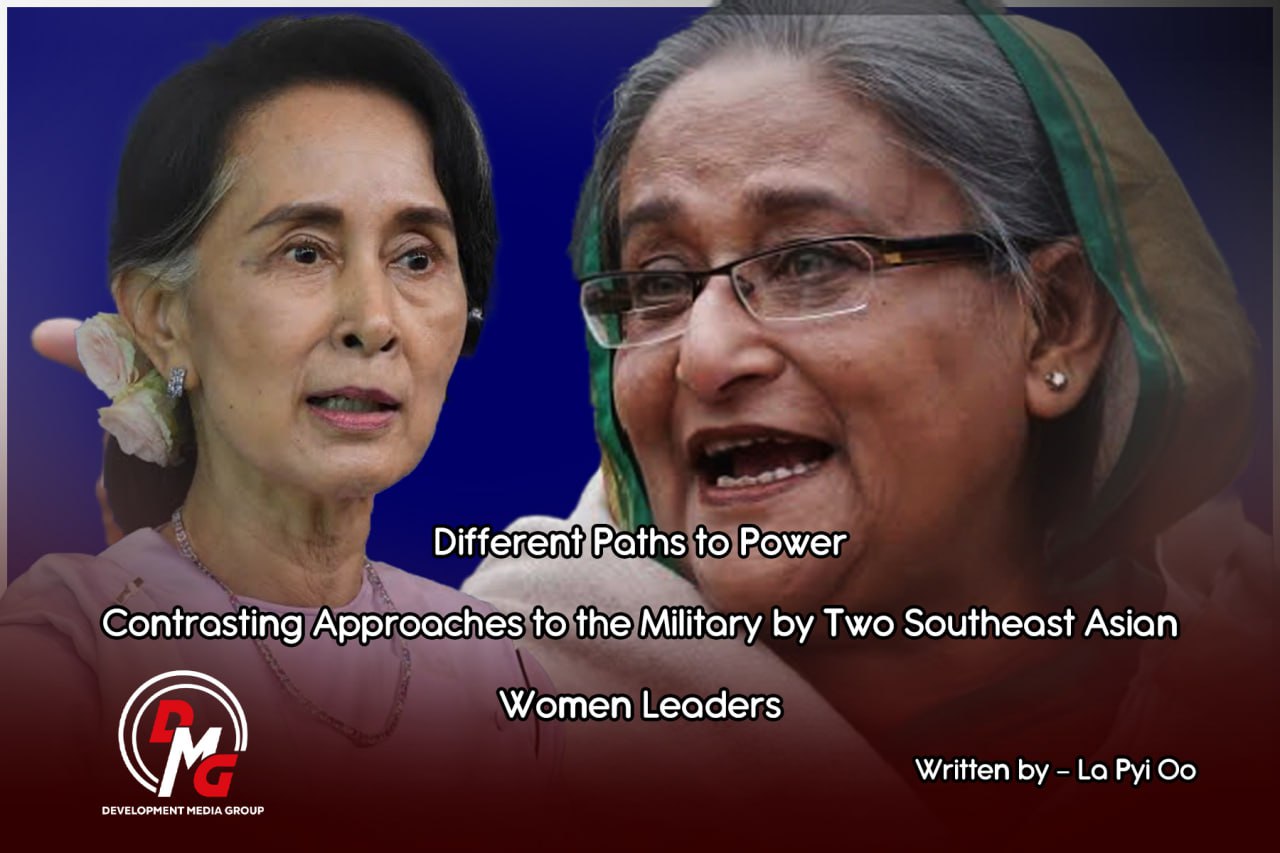
Different Paths to Power: Contrasting Approaches to the Military by Two Southeast Asian Women Leaders
Both leaders operated within systems where the military remained the ultimate arbiter of power. Their shared miscalculation was failing to build resilient civilian institutions capable of outlasting military dominance.
18 Dec 2025
Written by La Pyi Oo
Political Heritage and Attitudes Toward the Military
In Southeast Asia’s political landscape, two prominent women leaders — Daw Aung San Suu Kyi of Myanmar and Sheikh Hasina of Bangladesh — share striking parallels in their personal and political journeys. Yet their approaches toward the powerful militaries in their respective countries diverged profoundly, shaping not only their own political destinies but also the broader direction of their nations.
Historical Legacy and Political Lineage
Both leaders are daughters of men regarded as the architects of their nations.
Daw Aung San Suu Kyi is the daughter of General Aung San, who spearheaded Myanmar’s independence movement. Sheikh Hasina is the daughter of Sheikh Mujibur Rahman, widely known as the founding father of Bangladesh.
This inherited political legacy endowed both women with early legitimacy and mass support, positioning them as natural heirs to national leadership.
Daw Aung San Suu Kyi’s Approach to the Military
Daw Aung San Suu Kyi has long been associated with a profound emotional and historical connection to the Tatmadaw, the military institution created by her father. Her strategy centered on reconciliation with the armed forces, reflecting a belief that democratic transition could be achieved through cooperation rather than confrontation.
Her decades-long struggle for democracy led to nearly 15 cumulative years of detention, making her a global symbol of resistance to authoritarian rule.
After her National League for Democracy (NLD) secured a landslide victory in the 2015 general elections, she became State Counsellor and sought to manage the military through cautious engagement. However, this approach drew intense international criticism, particularly when she defended the military’s operations in Arakan State during the Muslim (Rohingya) crisis. Her refusal to publicly denounce military conduct severely damaged her reputation as a moral authority.
Despite attempts to gradually reform the system from within, the Tatmadaw seized power again in February 2021, alleging electoral fraud, and placed her under arrest. Her strategy — designed to avoid direct confrontation — ultimately proved ineffective against a military institution determined to retain ultimate authority. Ethnic armed groups later expressed skepticism toward her commitment to building a genuine federal union beyond the military’s shadow.
Sheikh Hasina’s Approach to the Military
In contrast, Sheikh Hasina adopted a control-oriented, centralizing approach to the armed forces. Rather than seeking reconciliation, she aimed to ensure the military’s loyalty by incorporating it into her political architecture.
Her career was shaped by recurring conflicts: coups, assassination attempts, and fierce rivalry with Khaleda Zia of the Bangladesh Nationalist Party (BNP).
During her four terms as Prime Minister, she appointed ex-military officials to influential positions and expanded the defense budget, cementing the military’s institutional interests. Her strategy relied not on challenging the military’s power, but on co-opting it.
Over time, however, her prolonged rule contributed to a steady erosion of Bangladesh’s democratic norms. International organizations and rights groups accused her government of enforced disappearances, election manipulation, media crackdowns, and systematic repression.
In the July 2024 mass uprising, she fled to India with the assistance of elements within the military. Unlike Daw Aung San Suu Kyi, her fall did not result from a military takeover, but from public revolt against authoritarian governance. Ironically, the institution she had strengthened ceased to offer unconditional support at her most critical moment.
Economic Policies, Human Rights, and Foreign Relations
Economic Trajectories
Daw Aung San Suu Kyi presided over Myanmar’s initial opening to international markets after decades of isolation. Foreign investment surged, though benefits were uneven and structural reforms remained incomplete.
Sheikh Hasina prioritized rapid industrial growth, spearheaded by Bangladesh’s garment sector. Under her leadership, Bangladesh moved from one of the world’s poorest nations toward lower-middle-income status. Yet corruption, elite patronage networks, and income inequality persisted.
Human Rights and Democratic Norms
Daw Aung San Suu Kyi, once a global advocate for human rights, oversaw policies that limited press freedom and defended the military’s conduct in Arakan, tarnishing her image as a democratic icon.
Sheikh Hasina transitioned from an opposition figure resisting military dominance to a leader criticized for authoritarian tendencies, including electoral interference, suppression of dissent, and human rights violations.
International Standing
Daw Aung San Suu Kyi initially enjoyed near-universal admiration, culminating in her Nobel Peace Prize. The Muslim crisis, however, dramatically reversed global perceptions.
Sheikh Hasina gained international recognition for sheltering Mublim/Rohingya refugees in 2017 and maintained strong ties with India and Western partners due to Bangladesh’s economic ascent. Yet her increasingly autocratic governance invited criticism, particularly in later years.
Political Analysis and Conclusion
The contrasting approaches of these two leaders demonstrate that the nature of civilian–military relations can decisively shape a nation’s democratic trajectory.
Daw Aung San Suu Kyi’s strategy of reconciliation failed when confronted by a military unwilling to relinquish power. Her accommodationist approach weakened democratic momentum and failed to secure ethnic trust.
Sheikh Hasina’s strategy of control and co-optation enabled enduring political dominance but hollowed out democratic institutions. Her downfall was triggered not by military intervention, but by public rejection of authoritarian rule.
Both leaders operated within systems where the military remained the ultimate arbiter of power. Their shared miscalculation was failing to build resilient civilian institutions capable of outlasting military dominance.
The lesson is unmistakable:
No democratic system can endure if its leaders either submit to or rely on militaries without developing robust civilian governance and earning public trust.

Opinion
.jpg)
How Can Myanmar’s Political Crisis Be Brought to an End?
By Admin 13 Sep 2026

By Cutting Trees, We Are Killing Ourselves
By Admin 06 Sep 2026

A Modern August We Must Never Forget
By Admin 31 Aug 2026
Arakan’s Political Shifts and the Debate Over Rights and Governance
By Admin 27 Aug 2026
Securing Rights for Bangladesh's Indigenous Peoples is Indispensable
By Admin 09 Aug 2026

POLITICS




BUSINESS





Industry to manufacture finished goods from coconut starting in early 2020
By Aung Kaung Zaw 20 Nov 2019