

- Junta airstrikes on Kyeintali Town, nearby village injure two civilians
- AA clashes with ARSA in northern Maungdaw
- Arakan records most armed incidents, civilian-targeted airstrikes in Myanmar: Report
- Nay Pyi Taw talks between junta, MNDAA halt over special region demand
- Arakanese civilians face widespread violence, humanitarian aid blockades, UN mechanism warns
The Echo of a Single Bullet (or) Hadi’s Death and the Flaming Streets of Bangladesh
The interim government led by Dr. Muhammad Yunus is now under extraordinary strain. The administration has offered a reward of 5 million Bangladeshi taka for information leading to the arrest of the shooter.
19 Dec 2025
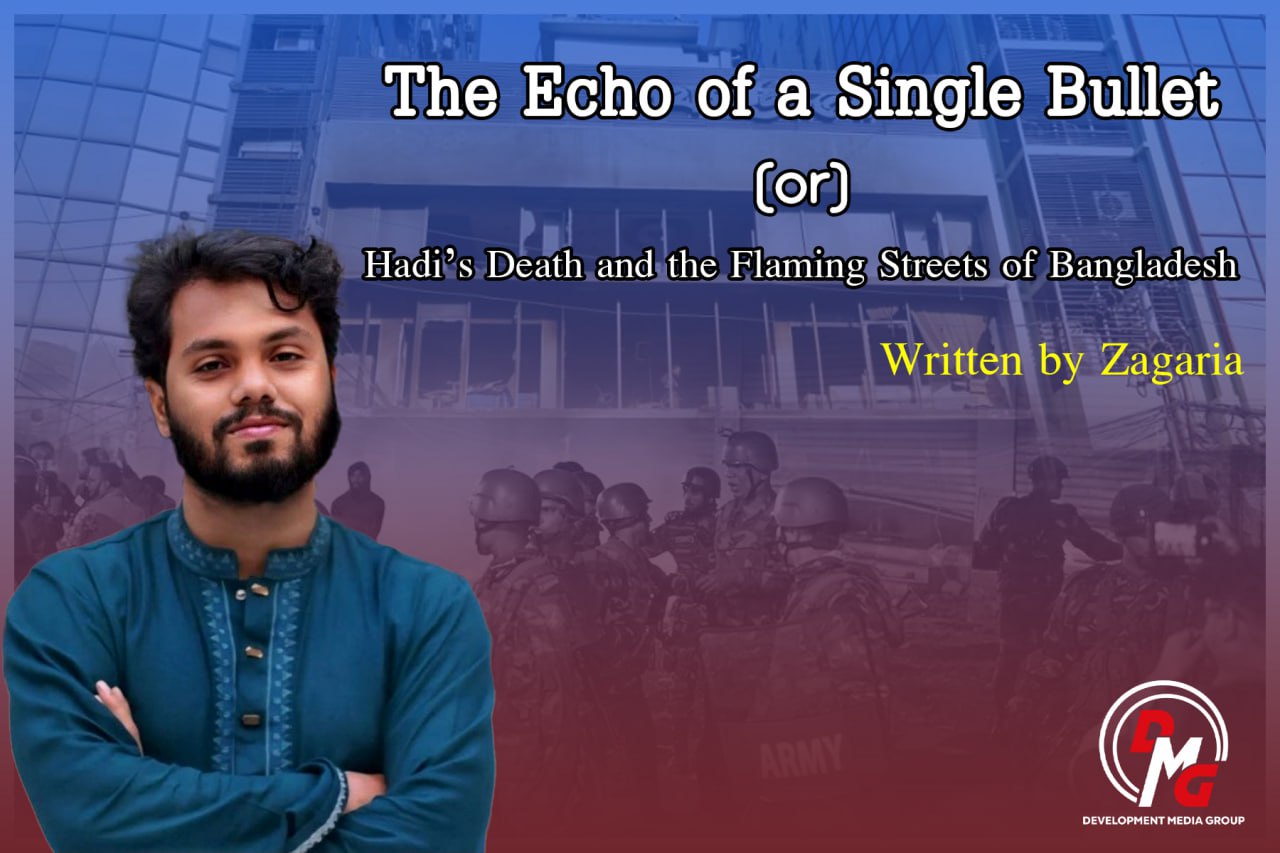
Written by Zagaria
The death of student leader and parliamentary candidate Osman Hadi — celebrated by many as a rising symbol of hope for Bangladesh’s youth-driven political future — has pushed the country to the brink of its deepest turmoil in years. His final breath did not usher in calm; instead, it ignited anger, fear, and fire on the streets of Dhaka.
1. The Incident and His Final Journey
On the night of 15 December, Osman Hadi was shot at close range by unidentified gunmen in central Dhaka. A bullet struck his head, leaving him critically wounded. He was flown to Singapore the following day for emergency treatment but died on the night of 18 December.
His body is scheduled to return to Dhaka this evening (19 December), and a state-level funeral will be held at Dhaka University on 20 December. The event is expected to draw massive crowds, raising concerns about potential unrest.
2. From the Arts to Political Leadership
Before stepping into politics, Hadi was a beloved cultural figure — a poet and writer whose revolutionary works inspired students and young activists across the country.
During the 2024 student uprising, his courage and clarity elevated him into the national spotlight. Many viewed him as the face of a new generation seeking accountability, transparency, and a break from traditional political power blocs. By 2025, he had become a prominent parliamentary candidate, widely expected to play a transformative role in Bangladesh’s evolving political landscape.
3. Media Offices Attacked Amid Pro-India Accusations
Following the announcement of Hadi’s death, enraged crowds targeted the offices of The Daily Star and Prothom Alo. Protesters accused these media houses of being aligned with India, claiming they were attempting to distort or conceal the truth surrounding the assassination.
Both offices were set ablaze, equipment destroyed, and journalists assaulted.
Simultaneously, protesters vandalized the historical residence of Sheikh Mujibur Rahman, portraying the act as an attempt to uproot the last remnants of what they called “the old political order.”
These attacks highlight a rapidly deteriorating trust between the public and mainstream media — a dangerous trend for any society in political transition.
4. Government Response: Rewards, Commissions, and Mounting Pressure
The interim government led by Dr. Muhammad Yunus is now under extraordinary strain. The administration has offered a reward of 5 million Bangladeshi taka for information leading to the arrest of the shooter.
CCTV footage shows a masked man in his early thirties fleeing on a motorcycle.
Authorities have formed a special investigative commission — yet public confidence remains extremely low.
Many citizens fear the assassination may be part of a larger conspiracy targeting emerging youth leaders who challenge entrenched political interests.
5. International and Domestic Reactions
The International Federation of Journalists (IFJ) has condemned the attacks on media outlets, urging Bangladesh to protect press freedom and ensure impartial reporting.
Online, the reaction has been explosive. Messages of grief and fury dominate social media:
“Our star of hope has fallen.”
“Justice for Hadi.”
“This death will not silence us.”
But other voices defend the attacks on media houses, describing them as actions against “national traitors” — evidence of deepening polarisation within society.
Meanwhile, foreign governments and rights groups are urging calm and demanding an independent, credible investigation into Hadi’s killing.
6. A Country at a Dangerous Crossroads
Bangladesh now stands perilously between mob rule and democratic aspiration.
Hadi’s funeral could either pass peacefully or ignite a new wave of anger that sweeps across the nation.
The political environment is already combustible:
Months of student protests over corruption, inflation, and governance failures
Intensifying clashes between pro- and anti-government groups
Rising anti-India sentiment linked to perceived political interference
A weakened interim government struggling to maintain order
Fears that the upcoming national election may lose legitimacy
If the government fails to identify and arrest the perpetrator swiftly, the credibility of the electoral process — already fragile — may erode completely.
Across Dhaka and other major cities, tens of thousands continue gathering in the heat, demanding justice and chanting slogans that echo the urgency of a nation on edge.
What Comes Next?
The coming days may determine whether Bangladesh moves toward greater civic solidarity or deeper violence. Hadi’s death has become more than a personal tragedy — it has become a symbol of national anxiety, political rupture, and the uncertain future of democratic reform.

Opinion
Beyond Military Victory: What Is Myanmar’s Ultimate Political Objective?
By Admin 26 Sep 2026
UN at a Crossroads: Six Priorities for a Shared Future
By Admin 23 Sep 2026
.jpg)
How Can Myanmar’s Political Crisis Be Brought to an End?
By Admin 13 Sep 2026
By Cutting Trees, We Are Killing Ourselves
By Admin 06 Sep 2026
A Modern August We Must Never Forget
By Admin 31 Aug 2026
POLITICS

BUSINESS
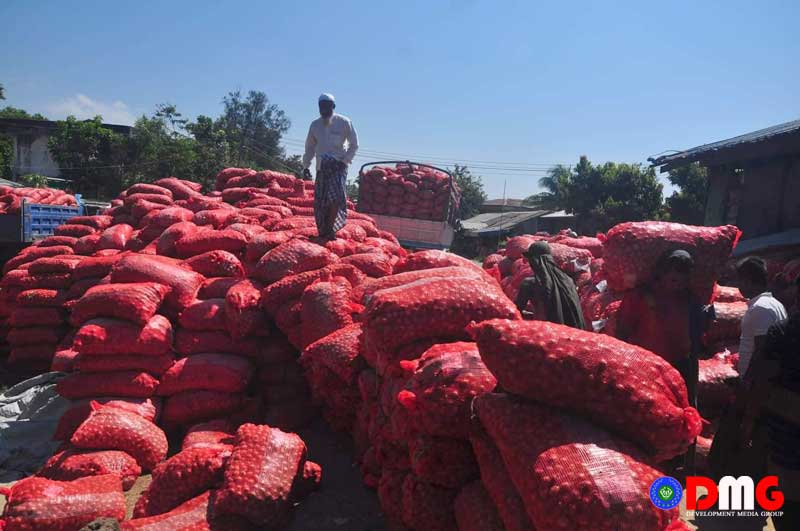
Industry to manufacture finished goods from coconut starting in early 2020
By Aung Kaung Zaw 20 Nov 2019