
- Military operations spread despite decline in clashes, BNI report finds
- Junta aerial attacks force school closures across three Arakan townships
- Family demands swift arrest of statutory rape suspect in Werathani
- Women face shrinking employment opportunities in Myanmar, UNDP reports
- AA seizes five junta outposts as Arakan records most civilian-targeted airstrikes: NLTA
DMG at 14: Journalism Under Fire in Arakan's Long War
This anniversary arrives at one of the most dangerous and precarious moments in DMG's history. Across Arakan (Rakhine) State, sustained armed conflict, relentless airstrikes, mass displacement, and prolonged communication blackouts have transformed journalism into a high-risk act of public service.
09 Jan 2026
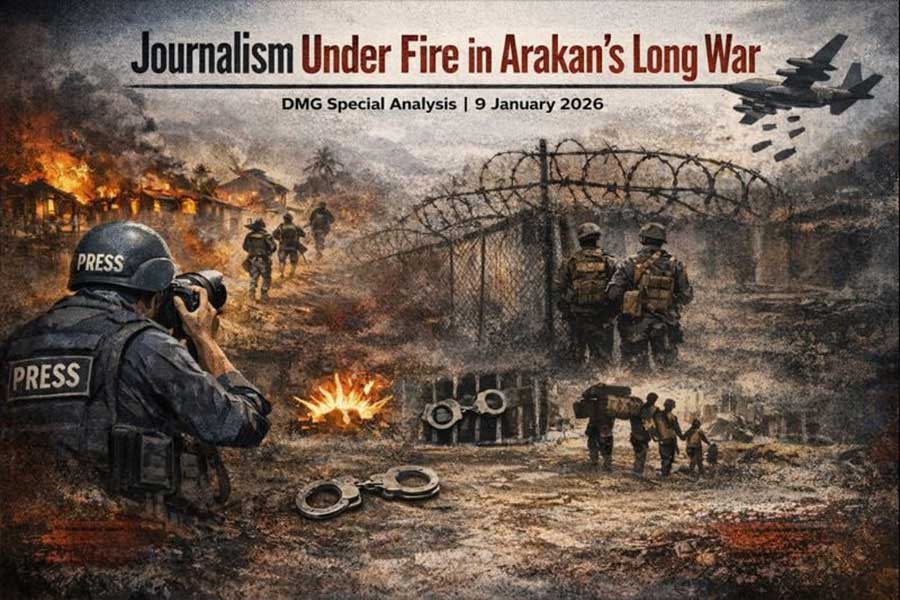
DMG Special Analysis | 9 January 2026
Introduction: An Anniversary in a Time of Danger
On 9 January, Development Media Group (DMG) marks its 14th anniversary not in celebration, but in reflection under extreme pressure.
This anniversary arrives at one of the most dangerous and precarious moments in DMG's history. Across Arakan (Rakhine) State, sustained armed conflict, relentless airstrikes, mass displacement, and prolonged communication blackouts have transformed journalism into a high-risk act of public service. At the national level, Myanmar's military regime is pressing ahead with managed elections, intensifying its reliance on airpower, and shrinking civic space to near extinction.
For DMG, turning fourteen is no longer simply about institutional longevity. It is about survival under attack, physical, legal, and financial, and about the moral cost of continuing to tell the truth when doing so places journalists directly in harm's way.
From the Border to the Frontlines: Fourteen Years of Adaptive Journalism Founded on 9 January 2012 on the Thai-Myanmar border, DMG began as a small independent media initiative at a time when Arakan's voices were largely absent from national and international reporting. Over fourteen years, DMG has evolved alongside Myanmar's political upheavals:
- from quasi-civilian rule to renewed military dictatorship,
- from ceasefires to full-scale war,
- from limited press freedom to systematic repression and the criminalisation of journalism.
Today, DMG operates in a reality where journalists are no longer observers of conflict, they are embedded within it. Reporting is conducted amid airstrike warnings, displacement, surveillance, and constant risk calculation. In Arakan, journalism has become inseparable from survival.
This reality was violently underscored in late October 2023, when Myanmar military forces raided DMG's head office in Sittwe, detaining two DMG staff members in connection with their journalistic work. Following prolonged detention and opaque legal proceedings, both were sentenced to ten years' imprisonment. Their incarceration stands as one of the clearest examples of how journalism in Arakan has been transformed from a profession into a punishable offence.
The Current Context: Arakan and Myanmar in 2025-2026
Arakan's political landscape has fundamentally shifted. Large parts of the state are no longer under the effective control of Myanmar's central military authorities. Yet this territorial shift has not translated into civilian safety. Instead, civilians remain exposed to relentless airpower, siege-like conditions, humanitarian collapse, and legal repression. Nationally, Myanmar's military regime is attempting to manufacture political legitimacy through elections conducted under conditions of war, displacement, censorship, and fear. For independent media, this moment is particularly dangerous:
- narratives are tightly controlled,
- dissenting information is criminalised,
- journalists are increasingly framed as security threats rather than public watchdogs.
In Arakan, prolonged telecommunications blackouts further isolate communities. For DMG reporters, this means:
- traveling without reliable communication,
- transmitting information through fragile and improvised channels,
- working without access to immediate emergency response or legal protection.
Legal Harassment, Raids, and Imprisonment: Journalism Criminalised
Beyond physical danger, DMG staff are confronting systematic legal repression. Journalists and editors linked to DMG have been subjected to:
- lawsuits and criminal complaints tied directly to their reporting,
- legal threats designed to intimidate, silence, and exhaust,
- administrative pressure, surveillance, and movement restrictions,
- and, in the most extreme cases, arbitrary detention and long-term imprisonment.
The October 2023 raid on DMG's Sittwe office, followed by the ten-year prison sentences imposed on two DMG staff, marked a decisive escalation. These actions were not isolated incidents or lawful prosecutions; they formed part of a broader strategy to weaponise the legal system against independent media turning courts and prisons into tools of repression.
Legal persecution has become another frontline risk for DMG staff alongside airstrikes, displacement, and arrest threats. It also carries a devastating financial cost: legal defence, family support for imprisoned staff, emergency relocation, and staff protection measures drain already-limited resources, accelerating institutional vulnerability.
Staff Safety: Journalism as Personal Risk
The greatest cost of this environment is borne by DMG's staff. Reporters and editors operate under conditions that include:
- exposure to airstrikes and artillery fire,
- risks from landmines and unexploded ordnance,
- repeated displacement and loss of shelter,
- surveillance, intimidation, arrest threats, lawsuits, and imprisonment,
- severe psychological strain from prolonged trauma, loss, and fear.
In such circumstances, journalistic ethics are inseparable from duty of care. Every editorial decision must balance public interest against staff safety. Every field assignment carries personal consequences far beyond professional responsibility.
That DMG continues to operate is not the result of favourable conditions-but of restraint, discipline, and collective courage, even in the face of imprisonment.
Why Independent Media Still Matters in Arakan
Despite these risks, DMG's work has never been more necessary. In an environment dominated by propaganda, rumour, and information warfare:
- accurate reporting saves lives by countering panic and misinformation,
- documentation preserves evidence of abuses that would otherwise disappear,
- local voices prevent Arakan from becoming invisible to the outside world.
For displaced families, farmers, health workers, and students, DMG's reporting is often the only reliable source of information about their own reality. Journalism here is not abstract, it functions as humanitarian infrastructure and historical record.
Institutional Crisis: Security, Funding, and Survival
At fourteen, DMG claims neither victory nor permanence. The organisation faces:
- acute security threats,
- escalating legal pressure and imprisonment of staff,
- repeated forced relocations,
- rising operational, legal, and safety costs,
- and a severe funding crisis as conflict disrupts donor cycles.
Sustainability is uncertain. Safety cannot be guaranteed. Yet withdrawal would carry its own moral cost: silence. DMG's commitment, therefore, is not to heroism, but to responsible endurance:
- adapting reporting formats to blackout conditions,
- prioritising staff safety and legal protection over speed,
- maintaining editorial independence without reckless exposure,
- documenting reality with care, precision, and restraint.
Conclusion: Fourteen Years, and the Road Ahead
DMG's 14th anniversary is a reminder that independent media in Myanmar does not exist because conditions allow it but because communities need it. In Arakan's long war, journalism has become an act of civic resistance, civilian protection, and historical preservation. Each report published reflects restraint, risk assessment, and collective resolve under pressure.
As DMG enters its fifteenth year, the question is not whether the work is dangerous it is.
The question is whether Arakan, and Myanmar more broadly, can afford a future without its own independent voice.
For fourteen years, DMG has answered that question by continuing despite airstrikes, office raids, imprisonment of staff, lawsuits, displacement, and profound uncertainty.

Opinion
Shadows Over Childhood: Confronting the Reality of Missing Children
By Admin 16 Oct 2026
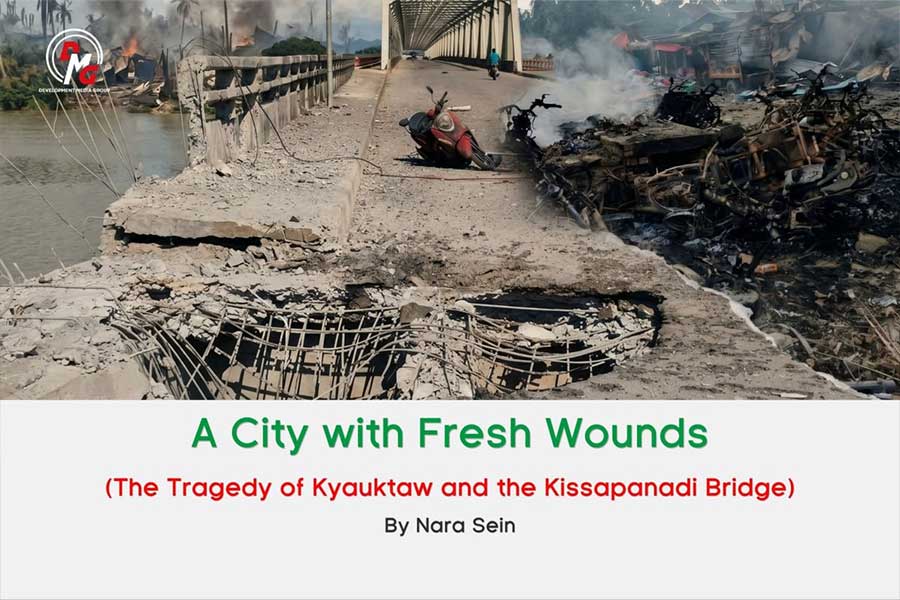
A City with Fresh Wounds (The Tragedy of Kyauktaw and the Kissapanadi Bridge)
By Admin 01 Oct 2026
Arakan Army’s Gains and the Changing Geopolitics of Arakan
By Admin 29 Sep 2026
Beyond Military Victory: What Is Myanmar’s Ultimate Political Objective?
By Admin 26 Sep 2026
UN at a Crossroads: Six Priorities for a Shared Future
By Admin 23 Sep 2026
POLITICS
BUSINESS
Industry to manufacture finished goods from coconut starting in early 2020
By Aung Kaung Zaw 20 Nov 2019