

- Junta seeks foothold on strategic island in Kaladan River as Arakan Army counterattacks
- Begging nearly doubles amid livelihood crisis in southern Arakan
- Heavy fighting near junta-held Sittwe fuels fear as frontlines approach city
- Displaced civilians struggle to access healthcare after junta airstrike destroys Ponnagyun clinic
- Kyauktaw market closure disrupts trade and drives up prices across Arakan
Fighting, disasters threaten Thazin flower cultivation in Arakan State
Thazin flower cultivation in Arakan State is declining due to armed conflict, natural disasters and a shrinking number of growers, raising concerns that the prized orchid could face extinction.
14 Jan 2026
DMG Newsroom
14 January 2026, Kyauktaw
Thazin flower cultivation in Arakan State is declining due to armed conflict, natural disasters and a shrinking number of growers, raising concerns that the prized orchid could face extinction.
The Thazin flower (Bulbophyllum auricomum), widely regarded as the Royal Orchid of Myanmar and highly valued by the Arakanese people, requires careful cultivation, suitable technology and sustained support to survive.
The industry suffered severe damage from Cyclone Mocha in May 2023 and has struggled to recover since. Renewed fighting has further disrupted farming activities, forcing growers to abandon their plants.
"When Cyclone Mocha hit Arakan State, houses and plants collapsed. We kept the Thazin flowers indoors because even if a storm strikes from far away, they can be destroyed," said Daw Ni Ni Aung, a Thazin flower grower in Kyauktaw Township. "All the flowers left outside died, including those attached to trees."
She added that many plants later died because growers were unable to provide daily care while fleeing fighting in the area.
Daw Ni Ni Aung has been cultivating Thazin flowers for more than a decade. In the past, Thazin farming was practiced in Kyauktaw, Mrauk-U, Sittwe, Ponnagyun and Buthidaung townships.
Thazin plants require moisture and cool conditions to survive, along with systematic care such as daily watering and spraying. Without regular attention, the plants quickly wither.
"Before the fighting, I grew Thazin flowers at home. During the war, I had to flee and couldn't take care of them," she said. "If they don't get water, they die. They need water and cool temperatures."
Naturally growing Thazin flowers in Arakan State are also becoming rare due to deforestation. With fewer people cultivating them, growers warn the species could disappear altogether.
"As far as I can see, Thazin flowers are now almost non-existent," Daw Ni Ni Aung said. "In the past, people collecting firewood would bring them from the forest to sell, but they are no longer available because of deforestation. Thazin resources are found in the mountains. If these mountains are destroyed, Thazin flowers could become extinct by up to 75 percent."
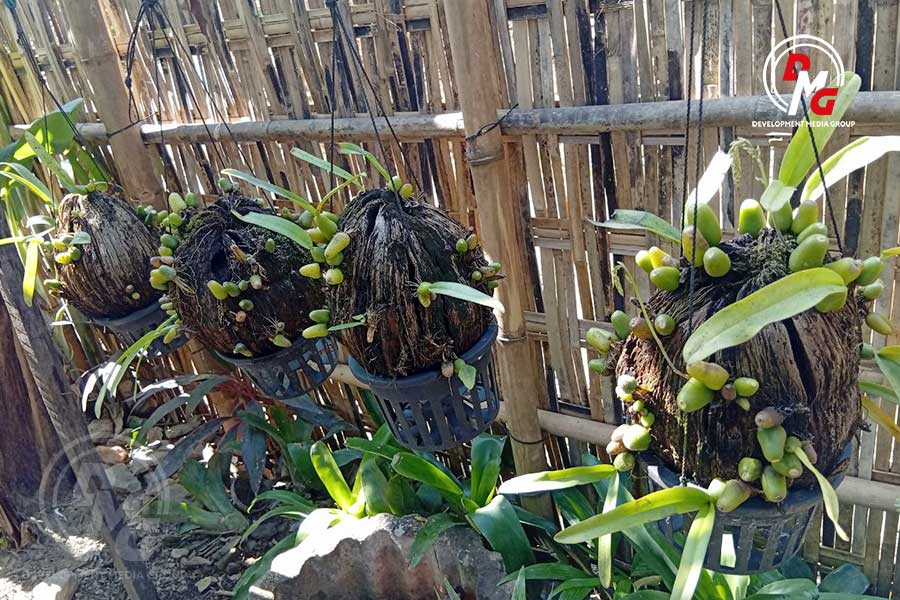
In Arakan State, Thazin flowers are typically grown by wrapping them in coconut husks, tying them with ropes and hanging them in rows, or by attaching them to trees. Successful cultivation requires the plant to develop roots within the coconut husks.
After flowering, the mother plant dies, leaving only new offshoots to survive. Growers say it can take at least a month to obtain a new branch.
"Thazin flowers are grown using coconut husks," said U Bo San Thein, a grower in Kyauktaw Township. "Once the roots develop, one main offshoot and two or three smaller ones emerge. The main one is the mother, and after it flowers, it dies. The stem grows from the offshoot and produces flowers. It takes about a month to get a branch."
A branch of Thazin flowers sells for between K2,500 and K3,000 in Arakan State. However, sales remain low due to the absence of festivals and ceremonies.
U Bo San Thein, who has cultivated Thazin flowers for 20 years, said he now grows them mainly as a hobby. Attempts to expand commercially have been limited by weak market demand.
Thazin flowers do not grow in soil and cannot withstand direct sunlight, requiring constant care, growers said.
Despite the challenges, cultivators stress that the Thazin flower is a symbol of pride for the Arakanese people and represents the dignity of women, and should therefore be preserved.

Top News

Begging nearly doubles amid livelihood crisis in southern Arakan
By Admin 12 Oct 2026
Heavy fighting near junta-held Sittwe fuels fear as frontlines approach city
By Admin 12 Oct 2026

Four civilians killed in junta shellings in Ayeyarwady Region
By Admin 11 Oct 2026