
- Magway records most airstrikes since new military chief took command: ISP-Myanmar
- Junta warship destroys two fishing boats, seizes another off Werathani
- Junta jet fighters drop 500-pound bombs on former junta battalions in Mrauk-U
- Junta deploys fighter jets to bomb Ponnagyun
- Rathedaung villagers set up night watches amid Sittwe clashes, ARSA threat
When the Son-in-Law Is a Crony and the Father-in-Law a Politician
His fortunes shifted dramatically in 1988, when his former mentor, U Ko Lay, became mayor of Yangon after the military coup. With U Ko Lay’s patronage, he secured a series of lucrative contracts for municipal markets, bridges, and infrastructure projects across Yangon.
20 Dec 2025
Written by Vraung Sein Aung
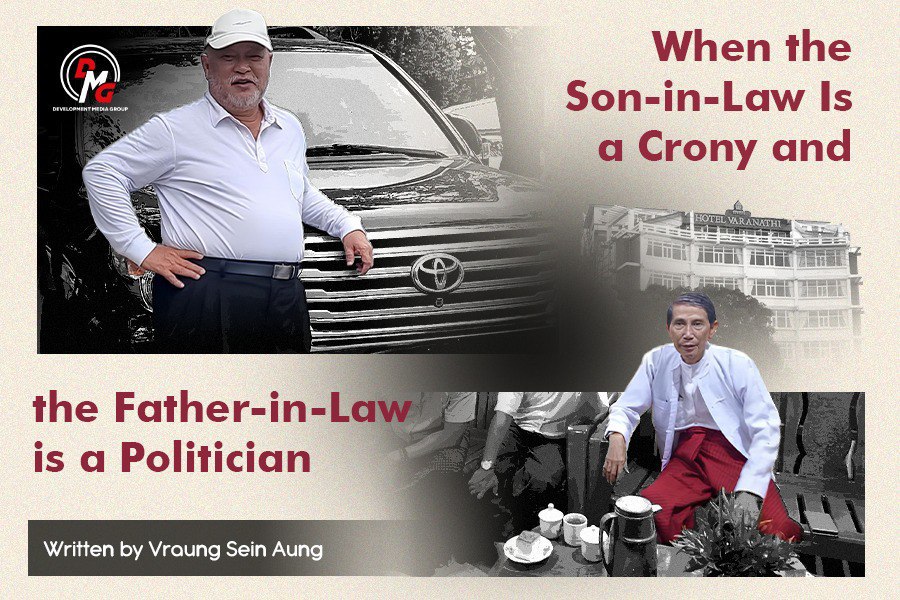
Among the luxury resorts and high-end hotels scattered across Arakan State, one notable establishment in Kyaukphyu is the Varanathi Hotel. The hotel offers sweeping views of the Bay of Bengal, the Than Zit River, and the Kyaukphyu coastline, making it a favored destination for foreign visitors and business elites seeking relaxation.
The owner of the hotel is 68-year-old U Nyein Chan Maung, a wealthy crony who rose to prominence after the military seized power in 1988. He is widely recognized as one of Arakan’s richest and most politically connected business figures.
His father-in-law, U Ba Shein — a well-known Arakan politician — has now formed a new political party to participate in the military junta’s planned election. The alliance between the two men, one a long-time crony and the other an established politician, has drawn attention and criticism.
A relative close to the family, U Thaung Htun (name changed), said: “Both of them believe the military cannot be defeated. So whatever the military does, they will cooperate. Everyone who knows them understands this very well.”
The United League of Arakan/Arakan Army (ULA/AA) has publicly rejected the junta’s upcoming election, warning that it could undermine the aspirations of the Arakan people’s revolutionary movement. The group has already announced that it will not allow polling in areas under its control.
Despite this, to secure their political and economic interests — and to align with China’s major strategic projects in Arakan — the father-in-law and son-in-law have joined forces to establish a new party known as the RNP.
From Military Sergeant to Crony Tycoon
In addition to the Varanathi Hotel, U Nyein Chan Maung also owns the upscale Rammarwadi resort — marketed as a “hate-free zone” — located on more than 10 acres near Natkyauk Beach in Kyaukphyu.
His business empire, which includes construction firms, hospitality ventures, and logistics companies connected to Kyaukphyu’s Special Economic Zone (SEZ), is estimated to be worth tens of billions of kyats. He has long-standing partnerships with the Myanmar military, enabling him to expand his influence up to Naypyidaw.
A resident of Kyaukphyu, U Myo Min (name changed), said: “He confiscated a wetland area in Ngalapwe Ward with government approval to build a port jetty, causing disputes with locals. The land where he built his resort once belonged to residents of Gonchwin Village, but the military seized it and handed it to him.”
Official sources report that he is involved in land acquisitions and construction activities related to the Kyaukphyu SEZ port project.
Born in Kangaw Village, Ramree Township, U Nyein Chan Maung joined the military at age 17 in 1974 and retired as a sergeant in 1985 at age 28.
His fortunes shifted dramatically in 1988, when his former mentor, U Ko Lay, became mayor of Yangon after the military coup. With U Ko Lay’s patronage, he secured a series of lucrative contracts for municipal markets, bridges, and infrastructure projects across Yangon.
Between 1989 and 1999, he received more than 30 contracts to construct marketplaces in Yangon Region, becoming a prominent tycoon. By the late 1990s, his business empire had expanded into Arakan, including shipping, aviation, fuel distribution, and real estate.
A Kyaukphyu resident, U Soe Naing (name changed), said: “Around 2003, he even had his own airline. Everyone here knew the Kyaukphyu–Sittwe island-hopping plane. People took pride in it.”
Today, U Nyein Chan Maung serves as chair of the Kyaukphyu District Native Ethnic Development Association and as a deputy executive of the China–Myanmar Friendship Association, positioning himself as a bridge between Beijing and the junta.
Although Arakan is Myanmar’s second most poorest state, his wealth — built on military patronage — places him among the most influential cronies in the region.
Family Ties: The Crony and the Politician
About 23 years ago, around 2003, U Ba Shein’s youngest daughter, Ma Moe Moe Shein, married U Nyein Chan Maung — a man roughly 30 years her senior and already married at the time. Their marriage drew considerable attention.
At first, U Ba Shein severed contact with his daughter for more than three years. But over time, U Nyein Chan Maung managed to reconcile with his father-in-law and built a close relationship.
A Kyaukphyu resident close to the family, U Aung Aung (name changed), explained: “Back then, society was not as open-minded as today. People criticized her for marrying a much older, wealthy man. U Ba Shein was upset at first, but eventually they became very close.”
Observers noted that political advantage began merging with economic benefit within the family. In 2010, when U Ba Shein won a parliamentary seat, his son-in-law was awarded reconstruction contracts for schools damaged by Cyclone Giri.
Since then, the intersection of political power and business interests within the family has attracted increasing scrutiny.
U Ba Shein’s Political Career
U Ba Shein began his political journey with the Arakan League for Democracy (ALD) in the 1990 election. He later joined the Rakhine Nationalities Development Party (RNDP), winning a parliamentary seat for Kyaukphyu in 2010.
When ALD and RNDP merged to form the Arakan National Party (ANP) in 2014, he became one of its senior leaders. He won another parliamentary seat in 2015.
He also served as a mediator during the public protests against Chinese investment in Kyaukphyu after 2016. However, locals accused him of treating them dismissively and siding with Chinese-backed interests.
A farmer from Pyartaik Village, U Ba Swe (name changed), recalled: “He scolded villagers, saying the government had the right to take their land and they should have accepted compensation earlier. We still remember those words.”
The RNP: A New Party Aligned with the Junta
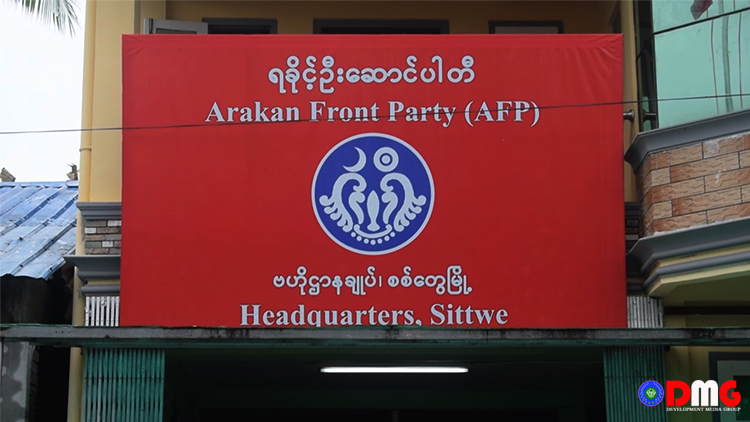
After the military annulled the 2020 election, the junta invited parties to re-register in early 2023. While many rejected the process, U Ba Shein attempted to re-register the ANP — a move criticized by former party members.
When the ANP was ultimately rejected, he founded a new party: the Rakhine Nationalities Party (RNP).
The father-in-law and son-in-law pair now appear to be working in tandem — politically and economically — to secure influence under the junta’s upcoming election.
A Party Built on Chinese Interests and Crony Capital
Kyaukphyu hosts at least 11 major Chinese-backed infrastructure projects, including the deep-sea port, oil and gas terminal, SEZ, and transport corridors linked to the Belt and Road Initiative (BRI).
Both U Nyein Chan Maung and U Ba Shein have vested interests in these projects — through land acquisition, community persuasion, and business partnerships.
A China-project analyst said: “If the Chinese want a party that will reliably support their agendas in Kyaukphyu, they will choose the RNP. So these two men stand to gain more political and economic power than anyone else.”
Although Myanmar election law prohibits foreign influence, enforcement under the junta-appointed Election Commission is lax.
Meanwhile, the ULA/AA has taken action against cronies and junta collaborators, warning that activities harming the interests of the Arakan people will not be tolerated.
Conclusion
Although the junta now controls only three out of Arakan’s 17 townships, it has designated 74 constituencies for elections. Voting is expected to occur in stages — first in Sittwe, Kyaukphyu, and Manaung, followed by other townships such as Ann, Taungup, Thandwe, and Gwa.
Analysts believe the RNP will focus on southern Arakan — Kyaukphyu, Ann, Ramree, Manaung — where Chinese projects and their associated economic interests are concentrated.
For many Arakan observers, the RNP — powered by the political experience of U Ba Shein and the economic influence of his crony son-in-law — is seen not as a party representing the people, but as a household party designed to protect the interests of the junta and China.
Ultimately, the junta’s election offers no benefit to the people of Arakan. Instead, it serves as a mechanism that prolongs the power of military elites and cronies at the expense of public welfare and political rights.

Opinion
.jpg)
How Can Myanmar’s Political Crisis Be Brought to an End?
By Admin 13 Sep 2026

By Cutting Trees, We Are Killing Ourselves
By Admin 06 Sep 2026
A Modern August We Must Never Forget
By Admin 31 Aug 2026
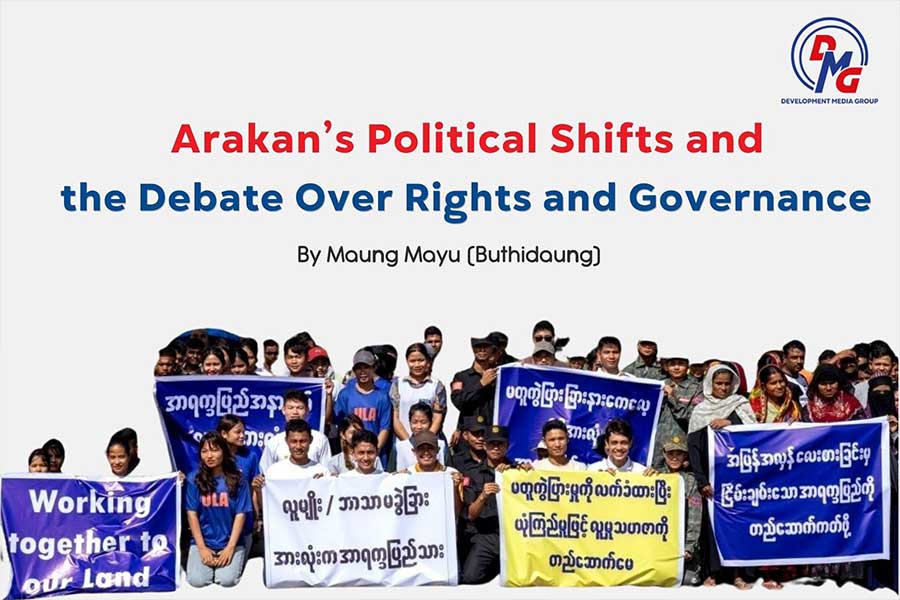
Arakan’s Political Shifts and the Debate Over Rights and Governance
By Admin 27 Aug 2026
Securing Rights for Bangladesh's Indigenous Peoples is Indispensable
By Admin 09 Aug 2026

POLITICS

BUSINESS
Industry to manufacture finished goods from coconut starting in early 2020
By Aung Kaung Zaw 20 Nov 2019