
- Arakan residents suffer severe mental and physical distress amid junta airstrikes
- Junta jet fleet bombs at least three locations in Kyauktaw
- Junta aerial bombardment of Taungup leaves two residents dead, one injured
- Junta deploys 2,000 troops in major offensive against AA-held territory: ISP-Myanmar
- APHR opposes Min Aung Hlaing’s Malaysia visit, urges halt to Myanmar returns
Let the World Hear a Little Girl’s Cry
Bombs hit the India Market and the area near the Kissapanadi Bridge in Kyauktaw, destroying shops and taking civilian lives. According to figures cited by DMG, the attack killed 50 civilians and injured 57 others.
06 Oct 2026
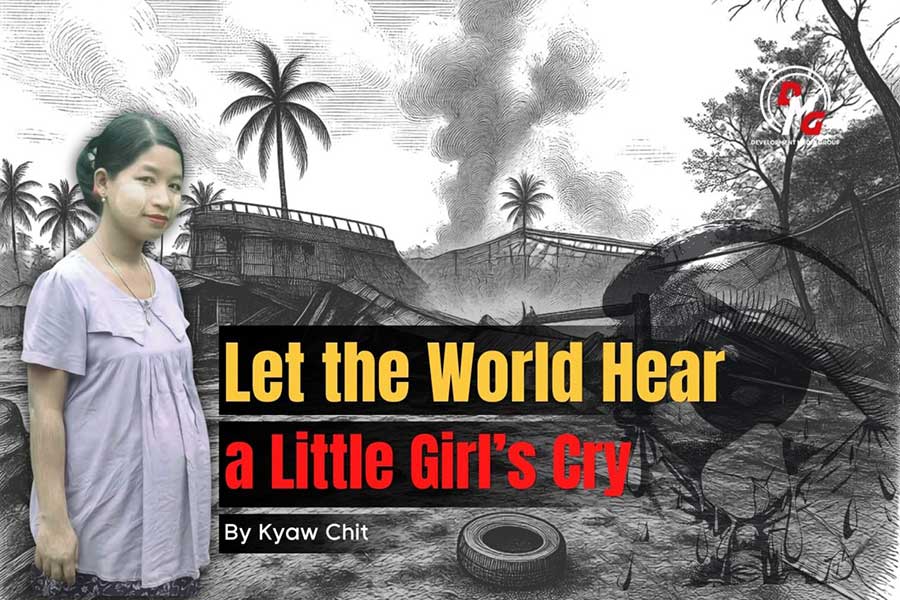
By Kyaw Chit
“Run... my little girl, run...”
Those may have been the final words of a mother, nine months pregnant, as she lay bleeding after being struck by bomb fragments.
Her six-year-old daughter had to run for her life. She would never get to wear the new pair of shoes her mother had gone to buy for her.
Thirty-two-year-old Ma Khin Mar Nwe and her daughter had gone to the bustling India Market in Kyauktaw that day for the simplest of reasons: to buy the child a new pair of shoes. Another baby was about to enter their lives.
But those ordinary hopes for the future were shattered within seconds by the roar of aircraft overhead.
Shortly after noon on September 28, 2026, their trip to the market turned into an inferno when an airstrike struck the area.
Bombs hit the India Market and the area near the Kissapanadi Bridge in Kyauktaw, destroying shops and taking civilian lives. According to figures cited by DMG, the attack killed 50 civilians and injured 57 others.
Witnesses described a scene resembling hell.
Bomb fragments struck the pregnant mother. Despite her severe wounds, she gave birth amid the flames.
For a brief moment, people nearby said they heard the newborn baby crying amid the explosions, burning buildings and screams.
But the cries did not last.
Both the mother and her newborn child who had experienced the world for only a matter of moments died amid the flames.
The six-year-old daughter narrowly survived after her mother shouted at her to run. But survival has not meant escaping the consequences of that day. She was also wounded by bomb fragments and is receiving medical treatment.
Even if her physical wounds heal, the sight of her mother and newborn sister dying before her eyes may cast a shadow over her childhood for years to come.
Then there is the surviving father.
That morning, his wife had left home with their daughter. Their second child was soon to be born, while their eldest was looking forward to a new pair of shoes.
Within moments, an ordinary family life was torn apart.
There are few words adequate to describe the grief of a father who loses his wife and newborn daughter at the same time. His loss embodies the human cost of a conflict in which civilians increasingly find themselves exposed to violence far from the front lines.
India Market was a place where ordinary people earned their livelihoods, shopped for their families and went about their daily lives. Children went there with their parents for things as ordinary as a pair of shoes.
For the people of Arakan, however, tragedies such as this are becoming part of a broader fear of airstrikes as Myanmar’s military increasingly relies on air power.
According to the Institute for Strategy and Policy-Myanmar (ISP-Myanmar), the Myanmar military carried out at least 1,583 airstrikes nationwide between March 31 and August 31, 2026, the first five months of Gen. Ye Win Oo’s tenure as commander-in-chief. Arakan State was among the areas most heavily affected, with at least 222 airstrikes recorded during that period.
DMG’s records show that between April 2024 and September 12, 2026, airstrikes in Arakan State killed 602 civilians and injured 1,211 others.
Behind every one of those numbers is a human life.
The death of a pregnant mother and her newborn child cannot be reduced to another entry in a casualty count. It represents a family destroyed, a life extinguished almost as soon as it began, and a childhood forever altered.
A six-year-old girl went to the market expecting to return home with a new pair of shoes.
Instead, she returned without her mother and newborn sister.
And amid the explosions, flames and screams of that September afternoon, another little girl entered the world and cried for the first—and last—time.
The question now is whether the world will hear her cry.

Opinion
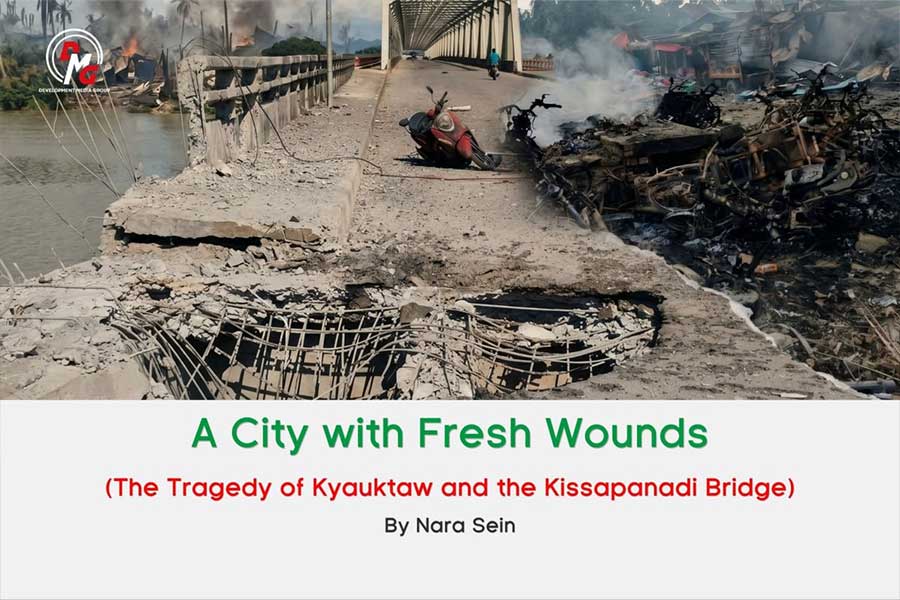
A City with Fresh Wounds (The Tragedy of Kyauktaw and the Kissapanadi Bridge)
By Admin 01 Oct 2026

Arakan Army’s Gains and the Changing Geopolitics of Arakan
By Admin 29 Sep 2026

Beyond Military Victory: What Is Myanmar’s Ultimate Political Objective?
By Admin 26 Sep 2026
UN at a Crossroads: Six Priorities for a Shared Future
By Admin 23 Sep 2026

.jpg)
How Can Myanmar’s Political Crisis Be Brought to an End?
By Admin 13 Sep 2026
POLITICS

BUSINESS
Industry to manufacture finished goods from coconut starting in early 2020
By Aung Kaung Zaw 20 Nov 2019