


- Two civilians reportedly killed, six injured in junta nighttime airstrike on Mrauk-U
- Arakan records highest civilian death toll in Myanmar mass killings: NLTA
- Begging rises in junta-held Sittwe as commodity prices soar and livelihoods deteriorate
- Maternal, newborn deaths reported across Arakan amid healthcare shortages
- Junta attacks kill 15 women in Arakan, 49 nationwide in October: BWU
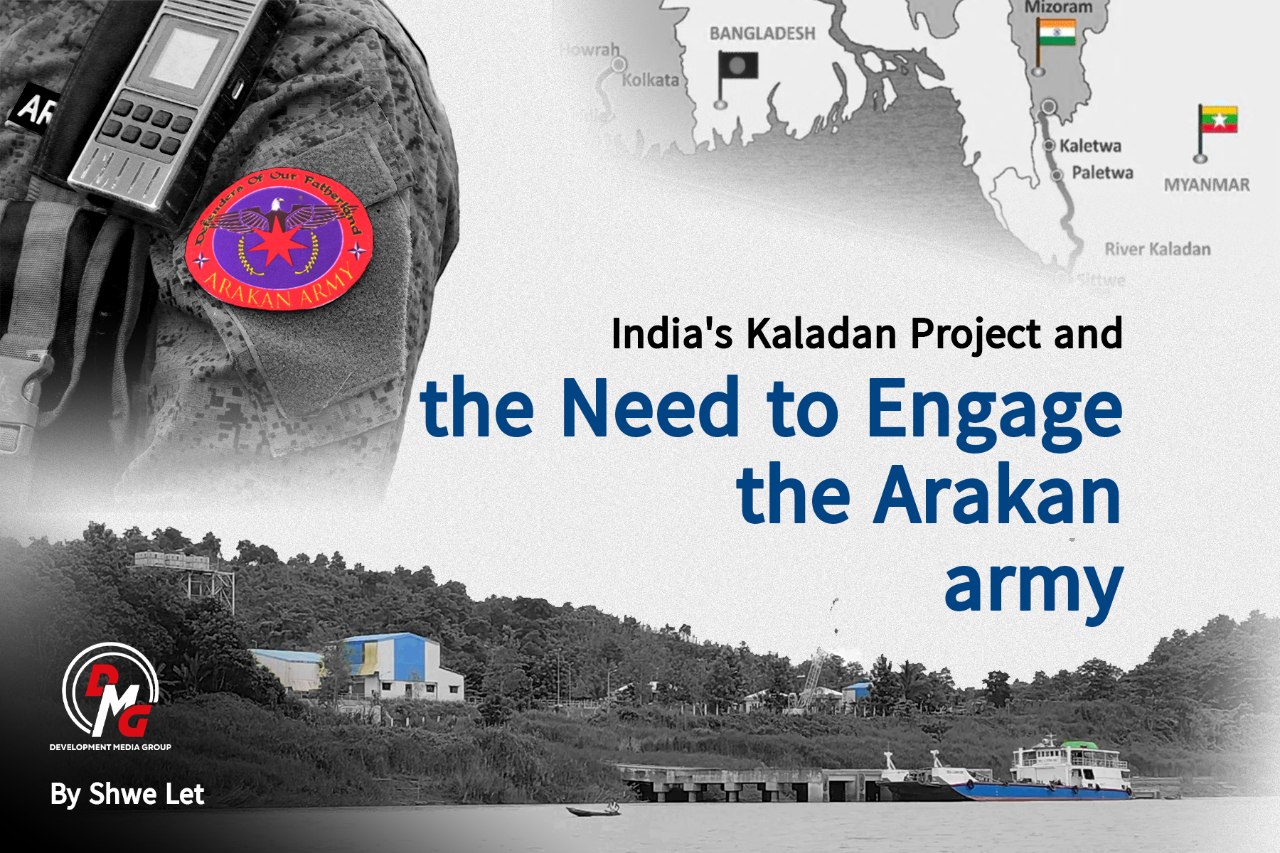
India's Kaladan Project and the Need to Engage the Arakan Army
On October 27, 2026, Mizoram Chief Minister Lalduhoma met with Indian Railways officials to review plans for a proposed railway connecting Sairang, near Aizawl in northeastern India, to Hmawngbuchhuah in Lawngtlai District, near the Myanmar border.
14 Nov 2026
By Shwe Let
On October 27, 2026, Mizoram Chief Minister Lalduhoma met with Indian Railways officials to review plans for a proposed railway connecting Sairang, near Aizawl in northeastern India, to Hmawngbuchhuah in Lawngtlai District, near the Myanmar border.
The proposed 230.11-kilometre railway, with 20 planned stations, could eventually complement the Kaladan Multi-Modal Transit Transport Project (KMMTTP), an Indian-funded infrastructure initiative designed to connect India's northeastern states with the Bay of Bengal through Myanmar.
Although the railway's integration with the Kaladan project has not been formally established, its proposed terminus near the border region adjoining Paletwa highlights the potential for greater transport and commercial connectivity between northeastern India and Arakan (Rakhine State).
The Arakan Army (AA) has also reportedly welcomed the proposed development.
These developments raise an important question: How can India advance its strategic infrastructure ambitions when the political and military realities in Arakan have changed so significantly?
Arakan's Strategic Importance to India
Located along the eastern coast of the Bay of Bengal, Arakan occupies a strategically important position between South Asia and Southeast Asia.
Its geographical location offers India an alternative route connecting its northeastern states to international maritime trade networks.
This advantage underpins the Kaladan Multi-Modal Transit Transport Project, which combines maritime shipping, inland waterways and road transportation.
Under the project, goods are intended to travel by sea from India's Kolkata and Haldia ports to Sittwe Port in Arakan. From Sittwe, cargo would move along the Kaladan River to Paletwa before continuing by road to Zorinpui on the India–Myanmar border.
The route would then connect with India's highway network in Mizoram.
According to Indian government project documents, the maritime section covers approximately 539 kilometres, while the inland waterway between Sittwe and Paletwa extends 158 kilometres. The Paletwa–Zorinpui road section is approximately 110 kilometres long, followed by another road connection of around 100 kilometres within India.
Once fully operational, the project could establish Sittwe as a major maritime and inland waterway transport hub, while Paletwa could become an important logistics centre linking river transportation with overland trade.
For India, the project offers an alternative transport corridor. For Arakan, it presents opportunities for trade, investment and economic development.
The Kaladan Project: From Earlier Agreements to New Realities
The Kaladan project originated through cooperation between the governments of India and Myanmar.
On April 2, 2008, the two countries signed a framework agreement and related transport protocols in New Delhi.
At the time, India was governed by Prime Minister Manmohan Singh, while Myanmar remained under the military government led by Senior General Than Shwe.
According to Indian government records, the project's original estimated cost was INR 535.91 crore, approximately 5.36 billion rupees. By 2015, the revised estimate had increased to INR 2,904.04 crore, approximately 29.04 billion rupees.
Initial implementation focused on port facilities and inland waterway infrastructure. Construction of Sittwe Port, the Paletwa inland water terminal and associated water transport facilities has since been completed.
However, the road connecting Paletwa to Zorinpui, a crucial component for the project's full operation, remains unfinished.
The approximately 109.2-kilometre road section is being implemented by India's IRCON International Limited.
According to a briefing by IRCON officials on October 5, 2026, physical construction progress had reached approximately 25 percent, while financial progress stood at around 30 percent.
India has renewed efforts to advance the project. The proposed railway extension from Sairang towards the Myanmar border could provide an additional transport connection if eventually integrated with the Kaladan network.
Yet the political circumstances surrounding the project have fundamentally changed.
When the original agreements were negotiated, India dealt primarily with Myanmar's central government.
Today, substantial sections of the proposed transport corridor lie within areas controlled by the Arakan Army.
This presents India with a diplomatic and practical challenge: completing a major infrastructure project originally negotiated with Myanmar's central authorities while significant parts of the territory involved are now controlled by a different political and military actor.
India's Strategic Interests and Act East Policy
India's northeastern states remain heavily dependent on the narrow Siliguri Corridor, which connects the region to the rest of the country.
The Kaladan project could reduce this dependence by providing an alternative transport route through the Bay of Bengal.
Improved connectivity could expand commercial opportunities for Mizoram, Manipur, Tripura and other northeastern states by facilitating the movement of goods and strengthening access to regional markets.
The project's importance extends beyond domestic transportation.
It forms part of India's broader Act East Policy, which seeks to deepen economic, political and strategic engagement with Southeast Asia.
Under this policy, India has prioritised infrastructure connectivity, trade, investment and regional cooperation, particularly through its northeastern states.
The Kaladan project and the India–Myanmar–Thailand Trilateral Highway are among the major connectivity initiatives associated with this policy.
The Kaladan project therefore serves several objectives.
Economically, it could reduce transportation constraints and create new trading opportunities.
Strategically, it could strengthen India's connections with Southeast Asia and improve access between its northeastern states and the Bay of Bengal.
From a geopolitical perspective, it could also expand India's regional influence through infrastructure development and commercial cooperation.
The project is thus more than a transport initiative. It represents an important component of India's long-term economic and strategic engagement with its eastern neighbours.
Economic Opportunities and Historical Inequalities in Arakan
Although the Kaladan project is primarily designed to improve connectivity for northeastern India, it could also generate substantial economic opportunities for Arakan.
If fully developed, Sittwe and Paletwa could become important centres for regional commerce, logistics and transportation.
Expanded trade could stimulate port operations, cargo handling, warehousing, transport services and other related industries.
Arakan's agricultural products, fisheries and other locally produced goods could gain improved access to Indian markets.
At the same time, Indian machinery, manufactured products, food and other commodities could become more readily available in Arakan.
However, the potential economic benefits of the project raise an important question: Who will control these opportunities, and who will ultimately benefit from them?
Historically, the people of Arakan have had limited authority over the management of their region's natural resources and major economic projects.
Under successive Myanmar governments, decisions concerning natural resource extraction, foreign investment and infrastructure development were largely controlled by central authorities.
In the author's assessment, these arrangements frequently disregarded the interests, preferences and decision-making rights of Arakan's local communities.
Article 37(a) of Myanmar's 2008 Constitution establishes the state as the ultimate owner of land and natural resources, including resources above and below the ground and in the country's waters and airspace.
The author argues that this constitutional framework reinforced centralised control over natural resources while limiting meaningful local participation in resource management.
Major investment and resource extraction projects in Arakan, he contends, have often proceeded without adequate consultation with affected communities or an equitable distribution of economic benefits.
These historical inequalities, together with the uneven distribution of resource revenues, have contributed to persistent poverty and underdevelopment in Arakan.
From this perspective, the Kaladan project should not become another infrastructure initiative that generates economic benefits for outside interests while leaving local communities with limited influence over decisions affecting their land and livelihoods.
Instead, its implementation should incorporate meaningful local participation, employment opportunities, transparent arrangements and a fair distribution of economic benefits.
Such an approach would help ensure that Arakan's strategic geographical position contributes to the development and prosperity of its own people.
Why India Must Engage the Arakan Army
The political and military landscape of Arakan has changed substantially in recent years.
The Arakan Army now controls most of the territory in Arakan and has been establishing administrative, legislative and judicial structures in areas under its authority.
According to the author's assessment, the AA controls more than 90 percent of Arakan's territory, while the Myanmar military's administrative authority has been substantially reduced across much of the state and neighbouring Paletwa.
Regardless of the position taken by Myanmar's military authorities towards the AA and the Arakan People's Revolutionary Government, the changing realities of territorial control cannot be ignored.
The future of strategically important cities such as Sittwe and Kyaukphyu could also have significant implications for the region's political, military and economic landscape.
For India, these developments create new practical considerations.
The original Kaladan agreements were negotiated with Myanmar's central government. However, the implementation and operation of infrastructure in areas now controlled by the AA will depend, at least in part, on conditions established by those exercising effective control on the ground.
Relying exclusively on earlier agreements may therefore be insufficient to ensure the project's completion and long-term operation.
India needs a realistic approach that takes account of these changing circumstances.
In particular, direct dialogue with the Arakan Army and the Arakan People's Revolutionary Government could help address the security, administrative and commercial challenges affecting the Kaladan transport corridor.
Such engagement would not necessarily require India to abandon its existing diplomatic relationships with Myanmar's central authorities or amount to formal diplomatic recognition of the AA's administration.
Rather, it would represent a pragmatic response to the political and territorial realities affecting a strategically important infrastructure project.
For the AA and the Arakan People's Revolutionary Government, cooperation with India could also offer opportunities to expand trade, improve transport connectivity and attract economic activity to areas under their administration.
However, any such cooperation should extend beyond the immediate interests of the parties involved.
The people of Arakan, including communities affected by the proposed transport corridor, should have a meaningful role in determining how the project is implemented and how its benefits are distributed.
Their interests in employment, livelihoods, natural resource management, community participation and economic development should be central considerations.
A mutually beneficial approach would require India to pursue its strategic and commercial objectives while recognising Arakan's economic interests and the needs of its population.
In international economic relations, a win-win approach seeks to create arrangements in which participating parties benefit from cooperation.
Applied to the Kaladan project, this principle would mean developing a framework that advances India's connectivity ambitions while creating tangible and sustainable economic benefits for Arakan.
A Pragmatic Path Forward
The future of the Kaladan project depends on more than India's financial commitments, engineering capacity and infrastructure investments.
It also depends on how effectively India responds to the changing political and military realities in Arakan.
The territorial control exercised by the Arakan Army has altered the circumstances under which the project was originally conceived.
Ignoring these developments could complicate efforts to complete and operate the transport corridor.
Constructive engagement with the AA and the Arakan People's Revolutionary Government, alongside appropriate diplomatic arrangements, could provide a more practical foundation for advancing the project.
At the same time, meaningful cooperation should ensure that the benefits of improved connectivity are not confined to India's strategic interests or the commercial gains of major investors.
Arakan's communities should also benefit through economic opportunities, improved infrastructure, local participation and fair access to the resources and revenues generated by development.
If India wants the Kaladan project to succeed, it must recognise the realities on the ground and engage with the Arakan Army and the Arakan People's Revolutionary Government in pursuit of mutually beneficial cooperation.
Ultimately, the project's success should be measured not only by the completion of transport infrastructure or the volume of goods moving across borders, but also by whether it contributes to sustainable economic development and improves the lives of the people of Arakan.

Opinion
India's Kaladan Project and the Need to Engage the Arakan Army
By Admin 14 Nov 2026

Diwali: Illuminating the Path Towards a More Inclusive Society
By Admin 09 Nov 2026

The Journey of Arakanese Language Education
By Admin 03 Nov 2026

Can the UN Restore Trust in a Fractured World?
By Admin 23 Oct 2026

Arakan Amid the Storm: From Survival to Rebuilding a People
By Admin 22 Oct 2026
POLITICS



BUSINESS
Industry to manufacture finished goods from coconut starting in early 2020
By Aung Kaung Zaw 20 Nov 2019