
- Military operations spread despite decline in clashes, BNI report finds
- Junta aerial attacks force school closures across three Arakan townships
- Family demands swift arrest of statutory rape suspect in Werathani
- Women face shrinking employment opportunities in Myanmar, UNDP reports
- AA seizes five junta outposts as Arakan records most civilian-targeted airstrikes: NLTA
Myanmar-Russia military drill signals need for revolutionary forces to adapt: analysts
A joint military exercise between Myanmar and Russia has highlighted the need for revolutionary forces to adapt to evolving battlefield tactics and weapons technologies, according to political and military analysts.
17 Jul 2026
DMG Newsroom
17 July 2026, Nay Pyi Taw
A joint military exercise between Myanmar and Russia has highlighted the need for revolutionary forces to adapt to evolving battlefield tactics and weapons technologies, according to political and military analysts.
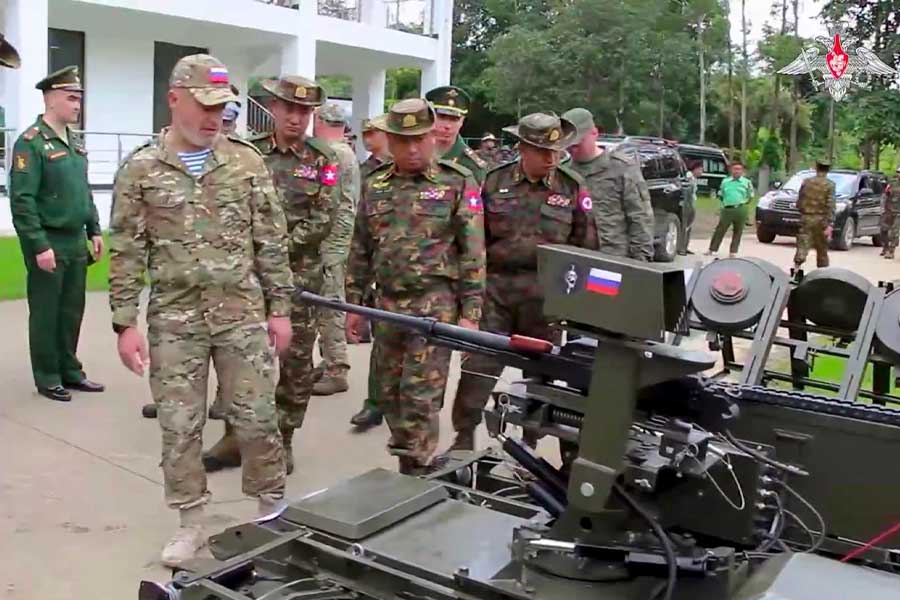
The joint exercise, held in Nay Pyi Taw from 6 July to 17 July, reportedly focuses on counterterrorism operations, anti-drone warfare and tactical raids in tropical environments. Military sources said Russian-made weapons are also being showcased during the training.
Analysts said the drill suggests the junta is preparing for future military operations and warned that revolutionary forces should not underestimate the significance of the training.
Captain Zin Yaw, a member of the Civil Disobedience Movement, said revolutionary forces should prepare countermeasures to address the junta's acquisition of new weapons and military technologies.
"The way they are displaying and deploying their military capabilities will not immediately translate into battlefield use. I see this as preparation for future warfare. However, revolutionary forces cannot afford to be complacent. At the beginning of the revolution, resistance groups gained the upper hand by using drone technology and inflicted heavy losses on the military. The junta later expanded its own drone capabilities and formed dedicated drone units," Captain Zin Yaw told DMG.
The military defector said that although the junta has recently displayed Unmanned Ground Vehicles (UGVs), they have yet to be widely deployed in combat and appear to be intended mainly for demonstration purposes and security operations in Nay Pyi Taw.
"As the military continues to expand its technological capabilities, revolutionary forces also need to seek access to advanced technologies, including those developed by Ukraine," he added.
The military defector said the latest joint exercise with Russia likely involves more advanced military training than previous engagements and requires close attention from revolutionary forces.
The exercise reportedly involved at least 24 Russian military personnel. On the Myanmar military side, Chief of Military Training Lt-Gen Pyae Sone Lin attended the exercise together with personnel from several combat support units.
Despite the joint exercise, the junta continues to face shortages of ammunition and weapons due to the country's ongoing armed conflicts.
Political and military analysts said revolutionary forces should remain alert as the junta seeks to strengthen its capabilities with Russian military equipment.
"The Myanmar military is currently facing shortages of technology and weapons. As fighting continues across ethnic areas, ammunition supplies are declining. However, the military continues to obtain weapons, components and technical expertise from Russia to support domestic production. Technical assistance, particularly in UAVs and drone technology, could improve its reconnaissance capabilities and enable more accurate airstrikes once precise intelligence is obtained," said U Aung Marm Oo, editor-in-chief of Development Media Group (DMG) and political analyst.
He added that the Myanmar military's fighter aircraft are already largely Russian-made and that new technologies or tactics acquired through cooperation with Russia could pose additional challenges for revolutionary forces.
"How the military applies the combat tactics learned from Russia will also be important. As the junta introduces more advanced technologies, revolutionary and ethnic armed groups will face greater challenges. New weapons and technologies could also be deployed on the Arakan front, so revolutionary forces need to remain vigilant," he said.
Russia remains one of the junta's closest international partners and is a major supplier of aircraft, drones and other military equipment to the Myanmar military.
Since the 2021 military coup, Myanmar has been engulfed in nationwide armed conflict. After losing control of more than 100 towns, the junta has recently launched counter-offensives in Sagaing, Mandalay and Tanintharyi Regions, Kayin and Chin States, reportedly with Chinese support.

Top News
Military operations spread despite decline in clashes, BNI report finds
By Admin 17 Oct 2026
Junta aerial attacks force school closures across three Arakan townships
By Admin 17 Oct 2026

Family demands swift arrest of statutory rape suspect in Werathani
By Admin 17 Oct 2026
Women face shrinking employment opportunities in Myanmar, UNDP reports
By Admin 17 Oct 2026