
- Regime deploys nearly 100 police personnel to Sittwe amid intense fighting
- Junta airstrikes on Kyeintali Town, nearby village injure two civilians
- AA clashes with ARSA in northern Maungdaw
- Arakan records most armed incidents, civilian-targeted airstrikes in Myanmar: Report
- Nay Pyi Taw talks between junta, MNDAA halt over special region demand
Holding On to Arakan
The people of Arakan must continue to hold on to Arakan rather than abandon it. We must endure hardships together and remain witnesses to the building of a new nation.
26 Jun 2026
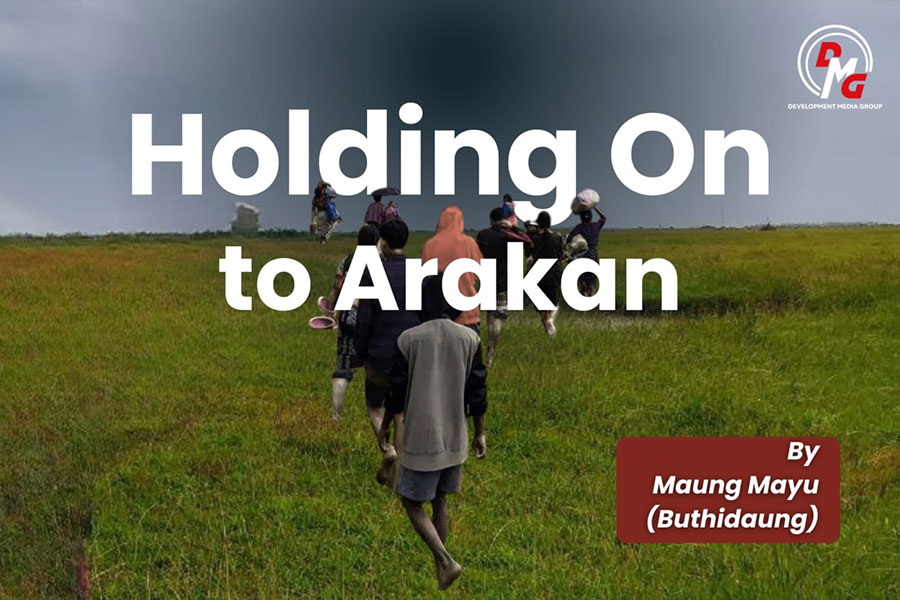
By Maung Mayu (Buthidaung)
The shadows of war began gathering over our town like dark storm clouds. To be precise, it was February 2024.
At that time, the Arakan Army (AA) had already launched town-capture offensives across Arakan and had taken control of Paletwa and Pauktaw townships. Preparations were underway to seize Kyauktaw and Mrauk-U, while other towns were expected to fall one after another.
For families like ours, it became clear that we would have to leave our town, at least temporarily. The difficult question was where we should seek refuge.
While we were trying to make that decision, some of the wealthier residents had already left Arakan. At the same time, my wife was carrying our second child. More important than our own safety was the need for proper medical care. Our first daughter had been delivered by cesarean section, which meant that a hospital capable of performing another operation was essential.
Yet functioning hospitals and clinics had become increasingly scarce across Arakan because of the war.
Relatives urged us to flee to Yangon. They argued that childbirth would be safer there and that finding work would be easier.
But I had no desire to leave Arakan.
Even if enormous hardships awaited us, I wanted to remain and hold on to Arakan. My determination stemmed largely from my trust in Arakan's leaders, Commander-in-Chief Major General Twan Mrat Naing and Dr. Nyo Twan Awng.
Throughout history, I have read about revolutionary leaders who inspired people not only because they fought against oppression, but because they envisioned a better society after victory. Revolution is not merely about destroying a bad system; it is also about creating a new one that serves the people.
That is why revolutionaries around the world have admired figures such as Che Guevara, who sought social justice for the poor, and Thomas Sankara, who dreamed of building a self-reliant and principled Africa.
Che Guevara helped overthrow Cuba's corrupt dictatorship and later worked to reform the country's institutions, laying foundations that helped Cuba become known for producing large numbers of medical professionals.
Thomas Sankara likewise prioritized anti-corruption efforts, women's rights, healthcare, and education. Even after coming to power, he remained closely connected to ordinary people and became known as "Africa's Che Guevara."
What made such revolutionary leaders compelling was their vision of what society could become after the revolution succeeded.
When I observed the Arakan Revolution, I felt that the leadership qualities, political vision, and commitment of Major General Twan Mrat Naing and Dr. Nyo Twan Awng offered a glimpse of a better future for Arakan. I genuinely believed they could achieve meaningful and lasting change, much as revolutionary leaders had done elsewhere in the world.
For that reason, I chose not to leave Arakan.
Instead, my family sought refuge in a small village not far from our hometown. Life as a displaced family was difficult. We had no stable source of income and faced many hardships.
Before long, we heard that our hometown had been burned down. Among the losses was our newly built family home, a house we had not even lived in for a full year.
The news was heartbreaking.
At the same time, the birth of our child was drawing near. As we searched for a hospital capable of performing a cesarean section, we found ourselves moving farther and farther away from home.
Yet we continued to hold on to Arakan.
Meanwhile, the Arakan Army was achieving remarkable military successes, capturing one town after another. While fighting battles on one front, it was simultaneously establishing administrative, judicial, educational, healthcare, and regional development mechanisms in territories under its control.
Efforts were also made to secure border trade routes and ensure the availability of essential goods and medicines for local communities.
In several towns, Arakanese doctors and healthcare professionals helped maintain medical services despite the conflict. As a result, on May 28, 2024, our second child was safely born in Arakan without major difficulties.
For me, that was proof that choosing to remain in Arakan had been the right decision.
Today, the Arakan Army controls almost all of Arakan. The Arakan People's Revolutionary Government is increasingly functioning as a governing authority, placing greater emphasis on administration and development across multiple sectors.
Although its achievements may not surpass those of revolutionary figures such as Che Guevara or Thomas Sankara, it has nevertheless managed to establish governance systems and public services during wartime to a degree that many people never expected.
This does not mean the system is perfect.
There are still shortcomings, weaknesses, and areas requiring reform. Public concerns have emerged regarding taxation, cases in which rape suspects were reportedly released after being detained, disputes over public military service recruitment policies, and instances of abuse of authority by some lower-level officials.
Such criticism should not be ignored.
However, these criticisms do not arise from hostility toward the Arakan People's Revolutionary Government. Rather, they come from people who joined the revolution because they rejected unjust systems and who fear seeing those same problems reappear under their own government.
At the same time, the people of Arakan must remember one important reality: the struggle is not yet over.
Major battles continue. Efforts to generate international pressure, as well as political and diplomatic campaigns aimed at weakening the unity of Arakan society, continue in various forms.
This remains a difficult and dangerous period.
At present, protecting people from falling once again into hardship and suffering is more important than anything else. Under such circumstances, Arakan's leaders cannot be expected to solve every problem perfectly or simultaneously.
When Arakan eventually achieves full liberation and establishes a stronger and more stable government, many of today's criticisms may gradually diminish. That does not mean criticism will disappear entirely. No government is perfect.
Many of the current shortcomings arise because wartime realities continue to demand priority, while some capable leaders and professionals cannot yet fully participate in governance due to ongoing conflict.
For that reason, unity remains essential.
The people of Arakan must continue to hold on to Arakan rather than abandon it. We must endure hardships together and remain witnesses to the building of a new nation.
Those who left Arakan for various reasons should also continue to dream of returning one day and retain their attachment to their homeland.
We did not hold on to Arakan simply because we loved the land itself.
We held on because we believed in the future we wanted to see for our country, for our people, and for future generations.
And I continue to believe that we will witness that future before long.

Opinion
Beyond Military Victory: What Is Myanmar’s Ultimate Political Objective?
By Admin 26 Sep 2026
UN at a Crossroads: Six Priorities for a Shared Future
By Admin 23 Sep 2026
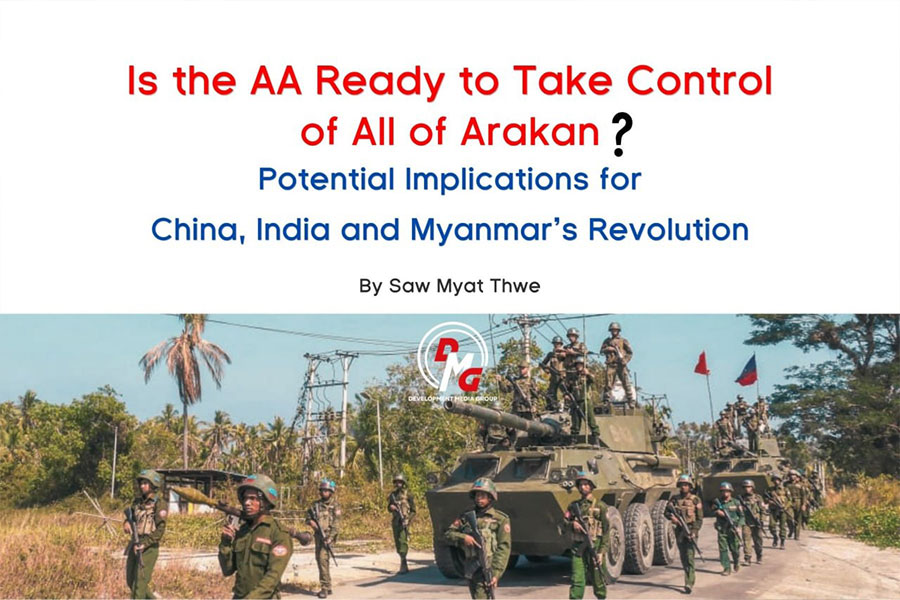
.jpg)
How Can Myanmar’s Political Crisis Be Brought to an End?
By Admin 13 Sep 2026

By Cutting Trees, We Are Killing Ourselves
By Admin 06 Sep 2026
A Modern August We Must Never Forget
By Admin 31 Aug 2026
POLITICS

BUSINESS
Industry to manufacture finished goods from coconut starting in early 2020
By Aung Kaung Zaw 20 Nov 2019