

- ISP-Myanmar reports at least 115 mass civilian killing incidents across Myanmar
- Junta airstrikes on Ponnagyun, Rathedaung villages kill one, injure three
- UN High Commissioner, UK condemn Kyauktaw airstrike killing at least 50 civilians
- ULA/AA faces governance challenges as it consolidates control in Arakan: ISP-Myanmar
- Death toll from Kyauktaw airstrike rises to 50
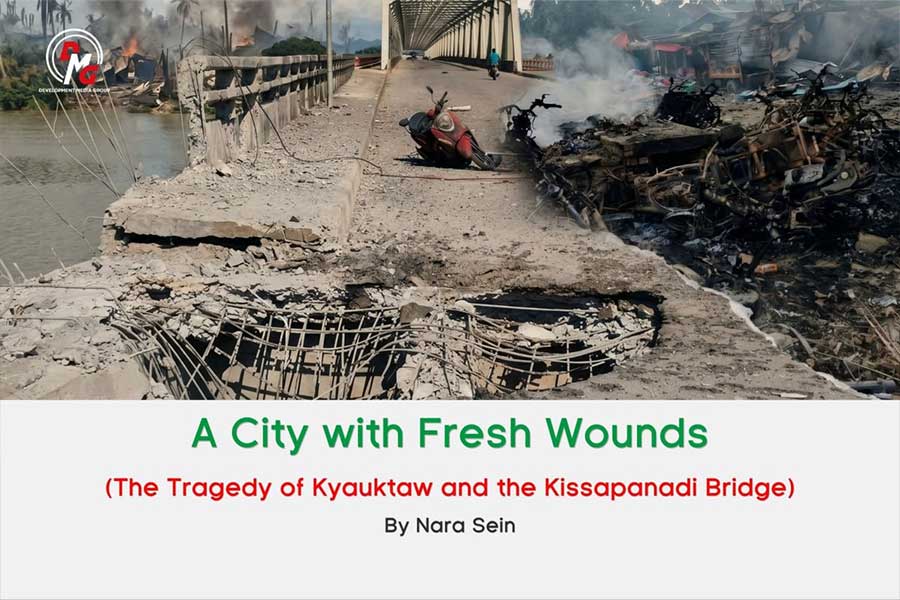
A City with Fresh Wounds (The Tragedy of Kyauktaw and the Kissapanadi Bridge)
Kyauktaw may be a small town, but its history and stature are immense. Among the towns situated along the banks of the Kissapanadi, or Kaladan River, two stand out: Sittwe at the river’s mouth and Kyauktaw upstream. Bordering Chin State, Kyauktaw is also a bustling centre of trade.
01 Oct 2026
By Nara Sein
Around this time last year, we experienced a similar tragedy. Local media reported that an airstrike on Pannya Pan Khin private school in Thayet Ta Pin village killed 23 children who were studying there and injured more than 20 others.
Then, on September 28 this year, bombs once again fell this time on a crowded market and the famous Kissapanadi Bridge. According to figures reported by the media, nearly 50 civilians lost their lives and nearly 60 others were injured. These were two of the deadliest incidents involving civilian casualties in the history of this small town.
Kyauktaw may be a small town, but its history and stature are immense. Among the towns situated along the banks of the Kissapanadi, or Kaladan River, two stand out: Sittwe at the river’s mouth and Kyauktaw upstream. Bordering Chin State, Kyauktaw is also a bustling centre of trade.
Directly opposite the town to the east stands the majestic Thaylagiri, or Morapabbata Mountain, an important landmark in Arakanese history. For generations, the people of the town have awakened in the mornings to the teachings of the Buddha. According to historical chronicles, King Sanda Thuriya made a solemn invocation from the summit of this mountain, inviting the Lord Buddha to visit. The Buddha is said to have journeyed there through the sky and rested upon the mountain.
According to Buddhist tradition, following the Buddha’s prophecy, a relic of his backbone was enshrined in a pagoda built atop the rocky Morapabbata Mountain. It is said that this gave rise to the name “Kyauktaw.”
Kyauktaw officially emerged as a town in 1910. In May 1941, it hosted the historic “Kyauktaw Conference,” formally a conference of the Arakan-wide ethnic association. Historical records remember the gathering simply as the “Kyauktaw Conference.”
The chronicles also identify this region with the beginnings of the Dhanyawadi era of Arakanese history, when King Marayu defeated and drove away hostile forces. The revered Mahamuni Buddha image is situated about five miles from the town. The surrounding plains bear the historical traces and boundaries of Dhanyawadi and are regarded as sacred ground where Arakanese civilisation took root and where the Buddha’s Dhamma flourished.
Kyauktaw is also a town carried in memory through the late singer Kaiser’s song, The Sound of the Kissapanadi Waves. It is a town that has carefully preserved its traditions and customs. And the great Kissapanadi Bridge passing along the edge of the town has long stood as one of Kyauktaw’s most recognisable symbols of modern architecture.
But today, it was on that very bridge that we saw the heartbreaking sight of innocent civilians lying dead after an airstrike.
On the blasted and damaged bridge, blood mingled with raindrops and flowed into the Kissapanadi River. In the burning market below, civilians had lost their lives in large numbers. At the cemetery shelter, bodies lay in a long row, some badly charred, others only partly burned.
Among all these horrifying scenes, perhaps the most heartbreaking was the fate of a heavily pregnant woman who had gone to the market and was burned to death.
How many times might she have gently stroked her belly as her unborn child kicked and moved inside her? How deeply must she have longed to see the face of the child whose sex she did not yet know? How eagerly must she have waited for the day her baby would enter this world?
But that child never had the chance to taste even a single drop of warm, sweet milk from its mother’s breast.
A baby passed from this world with its umbilical cord still attached. A mother, her young flesh burned, died alongside her unborn child.
What could this unarmed, innocent mother and child possibly have done to deserve such a fate in this war?
There were parents waiting for sons and daughters who had gone to the market. There were children waiting for their parents to return from the market with something for them to eat. There were families of porters, labourers, motorcycle-sidecar drivers and others struggling simply to make a living amid war and hunger. Their hearts must have been overwhelmed with fear and anxiety.
On social media, one woman desperately appealed for help finding her younger brother, who worked as a three-wheeler driver. Her plea was enough to leave anyone who read it with a heavy heart.
Equally devastating was the story of a married couple, both schoolteachers, who lost their lives on their 11th wedding anniversary. Imagine their two young children waiting at home, not yet knowing that both of their parents would never return.
There may be many more heartbreaking stories like these on the ground.
For the survivors, the fresh stains of blood in their hearts and wounds that may never fully heal will remain forever, half tears, half sorrow.
The deliberate targeting of innocent civilians, children and women is a blatant violation of international law and the fundamental rules and ethics of warfare. The disregard for human life and the brutality of such alleged war crimes raise an urgent question: how will the international community respond?
Recent accounts attributed to captured prisoners of war claimed that orders had been given to “kill all Arakanese people: children and women included.” If what they said is true, it is difficult not to think that such an order explains what we are witnessing. I find myself wondering what kind of human heart could carry out acts of such cruelty. As a human being, I cannot imagine doing such a thing.
No matter how much innocent civilians are oppressed and attacked, there is an old saying: “When has the Rakhine bamboo ever become extinct?”
As in the verses of the revered Manle Sayadaw’s Padamya Shwegu, let those who wish to bark at the moon continue barking, the moon will keep shining. Let them smear the golden shrine with mud and try to destroy it; the emerald-and-gold shrine will only shine more brightly than before.
So it is today.
The sacrifice of innocent Arakanese civilians will give rise to more Arakanese heroes. And the flag of Arakan will continue to fly in the wind.
The waters of the Kissapanadi will continue to flow, clear and eternal, through the heart of Arakan.
And Kyauktaw will remain on the riverbank like a great hero bearing countless wounds and scars.
Yet on the new pages of the town’s history, pages now written with drops of blood and fragments of bombs, the demand for justice for these crimes, and for those responsible to be held accountable, will remain a question that history continues to ask, generation after generation.

Opinion
A City with Fresh Wounds (The Tragedy of Kyauktaw and the Kissapanadi Bridge)
By Admin 01 Oct 2026

Arakan Army’s Gains and the Changing Geopolitics of Arakan
By Admin 29 Sep 2026

Beyond Military Victory: What Is Myanmar’s Ultimate Political Objective?
By Admin 26 Sep 2026
UN at a Crossroads: Six Priorities for a Shared Future
By Admin 23 Sep 2026
.jpg)
How Can Myanmar’s Political Crisis Be Brought to an End?
By Admin 13 Sep 2026
POLITICS

BUSINESS
Industry to manufacture finished goods from coconut starting in early 2020
By Aung Kaung Zaw 20 Nov 2019