
- Rice shortages put thousands of Kyaukphyu IDPs at risk of starvation
- Myanmar junta, Cambodia seek closer defence and security ties
- Fear grips Yangon as junta intensifies forced conscription, portering
- Residents face security risks along Ponnagyun-Rathedaung route amid ongoing fighting
- Arakan youth face growing crisis amid war and joblessness: CAS
How Can Myanmar’s Political Crisis Be Brought to an End?
The questions that deserve greater attention are: Why did we reach this point? How can we find a way out of this crisis? And, ultimately, what kind of country do we want to build when the crisis is over?
13 Sep 2026
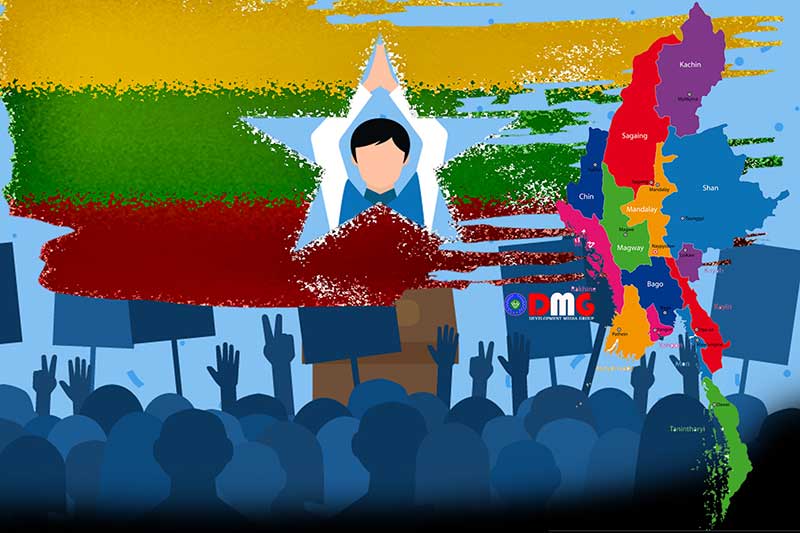
.jpg)
By Min Htee
Answering the question, “Where does Myanmar stand today?” is no longer straightforward. The country’s current situation cannot be explained simply as a political crisis, a military conflict or an economic crisis in isolation.
Myanmar’s crisis today has evolved into a complex web of interconnected political, military, social, economic, and ethnic and national questions.
For that reason, if an assessment of Myanmar’s current political situation focuses only on the questions of “Who will win?” and “Who will lose?”, I believe it will fail to capture the full nature of the problem.
The questions that deserve greater attention are: Why did we reach this point? How can we find a way out of this crisis? And, ultimately, what kind of country do we want to build when the crisis is over?
Re-examining the Roots of Myanmar’s Political Crisis
Myanmar’s present crisis did not emerge overnight. Since independence, the country has struggled with questions of political power-sharing, equality and self-governance for ethnic nationalities, the structure of the Union, trust between successive governments and ethnic forces, democracy, and competing concepts of security.
When these problems could not be resolved through political dialogue, negotiation and mutual trust, armed conflict increasingly came to be seen as an alternative means of addressing them.
The roots of this political conflict are also connected to Myanmar’s military leaders’ attempts to monopolize political power and their lack of political will to resolve longstanding political problems.
Therefore, when examining the roots of Myanmar’s crisis, rather than focusing solely on which organization, political party or individual should be blamed, we need to consider more deeply why these problems could not be resolved through political means.
Under the present circumstances, politics and warfare can no longer be viewed separately. Territorial control, security, governance and people’s daily lives have become directly intertwined with the military situation.
Today, ethnic armed organizations are controlling more territory and becoming stronger, while the Myanmar military has weakened and its capabilities have declined. These developments are changing the balance of political power in Myanmar.
Military victory, however, is not the same as resolving a political problem once and for all. What Myanmar genuinely needs is not simply a military winner or loser, but a political solution capable of addressing the underlying causes of the conflict.
This raises a question more important than “Who will govern?”: How will the country be governed?
When political power becomes concentrated in the hands of one side, other forces may become concerned about their political future and security. Such concerns create mistrust, and mistrust can generate conflict. Once conflict takes hold, escaping that cycle becomes increasingly difficult.
The questions we should therefore be asking are: How should power be shared? How should responsibilities be divided between the regions and the centre? How can equality for ethnic nationalities be guaranteed? And how can the political rights of citizens be protected?
In this context, democracy, federalism, equality, self-governance, power-sharing and the rule of law can no longer be treated as separate political slogans.
Myanmar has traditionally used administrative terms such as “states” and “regions,” but given today’s political circumstances, I prefer the broader term “areas.” This is because territories currently controlled by revolutionary forces have become part of a new geopolitical reality that must be taken into account when considering Myanmar’s political future.
These questions are directly connected to the fundamental issue of how a future Union should be built.
Peace Is More Than the Absence of War
Peace does not simply mean that the sound of weapons has fallen silent. Nevertheless, ending the war is the beginning of peace.
What happens after the fighting stops?
Trust that has been destroyed between communities will have to be rebuilt. A political culture in which disagreements can be resolved without resorting to arms will have to be established.
The education, healthcare and social lives of people displaced by war will have to be rebuilt. The economy will need to recover. Relationships damaged between different communities will also have to be restored.
Peace, therefore, should not be defined merely as the “absence of war.” We must think of peace more broadly as the ability to resolve conflicts through political means.
How Can Trust Be Rebuilt?
One of the deepest consequences of Myanmar’s crisis has been the destruction of trust.
Trust has weakened between political forces, among ethnic nationalities, between governments and citizens, and among different communities.
Such trust cannot be restored through a single statement or agreement. It must be demonstrated through actions. There must be accountability and transparency. There must be mutual respect. And rebuilding trust will take time.
Trust takes a long time to build but can be destroyed very quickly. Building trust must therefore become a central component of Myanmar’s political future.
We can no longer say, “We will think about nation-building after the war is over.” Questions are already waiting for us: What political system should be established after the conflict? How should the country be governed? What role should different areas play? How should citizens’ rights be guaranteed? And how should the economy be rebuilt?
We need to start thinking about these questions now.
Rebuilding a country requires more than reconstructing roads, bridges and buildings. At the same time, we must consider trust among people, the rule of law, good governance, strong and effective institutions, education, and the future of young people.
These will be at the heart of the task of nation-building.
What Lies at the End?
I believe Myanmar has reached a crossroads.
One path is to continue responding to conflict with conflict. That path may produce a winner, but it may also leave behind mistrust and resentment.
The other path is to confront the causes of conflict through political means and attempt to build an inclusive political system and a Union founded on equality and mutual trust.
That path will not be easy. It will take time. Compromises will be necessary. The pain of the past will have to be confronted, and the process will have to begin in an environment where the different sides deeply distrust one another.
But building the future of a country is not about choosing the easiest path. What matters is ensuring that today’s crisis is not simply passed on as tomorrow’s crisis.
Therefore, when we ask, “What lies at the end of Myanmar’s crisis?”, our answer should be clear.
At the end of war, there must be peace. From peace, we must continue working toward a political agreement.
At the end of that political process, there must be a political system capable of guaranteeing justice, equality and self-governance.
Whether the end of today’s crisis becomes the beginning of another crisis will ultimately depend on the future we envision today, and on the kind of country we are preparing to build.

Opinion
How Can Myanmar’s Political Crisis Be Brought to an End?
By Admin 13 Sep 2026
By Cutting Trees, We Are Killing Ourselves
By Admin 06 Sep 2026
A Modern August We Must Never Forget
By Admin 31 Aug 2026
Arakan’s Political Shifts and the Debate Over Rights and Governance
By Admin 27 Aug 2026
Securing Rights for Bangladesh's Indigenous Peoples is Indispensable
By Admin 09 Aug 2026
POLITICS
BUSINESS
Industry to manufacture finished goods from coconut starting in early 2020
By Aung Kaung Zaw 20 Nov 2019