

- Deadly junta airstrike leaves Kyauktaw daily-wage earners jobless
- India pushes to accelerate work on Kaladan road project in 2027 working season
- Junta launches fresh multi-aircraft bombardment of Kyauktaw mountain ranges
- Fierce combat erupts in Kyindwe, southern Chin State as resistance forces capture junta troops
- Malaysian firms linked to Myanmar military aviation supply chain: JFM
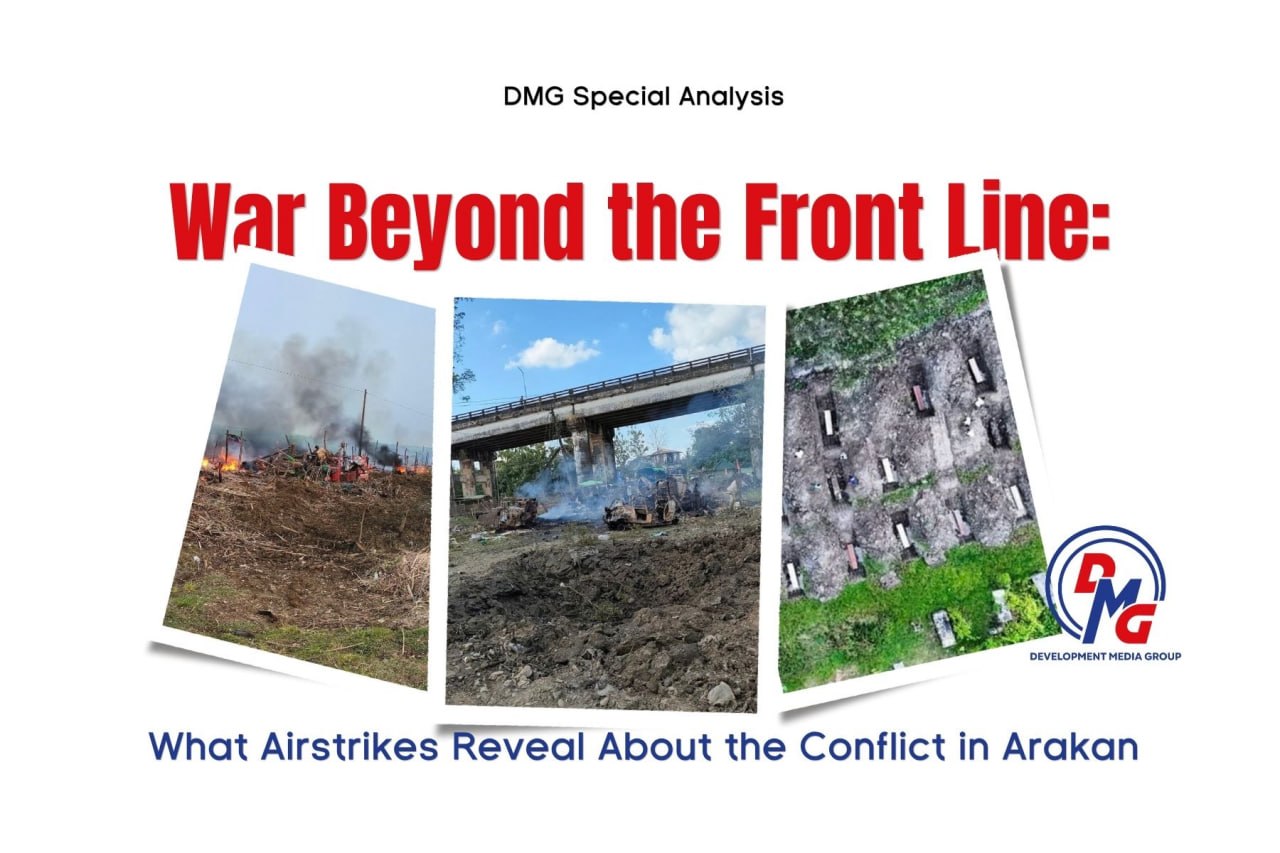
War Beyond the Front Line: What Airstrikes Reveal About the Conflict in Arakan
Territorial control has shifted dramatically across much of Arakan (Rakhine State). Yet for civilians, being far from an active front line no longer necessarily means being safe.
09 Oct 2026
DMG Special Analysis
Territorial control has shifted dramatically across much of Arakan (Rakhine State). Yet for civilians, being far from an active front line no longer necessarily means being safe.
From April 2024 through September 30, 2026, Myanmar military airstrikes in Arakan killed at least 667 civilians and injured 1,302 others, according to records compiled by Development Media Group (DMG). Altogether, at least 1,969 civilians were killed or injured during the period.
Among them, 133 children were killed and 194 injured, while 61 elderly people were killed and 121 injured.
DMG records casualties among prisoners of war (POWs) and detainees separately from civilian casualties. During the same period, 187 POWs and detainees were killed and at least 122 injured in airstrikes documented by DMG.
These figures, however, are not a definitive toll. Communications blackouts, insecurity, restrictions on movement and difficulties verifying some incidents mean that the actual number of casualties may be higher.
But the picture emerging from DMG's records extends well beyond the numbers.
As the Arakan Army (AA), the armed wing of the United League of Arakan (ULA), has expanded its territorial control and the Myanmar military has lost much of its ability to operate on the ground across large parts of Arakan, air power has remained one of the military's principal means of striking deep inside territory it no longer controls.
Hospitals, schools, markets, residential areas, monasteries, displacement sites and facilities holding prisoners of war have all been hit.
Among the incidents that most clearly illustrate the changing nature of the conflict are the attacks on Mrauk-U Hospital, schools at Thayat Tapin, the India Market area in Kyauktaw and facilities holding POWs in Ann Township and elsewhere.
Mrauk-U: When Even a Hospital Is No Longer Safe
On December 10, 2025, International Human Rights Day, a Myanmar military airstrike caused extensive destruction at Mrauk-U Hospital.
According to DMG's records, 33 civilians were killed and 77 others injured. The casualties included patients, caregivers and others who were at the hospital.
But the consequences did not end with the casualty toll.
The attack damaged an important healthcare facility relied upon by local communities and destroyed medical equipment and supplies.
For survivors, even a hospital no longer felt safe.
Writer Wai Hun Aung, who helped injured people following the attack, told DMG that some patients were too frightened to receive treatment inside buildings and would wake in fear at sudden noises.
His account points to consequences that cannot easily be captured in casualty statistics.
When patients become afraid to seek treatment inside a hospital, the effects of an airstrike extend far beyond the moment and location of the attack. Damage to a major hospital affects not only those directly caught in the strike but potentially an entire region's access to healthcare.
Thayat Tapin: War Reaches the Classroom
Hospitals have not been the only civilian spaces exposed to airstrikes. Places where children study have also been hit.
Shortly after 1 a.m. on September 12, 2025, an airstrike struck Pannya Pan Khin and Amyin Thit private high schools in Thayat Tapin village, Kyauktaw Township.
According to DMG's records, 20 students were killed and 21 others injured.
The significance of the Thayat Tapin attack extends beyond the immediate death and injury toll.
When schools and student accommodation are struck, the consequences affect not only children's physical safety but also their access to education and the confidence of parents and communities that schools can remain places of relative safety.
Following the attack, some schools in Arakan temporarily suspended classes, according to DMG reporting, demonstrating how the effects spread beyond the schools directly hit and disrupted the education of other children.
If the Mrauk-U Hospital attack exposed the vulnerability of healthcare, Thayat Tapin demonstrated another dimension of the conflict: the threat from the air had reached children's classrooms and their educational future.
Kyauktaw: Bombs Fall Into the Heart of Everyday Life
On September 28, 2026, the war again reached a place central to civilian daily life.
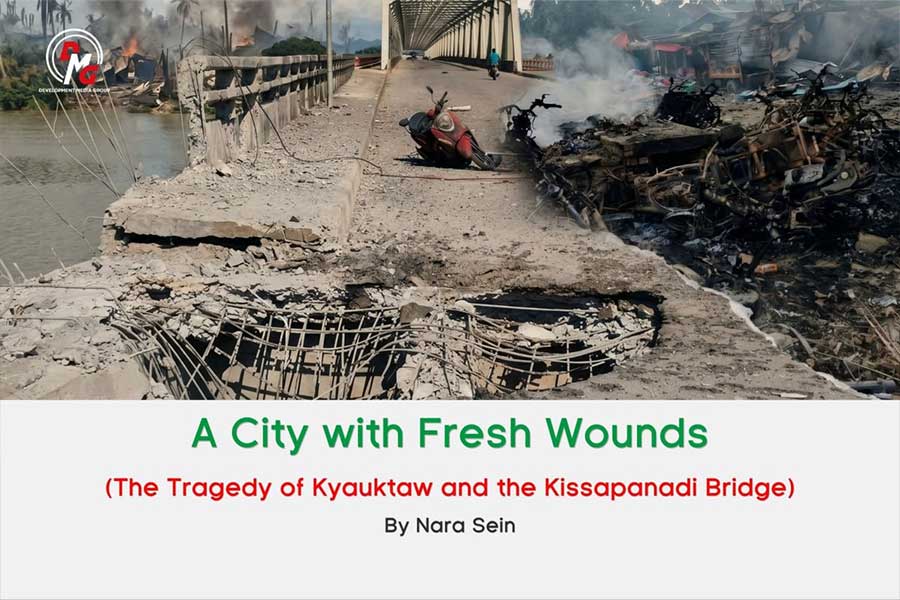
Around midday, a Myanmar military fighter jet bombed the area around India Market and the Kissapanadi Bridge in Kyauktaw, when the area was busy with vendors, shoppers, traders, transport workers and travellers.
According to DMG's latest records, 50 civilians were killed and 58 injured.
It was among the deadliest airstrikes documented by DMG in Arakan during the period covered by its casualty records.
Yet the significance of the attack lies not only in the number of casualties, but also in where it happened.
A market is more than a place where goods are bought and sold. In a region whose economy has already been severely disrupted by conflict, markets connect food supplies, transportation, household incomes and local commerce.
When a busy marketplace is bombed, the consequences extend beyond those killed or wounded.
Families lose breadwinners. Vendors lose businesses and capital. Vehicles and merchandise are destroyed. People may also become afraid to return to the very places on which they depend for their livelihoods.
The Kyauktaw attack illustrates a fundamental contradiction in the current conflict.
Kyauktaw is under ULA/AA control.
But control of the ground does not mean control of the sky.
A town may be far removed from active ground fighting and still remain within reach of military aircraft.
POWs: Removed From Combat, But Not From the Reach of Airstrikes
Airstrikes have not been confined to civilian locations.
Facilities holding captured Myanmar military personnel have also been hit.
On March 8, 2026, aircraft repeatedly struck a site holding prisoners of war in the Dalet Chaung area of Ann Township. According to DMG's records, 116 POWs and detainees were killed and 32 injured.
Many of those killed were captured members of the Myanmar military.
Nor was this an isolated incident.
In September 2024, an airstrike on a facility holding POWs and detainees at Shin Ywar in Pauktaw Township killed 17 people and injured 10.
Another airstrike on a detention facility at Border Guard Police Battalion No. 2 (BGP-2) in Maungdaw's Four-Mile area killed 50 POWs and detainees and injured 80.
Because prisoners of war and detainees have legal protections distinct from the civilian population under international humanitarian law, DMG records these casualties separately from civilian deaths and injuries.
But the incidents reveal another dimension of the air war:
Even people who were no longer directly participating in hostilities were not beyond the reach of airstrikes.
A Changing Map of Risk
Mrauk-U Hospital, the schools at Thayat Tapin, India Market in Kyauktaw and the POW facility in Ann are very different places.
Viewed together, however, they illustrate how the geography of risk in the Arakan conflict has changed.
A patient lying in a hospital bed, a child attending school, a vendor working in a market, a displaced family, an elderly person at home or a captured soldier in detention may be far from active ground combat. But that no longer necessarily places them beyond danger from the air.
The ULA/AA's expansion of territorial control has significantly transformed the military and administrative landscape of Arakan.
Yet the Myanmar military retains the ability to strike from the air even in territories where it has lost control on the ground.
For civilians, this creates a stark contradiction:
The front line may move farther away, but the war can remain close.
The Harm Casualty Figures Cannot Capture
DMG's documented figure of 1,969 civilian casualties measures people killed or physically injured.
It cannot fully capture the wider consequences of airstrikes.
A child who stops attending school because their parents fear another airstrike does not appear in a casualty count.
Neither does a patient too frightened to enter a hospital, a displaced family forced to flee again, a household that takes cover whenever aircraft are heard overhead, or a market vendor whose livelihood has been destroyed.
The consequences of airstrikes therefore cannot be measured solely by the number of people killed or injured.
They can also have lasting effects on healthcare, education, livelihoods, displacement, access to humanitarian assistance and the psychological well-being of communities.
Documentation Is Growing. But Where Is Protection?
Deadly airstrikes in Arakan have increasingly drawn international attention.
International organisations have repeatedly called for civilians and civilian infrastructure to be protected.
The September 2025 attack at Thayat Tapin drew international concern, and the Independent Investigative Mechanism for Myanmar (IIMM) sought information and evidence relating to the incident.
Following the September 2026 attack around India Market and the Kissapanadi Bridge in Kyauktaw, the IIMM also sought information from witnesses and others with direct knowledge of the attack.
Yet airstrikes have continued.
This exposes a troubling gap between documenting possible violations and preventing further civilian harm.
Casualties are being recorded. Evidence is being collected. Survivors are telling their stories. International bodies are seeking information and examining incidents.
But for people on the ground, the more immediate question is:
Can any of these processes make them safer before the next aircraft arrives?
What DMG's Records Tell Us
DMG's casualty records cannot capture every consequence of the air war in Arakan, nor do they claim to document every person killed or injured.
Communications blackouts, insecurity, travel restrictions and difficulties verifying information mean that some incidents remain incomplete or cannot yet be fully confirmed.
The figures should therefore be understood as minimum documented casualties, rather than a definitive total.
Even with those limitations, however, the pattern emerging from the records is clear.
Between April 2024 and September 30, 2026, DMG documented at least 667 civilians killed and 1,302 injured in Myanmar military airstrikes across Arakan.
Behind those figures are hospitals, schools, markets, homes, monasteries, displacement sites and other places central to civilian life.
For humanitarian organisations, the challenge is how to sustain healthcare, education, shelter and emergency assistance while communities remain exposed to aerial attack.
For researchers, the records raise questions about how air power is being used as territorial control on the ground changes.
For accountability mechanisms, each incident underscores the importance of preserving evidence and assessing the circumstances of individual attacks under international humanitarian law.
For the media, documenting deaths and injuries is essential — but so is recording the lives and communities disrupted behind those statistics.
For the people of Arakan, however, the question is simpler and more urgent.
The battlefield has changed.
The front lines have moved.
But safety has not necessarily moved with them.
As long as military aircraft retain the ability to strike places where civilians live, study, seek medical treatment and earn their livelihoods, the central question facing Arakan is no longer only:
“Who controls the ground?”
It is also:
“Who can protect the people beneath the sky?”
About the DMG Casualty Data
Development Media Group has documented at least 667 civilians killed and 1,302 injured in Myanmar military airstrikes in Arakan between April 2024 and September 30, 2026.
Among the documented civilian casualties, 133 children were killed and 194 injured, while 61 elderly people were killed and 121 injured.
Separately, DMG recorded 187 POWs and detainees killed and at least 122 injured in airstrikes during the period. These figures are not included in the civilian casualty total.
The figures represent casualties DMG has been able to document and verify and should not be considered a definitive accounting of all casualties caused by airstrikes in Arakan. Communications blackouts, restrictions on movement, insecurity and difficulties verifying incidents mean that the actual toll may be higher.

Opinion
A City with Fresh Wounds (The Tragedy of Kyauktaw and the Kissapanadi Bridge)
By Admin 01 Oct 2026

Arakan Army’s Gains and the Changing Geopolitics of Arakan
By Admin 29 Sep 2026

Beyond Military Victory: What Is Myanmar’s Ultimate Political Objective?
By Admin 26 Sep 2026
UN at a Crossroads: Six Priorities for a Shared Future
By Admin 23 Sep 2026
.jpg)
How Can Myanmar’s Political Crisis Be Brought to an End?
By Admin 13 Sep 2026
POLITICS

BUSINESS
Industry to manufacture finished goods from coconut starting in early 2020
By Aung Kaung Zaw 20 Nov 2019