
- Y-12 aircraft, drones circle over Sittwe as clashes intensify
- Panic grips Sittwe after deadly reported Y-12 airstrike
- At least six killed, 37 injured in reported Y-12 bombing of downtown Sittwe
- Junta column heading toward Kyindwe suffers heavy casualties in resistance ambushes
- Junta replaces Arakan State security minister amid escalating battles near Sittwe
Weekly Highlights from Arakan (August 24 to 30, 2026)
In an era when daily news from Arakan is often fragmented and fast-changing, DMG's Weekly Highlights of Arakan brings clarity, depth, and context to the stories that matter most.
31 Aug 2026
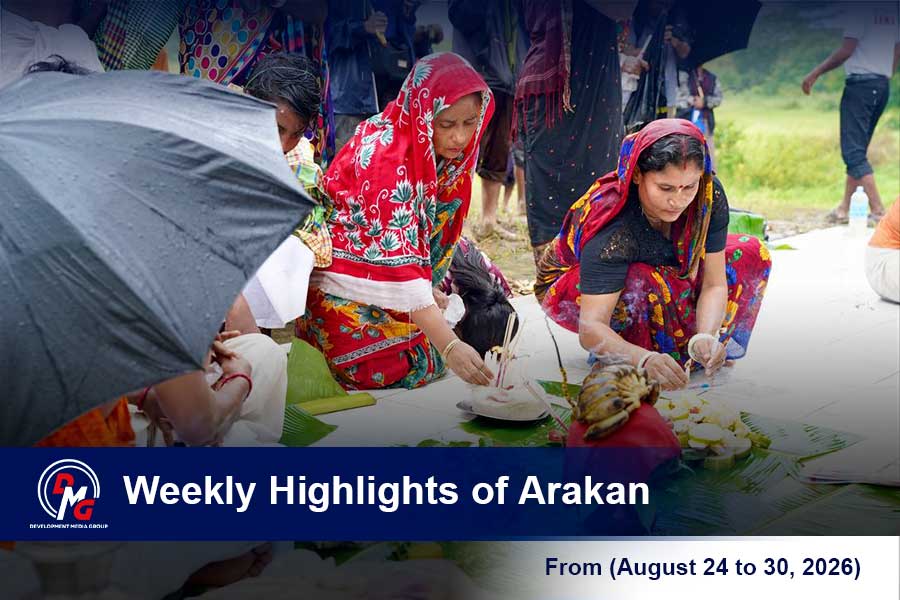
In an era when daily news from Arakan is often fragmented and fast-changing, DMG's Weekly Highlights of Arakan brings clarity, depth, and context to the stories that matter most.
Each week, we round up key political, military, social, and humanitarian developments across Arakan State - connecting the dots between events and offering analysis to help audiences see the bigger picture.
This series is designed for readers and viewers seeking a concise yet comprehensive understanding of how ongoing conflict, governance shifts, and community issues continue to shape lives across Arakan.
Junta threats compound daily survival challenges in Gwa Twsp
Residents in Gwa Township, the southernmost town in Arakan State, report that persistent threats from military junta airstrikes and naval activity are compounding daily survival challenges and worsening livelihood hardships.
The military junta is attempting to penetrate Gwa Township from Ayeyarwady Region, launching heavy airstrikes across the township alongside active naval deployments at sea.
Consequently, local residents say earning a living amid constant junta threats has become nearly impossible, forcing families to prioritize personal safety over their livelihoods and resulting in severe income losses.
Gwa and Thandwe townships are among the areas hardest hit by military junta air and naval strikes throughout July and August.
Gwa Township has limited arable farmland, with residents relying primarily on offshore fishing for their livelihoods and depending on Ayeyarwady Region for basic food supplies.
Due to military junta blockades imposed since 2024, trade from mainland Myanmar through Ayeyarwady Region has been severed, forcing residents to rely on trade routes connected to northern Arakan State townships.
However, trading with northern Arakan State involves long travel distances and high transportation costs, nearly doubling local commodity prices.
In Gwa Township, a bag of low-grade rice sells for K90,000, while one liter of cooking oil is priced at K15,000, one viss of onions at K14,000, one viss of garlic at K22,000, and one liter of fuel at up to K13,000.
Furthermore, humanitarian assistance reaching Gwa Township remains extremely limited, while local community relief efforts are unable to meet existing needs, exacerbating hardships for both displaced people and local residents.
As the military junta attempts to break through into Arakan State via Gwa Township from Ayeyarwady Region, relentless airstrikes continue to leave local populations without safety or security.
ULA to recruit second batch of medical students amid doctor shortage
The United League of Arakan (ULA) is preparing to recruit its second batch of medical students to address an ongoing shortage of qualified doctors in areas controlled by the Arakan Army.
The ULA Department of Public Health issued an announcement on August 24 inviting applications for the second batch of the Arakan Medical School.
Interested candidates can submit applications to their respective township health departments between September 9 and October 5.
Applicants must be under 25 years of age, reside in Arakan State, and have passed the old-system high school matriculation examination before 2024 with a biology combination. They must have scored at least 60 marks each in biology, chemistry and physics.
Candidates must also have a combined score of at least 200 in the three subjects and score at least 55 marks in English.
Students who passed the new-system Grade 12 examinations between 2021 and 2026 and meet equivalent criteria are also eligible to apply.
Candidates who passed Grade 12 examinations conducted by the Department of Education between 2021 and 2025 must have graduated with a biology combination, achieved at least a D grade in English, and obtained at least two C grades and one B grade in biology, chemistry and physics.
Selected applicants must complete a seven-year medical course and sign a commitment to serve as staff members under the ULA Department of Public Health after graduation.
The Department of Public Health has operated the medical school since late December 2025 and is now preparing to open its second batch.
In areas under its control, the Arakan Army has established administrative structures and departments and is operating as a revolutionary government.
Due to shortages of human resources and qualified doctors within the ULA healthcare sector, local residents continue to face challenges accessing healthcare services.
Thandwe locals flee homes again amid intense junta airstrikes
The military junta has been launching intense airstrikes across Thandwe Township, Arakan State, increasing civilian casualties and causing growing damage to homes and infrastructure.
With residents no longer feeling safe, many are unable to remain in their communities and have fled to safer areas.
Residents of Thandwe Town and the Ngapali beach area, where the junta has concentrated its airstrikes, are taking refuge in Taungup and Ramree townships.
Displaced residents fleeing Thandwe Township face severe hardships while staying temporarily with relatives or in makeshift shelters near forested areas.
The military junta has been carrying out airstrikes in Thandwe Township since last July, deploying aircraft formations and dropping hundreds of bombs.
On August 21, the junta launched a one-hour bombing campaign targeting at least three locations in Thandwe Township using 10 aircraft, including jet fighters, Y-12 and Y-8 aircraft, dropping around 100 bombs, according to the Arakan Army.
The attack left one civilian dead, 14 injured, and damaged multiple homes and buildings.
Amid continuous airstrikes, Thandwe residents report severe economic disruption and worsening livelihood conditions.
Memorial service held in Maungdaw for victims of Hindu mass killings
A ceremony commemorating the ninth anniversary of the Hindu community members killed by the Arakan Rohingya Salvation Army (ARSA) in Khamoungseik and Yebawkya villages, Maungdaw Township, Arakan State, was held on August 25.
During the event, family members gathered at a stone monument inscribed with the names of the victims to offer prayers.
On August 25, 2017, members of the Hindu community in Maungdaw Township were targeted and killed by ARSA, leaving 113 Hindus dead, including men, women and children.
Days after the violence, human remains were uncovered in four mass graves, while some families have still not recovered the bodies of their loved ones.
During the 2017 conflict in the Maungdaw region, alongside violence committed against Muslims in Buthidaung and Maungdaw by the Myanmar military, local Hindu residents suffered atrocities at the hands of ARSA.
The massacre of Hindus has received significantly less attention from the international community and human rights organizations compared to the violence against Muslims.
Observing the intense focus placed on Muslims in discussions surrounding the conflict in Arakan State, members of the Hindu community have questioned the standards applied by international bodies and rights groups.
The memorial service for the victims of the Hindu mass killings in Maungdaw has been held annually and reached its ninth year on August 25.
The Arakan Army stated that it will step up security measures in the region to prevent any potential ARSA activities in Maungdaw Township.
To protect against threats from Muslim armed groups in Maungdaw Township, the Arakan Army has imposed a curfew and maintained continuous day-and-night security patrols.
Caption: Scenes from the memorial service held on Tuesday for the victims of the Hindu mass killings. Photo: One Nation News
ULA warns public of possible chemical weapon hazards after suspicious bombing
The Health Department under the United League of Arakan (ULA) has warned the public to exercise caution over suspected chemical weapon hazards following recent military junta bombing incidents in Arakan State.
Following a recent bombing in Rathedaung Township, cattle released into nearby pastures began dying one after another without any identifiable cause.
The ULA Health Department said it considers the incident suspicious and is conducting a thorough investigation.
Chemical weapons pose serious health risks and can be deployed in gas, liquid or powder form through artillery shells, missiles, aerial bombs and drone-dropped munitions.
The ULA Health Department warned that chemical toxins can enter the human body through the respiratory tract, lungs, skin, eyes or internal organs, causing poisoning and damage to the skin, eyes, lungs, heart, brain and nervous system.
The department therefore urged the public to remain vigilant about potential chemical weapon hazards.
It also advised residents not to consume fruits or other food items collected near airstrike sites and to prevent livestock from grazing in those areas.
Displaced children, pregnant mothers face malnutrition in Arakan State
Internally displaced children and pregnant mothers in Arakan State are suffering from malnutrition due to severe livelihood hardships, with some experiencing deteriorating health conditions, according to local sources.
Displaced residents face daunting daily survival challenges due to a scarcity of job opportunities, soaring commodity prices, and limited aid supplies.
As a result, displaced children and pregnant women lack access to adequate food, resulting in widespread malnutrition.
Facing extreme financial hardship, families are forced to survive on whatever food is available, leaving young children vulnerable to nutritional deficiencies, according to displaced residents.
Many displaced children are deprived of meat and fish with their rice, as well as nutritious snacks, leaving them vulnerable to nutritional deficiencies.
Humanitarian workers report that displaced children from Thandwe Township are similarly suffering from malnutrition, with some showing signs of deteriorating health.
Displaced residents from Thandwe Township said that while they receive basic rations of rice, oil, and salt, the supplies are insufficient, leaving them in constant distress over their daily needs.
Consequently, displaced people are calling for urgent relief aid to ensure that young children and pregnant mothers in IDP camps receive adequate nutrition.
The ongoing armed conflict in Arakan State has displaced more than 500,000 people, the majority of whom are women and children.
According to figures published by the World Food Programme (WFP), more than 4 million people are displaced across Myanmar, with nearly 400,000 children facing malnutrition.

Opinion
Can the UN Restore Trust in a Fractured World?
By Admin 23 Oct 2026
Arakan Amid the Storm: From Survival to Rebuilding a People
By Admin 22 Oct 2026
Surviving Amid the Bombs: Arakan's Quiet Resistance
By Admin 19 Oct 2026

Shadows Over Childhood: Confronting the Reality of Missing Children
By Admin 16 Oct 2026
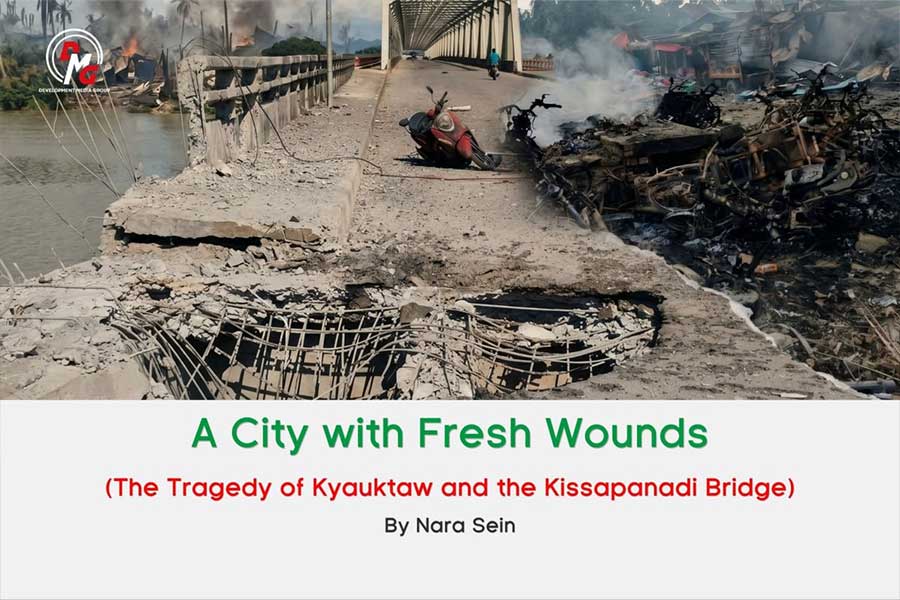
A City with Fresh Wounds (The Tragedy of Kyauktaw and the Kissapanadi Bridge)
By Admin 01 Oct 2026
Arakan Army’s Gains and the Changing Geopolitics of Arakan
By Admin 29 Sep 2026
POLITICS

BUSINESS
Industry to manufacture finished goods from coconut starting in early 2020
By Aung Kaung Zaw 20 Nov 2019