
- Victims dissatisfied after suspect released in Maungdaw rape and corpse concealment case
- Ammunition shortages drive loss of resistance-held towns
- Growing criticism among Arakanese over AA detentions of traders and youth
- Junta builds military camp in Saw village, threatening trade routes to Chin and Arakan states
- Weekly Highlights from Arakan (April 20 to 26, 2026)
Ammunition shortages drive loss of resistance-held towns
The Myanmar military is intensifying counteroffensives to reclaim territories captured by revolutionary forces across the country, using large troop deployments, heavy weaponry, and increased aerial support.
28 Apr 2026
DMG Newsroom
28 April 2026, Mrauk-U
The Myanmar military is intensifying counteroffensives to reclaim territories captured by revolutionary forces across the country, using large troop deployments, heavy weaponry, and increased aerial support.
By launching offensives with superior ground forces and firepower, the military has regained control of several previously lost areas.
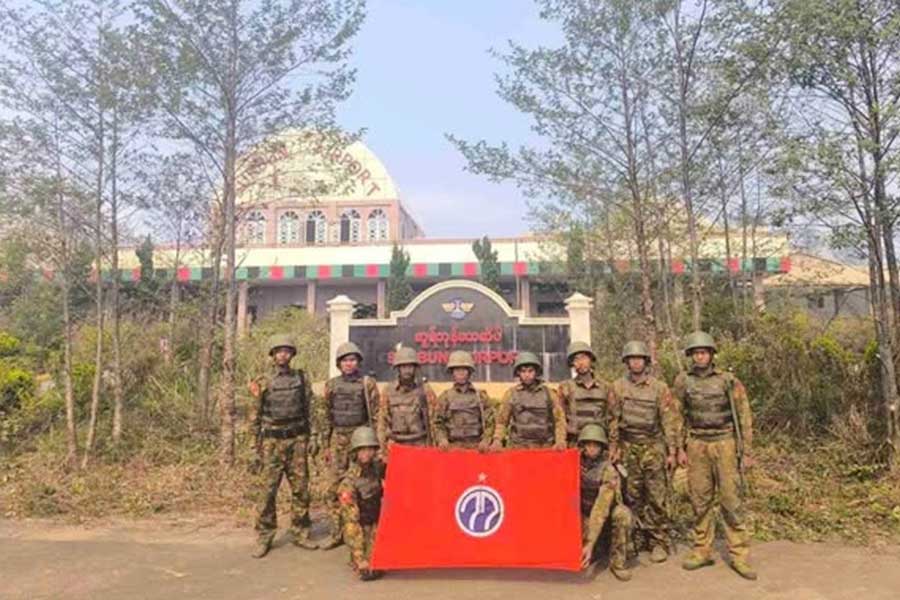
Between March and April, the military retook three townships across Mandalay Region, Sagaing Region, and Arakan State. Over the course of 2025 and early 2026, it also reclaimed at least 10 townships in northern Shan State, Mandalay Region, and Sagaing Region.
Military observers say the main reason revolutionary forces are losing control of towns is a shortage of ammunition.
"The regime is able to use overwhelming aerial support and firepower. Because revolutionary forces lack sufficient ammunition to withstand these attacks, they are forced to retreat as the military advances. I believe this is mainly due to ammunition shortages," said Captain Zin Yaw, a participant in the Civil Disobedience Movement.
After nearly seven months of fighting, the military regained control of Falam on April 25. Similarly, on March 26, it retook Htigyaing Township in Sagaing Region and is now advancing toward Katha Township.
Chin political analyst Ko Salai Bawi Lian said Falam's strategic location makes its loss a concern for northern Arakan State.
"Although the Chin Brotherhood captured Falam, they did not control the entire township. Some local groups supported the Chin National Army, so control was divided. When the main offensive targeted the Chin National Army base, the Chin Brotherhood could not provide immediate reinforcement. The regime's recapture of Falam could raise concerns for northern Arakan State," he said.
He added that a lack of unity among Chin revolutionary forces contributed to the loss, calling it a major setback for the Chin resistance.
Military sources said that although the Chin Brotherhood and the Chinland Council worked together to defend Falam, they were ultimately unable to withstand the military's superior strength and heavy use of air support.
Observers also believe the military has benefited from external and internal factors, including increased manpower and geopolitical developments.
"The regime already had strong firepower. After the fall of Lashio, pressure from China on ethnic armed groups in northern Shan State to halt offensives, along with increased manpower from conscription, has strengthened the military's operations," said an Arakanese youth and military analyst.
Following coordinated offensives by revolutionary forces under Operation 1027, the military lost large areas of territory in a short time and faced mounting pressure.
However, after a China-brokered ceasefire with the Myanmar National Democratic Alliance Army and the Ta'ang National Liberation Army in northern Shan State, the military has regained momentum. It is now intensifying efforts to retake territory using expanded manpower and firepower.
Recent offensives have focused on Arakan State, the Magway-Bago border, and Ayeyarwady Region, as the military seeks to regain control of key areas.

Top News
Ammunition shortages drive loss of resistance-held towns
By Admin 28 Apr 2026
Growing criticism among Arakanese over AA detentions of traders and youth
By Admin 27 Apr 2026
Regime escalates airstrikes in Arakan State despite peace invitation
By Admin 25 Apr 2026