
- Military operations spread despite decline in clashes, BNI report finds
- Junta aerial attacks force school closures across three Arakan townships
- Family demands swift arrest of statutory rape suspect in Werathani
- Women face shrinking employment opportunities in Myanmar, UNDP reports
- AA seizes five junta outposts as Arakan records most civilian-targeted airstrikes: NLTA
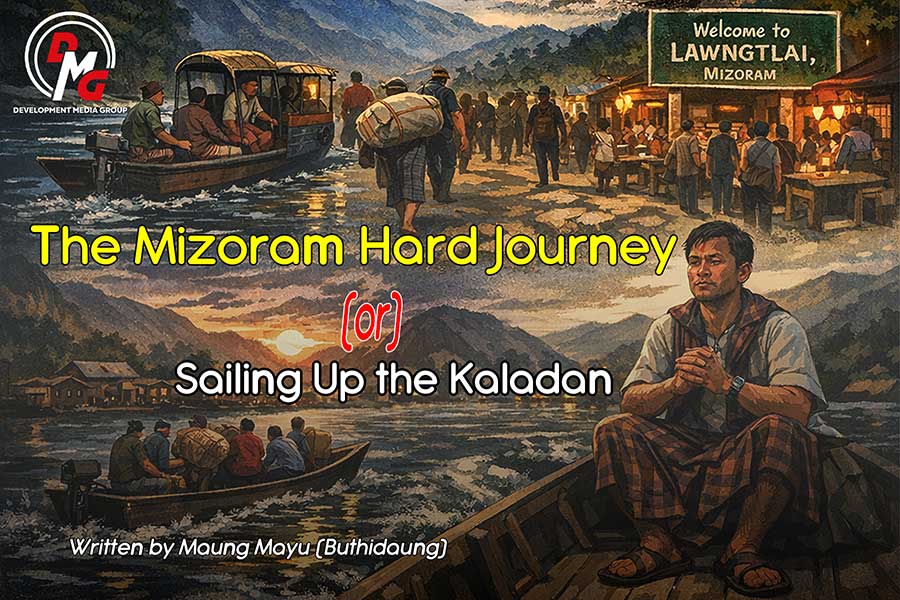
The Mizoram Hard Journey (or) Sailing Up the Kaladan
As unemployment and high prices converged, their savings gradually disappeared. Having spent nearly a decade as a schoolteacher and lacking other skills, U Mya Than worried deeply about his future.
14 Feb 2026
Written by Maung Mayu (Buthidaung)
Near the stairway entrance of the Moonlight Guesthouse, a man lay collapsed on the ground. Passersby from the Mizo community had gathered around him, speaking among themselves in different voices. Seeing the crowd, we became alarmed. The Moonlight Guesthouse was also where we were staying. At that guesthouse, only traders from Arakan were lodging. Naturally, we feared that something terrible had happened to one of the Arakanese traders.
When we drew closer, it was indeed an Arakanese trader lying unconscious. His face was not clearly visible, but the longyi he was wearing made it obvious that he was Arakanese. A small amount of blood was visible along the bridge of his nose, and his forehead was flushed red.
As he was unconscious, the guesthouse owner and several Arakanese traders hired a three-wheeled vehicle and rushed him to a clinic. On the way back from the clinic, he regained consciousness. We learned that due to exhaustion from travel, lack of sleep, and inadequate food intake, his blood pressure had dropped, causing him to collapse while climbing the stairs.
This incident involved U Mya Than, a schoolteacher who had traveled to India’s Mizoram State to buy goods. Although most Arakanese traders experience incidents like this from time to time, they continue making such journeys simply to survive.
Those who know him, friends and acquaintances alike call him “the schoolteacher.” He was once a government middle-school teacher and is the father of two young children. His wife also works in the education sector. Together, their combined salaries were never abundant, but they were enough to support a family.
However, after the military council seized state power, prices rose sharply across the country, making daily survival increasingly difficult for ordinary people. Those living in remote western border areas like Arakan, where transportation is already difficult, suffered even more. As rising prices outpaced salaries, the civil war intensified.
With the launch of Operation 1027 by the Three Brotherhood Alliance, the war in Arakan began on November 13, 2023. In 2024, battles to seize towns spread widely, and the military regime lost control of most townships in Arakan. As a result, the regime blocked major trade routes into Arakan, leading to severe shortages of basic food items and medicines.
From that point onward, government employees in Arakan people like U Mya Than were effectively dismissed overnight and left without salaries. Not only were they unpaid, but due to the fighting, they were forced to temporarily abandon their towns. For years, they lived as displaced people in places far from the sounds of war. As unemployment and high prices converged, their savings gradually disappeared. Having spent nearly a decade as a schoolteacher and lacking other skills, U Mya Than worried deeply about his future.
On the other hand, farsighted Arakanese revolutionary leaders, who understood that prolonged war would lead to famine, successfully secured key border trade routes. As a result, from mid-2024, the Arakan Army was able to initiate India-Arakan trade, followed by Arakan-Bangladesh trade later that year.
However, Arakan-Bangladesh trade has faced numerous difficulties. From early July 2025, Bangladeshi authorities tightened security at trade gates, seized goods imported from Arakan, and blocked exports bound for Arakan. At times, trade came to a complete halt. Ambush attacks by the Arakan Rohingya Salvation Army (ARSA) also negatively affected these trade routes.
Consequently, the India route became Arakan’s primary trade lifeline. Yet due to long distances and poor transportation, rising prices could not be contained. It is widely believed that if standard rates could be set for carrier trucks and small transport boats, the market would stabilize better. Nevertheless, this new route allowed the people of Arakan to breathe again. Employment opportunities also began to emerge.
At present, the Arakan People’s Revolutionary Government has managed to carry out some level of reconstruction within Arakan. However, weaknesses remain, and many dismissed civil servants, people like U Mya Than are still unable to participate in rebuilding efforts. Former teachers are now working as snack sellers, fish vendors, or taking on any odd jobs they can find to feed their families. Because the Arakan People’s Revolutionary Government is not yet able to provide adequate salaries, U Mya Than has remained separated from his teaching profession and has instead embarked on the grueling Mizoram journey as a trader.
To reach Mizoram, Arakanese traders must struggle upstream along the Kaladan River in both large and small motorized boats. Since traveling at night is impossible, they must sleep midway through the journey, spending one night and one full day on the river. Navigating shallow waters requires skillful maneuvering to avoid rocks and boulders, making the journey truly arduous. Only after passing through Chin State and reaching the Indian border road can they finally breathe a little easier. From there, they must endure another ten hours by car to reach the small Indian border town of Lawngtlai.
Mizoram is one of India’s lowest-producing states. Yet even in a small border town like Lawngtlai, electricity and water are available everywhere, at all times. Power reaches even remote hill villages, and 4G internet services are accessible. Smooth roads stretch across the state, high-rise buildings are numerous, and nearly every household owns one or two Indian-made Suzuki vehicles. Living standards are visibly high. Seeing this, U Mya Than could not help but admire the foresight and generosity of India’s central government, and the goodwill it shows toward its people.
Before reaching this stage, the Mizo people once took up arms against the Indian central government. Their movement was not large-scale about 2,000 fighters struggling for ethnic rights.
In the 1970s, after losing arms support from East Pakistan, their strength declined. Rather than annihilating them, the Indian government prioritizing unity over fragmentation signed a peace agreement with the Mizo rebels in 1986 and addressed their demands. Since then, the Mizo people have enjoyed full self-administration and have been able to pursue their development freely.
If it were the Myanmar government, there is no doubt the Mizo rebels would have been annihilated once their strength declined, cut down without leaving even the roots behind. Is this not proven today by how ethnic armed groups are being treated? The refusal to even hear the words “self-administration,” and the bombing and repression of ethnic civilians by every possible means, these are acts of shame. The lack of generosity, refusal to negotiate, and deliberate blindness to reality while killing civilians define the cruelty of the Myanmar state.
On the Kaladan River plain, small cargo boats move steadily upstream and downstream. Watching them, U Mya Than’s thoughts wander. Yet he is not thinking about the repulsive Myanmar government, nor about the Arakan People’s Revolutionary Government that stands with its people. He is thinking only of one thing: ensuring that the goods he has painstakingly gathered over a week of mental and physical exhaustion will reach where they are needed safely.
It is said that the downstream journey, the return trip is even more dangerous than going upstream. Small cargo boats without proper gear often lose control in fast currents and capsize.
There are countless stories of travelers whose lives were ruined when boats overturned, or who lost their capital when the goods they struggled to bring back failed to fetch good prices.
And so, U Mya Than sits at the bow of the boat, murmuring something continuously under his breath. Small boats drift steadily along the Kaladan River. Engine sounds echo across the water. This is the Mizoram journey of U Mya Than, a schoolteacher scarred by war.
Acknowledgement: Some references were drawn from articles on Mizoram written by Sayar Maung Hnun Khaing (Ponnagyun).

Opinion
Shadows Over Childhood: Confronting the Reality of Missing Children
By Admin 16 Oct 2026
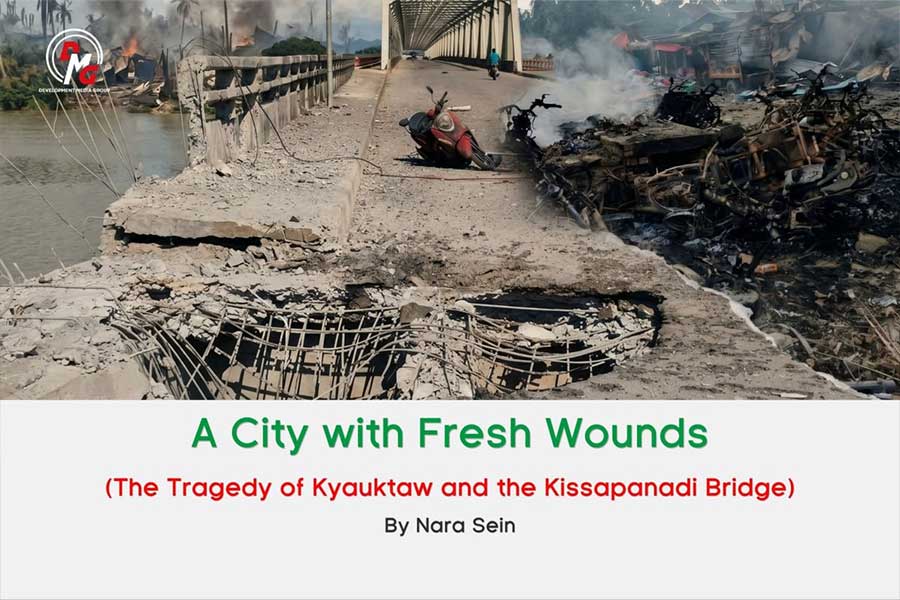
A City with Fresh Wounds (The Tragedy of Kyauktaw and the Kissapanadi Bridge)
By Admin 01 Oct 2026
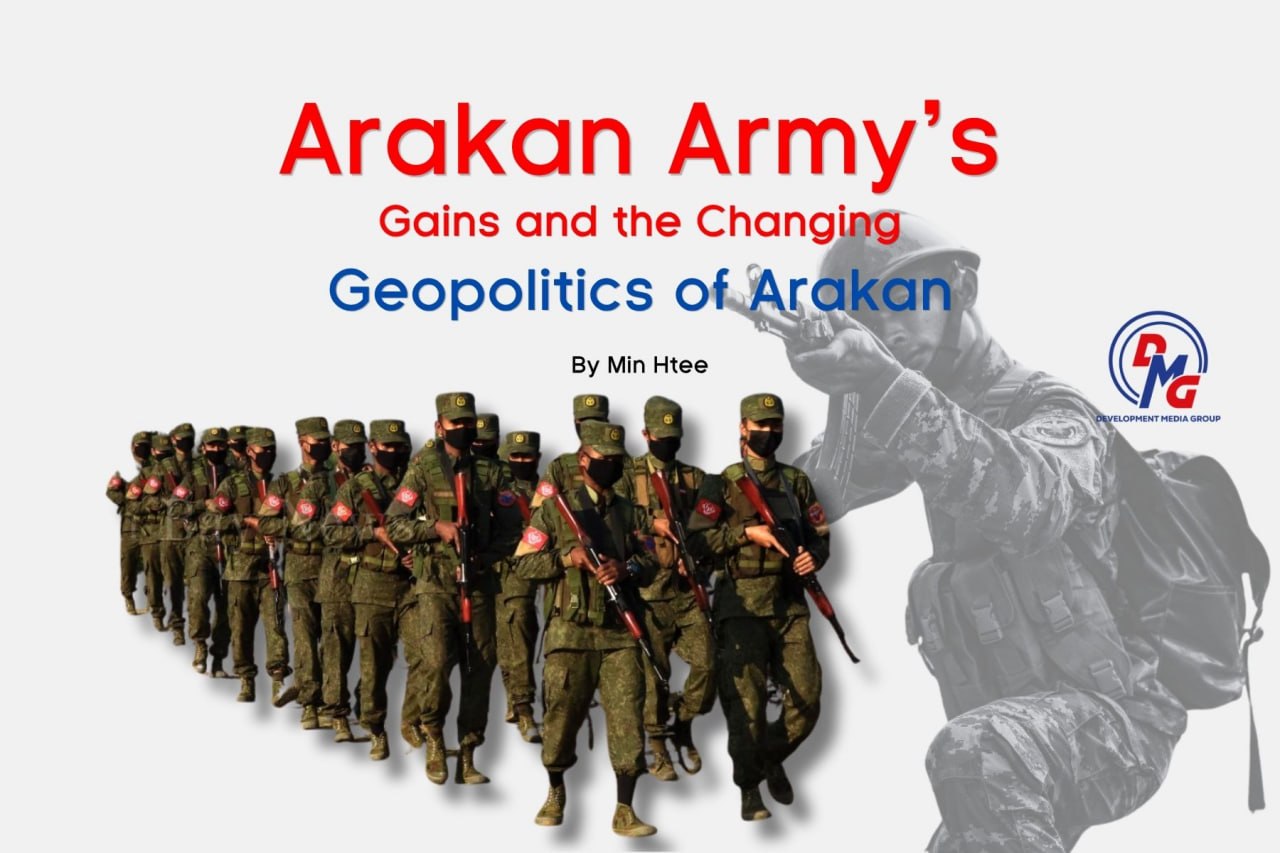
Arakan Army’s Gains and the Changing Geopolitics of Arakan
By Admin 29 Sep 2026
Beyond Military Victory: What Is Myanmar’s Ultimate Political Objective?
By Admin 26 Sep 2026

UN at a Crossroads: Six Priorities for a Shared Future
By Admin 23 Sep 2026
POLITICS


BUSINESS
Industry to manufacture finished goods from coconut starting in early 2020
By Aung Kaung Zaw 20 Nov 2019