

- Malaria cases surge across Ann Twsp as residents struggle to access healthcare
- Arakan’s elderly face deepening crisis amid war: CAS study
- ULA detains Arakanese merchants over Khaikhy dispute, moves to resolve issue
- Arakan Army captures four junta outposts on Sittwe-Ponnagyun front
- Magway records most airstrikes since new military chief took command: ISP-Myanmar
Myanmar among nations with worst press freedom, says IPCM
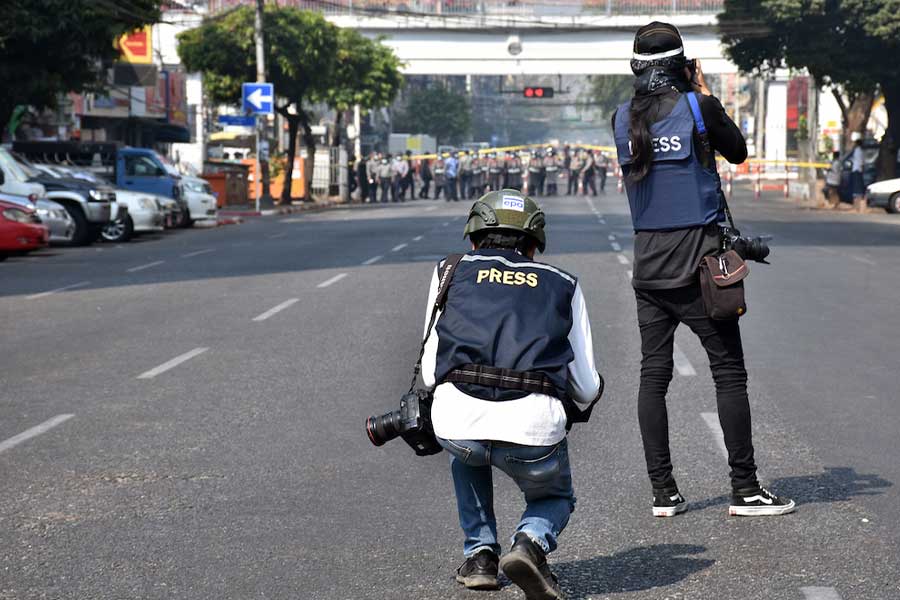
The Independent Press Council Myanmar (IPCM) has reported that press freedom in Myanmar is rapidly declining, with journalists facing multiple restrictions and oppression in their efforts to gather information.
05 May 2026
DMG Newsroom
5 May 2026, Yangon
The Independent Press Council Myanmar (IPCM) has reported that press freedom in Myanmar is rapidly declining, with journalists facing multiple restrictions and oppression in their efforts to gather information.
The IPCM released the statement on May 3 to mark World Press Freedom Day. Meanwhile, Reporters Without Borders (RSF) published its World Press Freedom Index, ranking Myanmar 166th out of 180 countries and placing it in the "red zone" for extremely poor press freedom conditions.
Since the military coup, press freedom in Myanmar has continued to deteriorate, with journalists facing long prison sentences and media outlets having their licences revoked.
On April 24, the regime announced the revocation of licences for Chin World, Khonumthung News, and Nowadays News. Similarly, the licence of Shwe Phee Myay News Agency was revoked in January 2026.
According to the IPCM, the regime has targeted media professionals between February 2021 and May 2026 using various legal provisions. These include Section 505(a) and Section 505(b) of the Penal Code, Section 124(a) of the Penal Code, Section 17(1) of the Unlawful Associations Act, Section (d) of the Telecommunications Act, the Immigration Act, Section 5 of the Explosive Substances Act, Section 27 of the Natural Disaster Management Law, and the Counter-Terrorism Law.
“A society without press freedom is like walking in the dark. If the truth is hidden, justice can never prevail. Journalists face oppression and the constant risk of arrest. Some have already been detained and sentenced to prison. In this situation, beyond the lack of security, there is a great deal of fear and anxiety when reporting from dangerous areas,” said Ma Khin Thara Phi Oo, a senior reporter from Than Lwin Khet News.
The IPCM stated that from the time of the coup until May 2026, more than 200 media professionals have been unjustly arrested, with 18 still detained under various charges.
The council expressed opposition to the regime’s revocation of media licences and called for the immediate release of all unjustly detained journalists, as well as an end to the targeting of media outlets.
A reporter named Justino said: “Since the military coup, journalists like us have been working in constant fear. The worst part is that when gathering news on the ground, we do not dare to openly identify ourselves as reporters. We have to work discreetly. While some are being arrested, others have had to flee and work in hiding due to the crackdowns.”
The IPCM emphasized that despite ongoing pressure, independent media will continue to stand with the public and provide accurate and timely information in line with media ethics.
The council also noted that although the regime attempts to present itself as a civilian government on a democratic path, there has been no easing of media repression.
Currently, 18 media professionals remain imprisoned, including three women. Among them, 13 are serving long-term sentences, including life imprisonment and 20-year terms.
Journalists said that press freedom and freedom of expression are essential not only for the media sector but also for the future of a federal democratic system.
The IPCM called on relevant organizations to ensure that media professionals can work freely and safely, and condemned the arrest, imprisonment, torture, and killing of journalists, demanding accountability for these violations.

Top News
Malaria cases surge across Ann Twsp as residents struggle to access healthcare
By Admin 19 Sep 2026
Arakan’s elderly face deepening crisis amid war: CAS study
By Admin 19 Sep 2026
ULA detains Arakanese merchants over Khaikhy dispute, moves to resolve issue
By Admin 18 Sep 2026
Arakan Army captures four junta outposts on Sittwe-Ponnagyun front
By Admin 18 Sep 2026
Magway records most airstrikes since new military chief took command: ISP-Myanmar
By Admin 17 Sep 2026

.jpg)