

- UN High Commissioner, UK condemn Kyauktaw airstrike killing at least 50 civilians
- ULA/AA faces governance challenges as it consolidates control in Arakan: ISP-Myanmar
- Death toll from Kyauktaw airstrike rises to 50
- Myanmar military carried out at least 222 airstrikes in Arakan over five months: ISP-Myanmar
- Junta airstrikes on four Arakan townships leave more than 100 civilian casualties
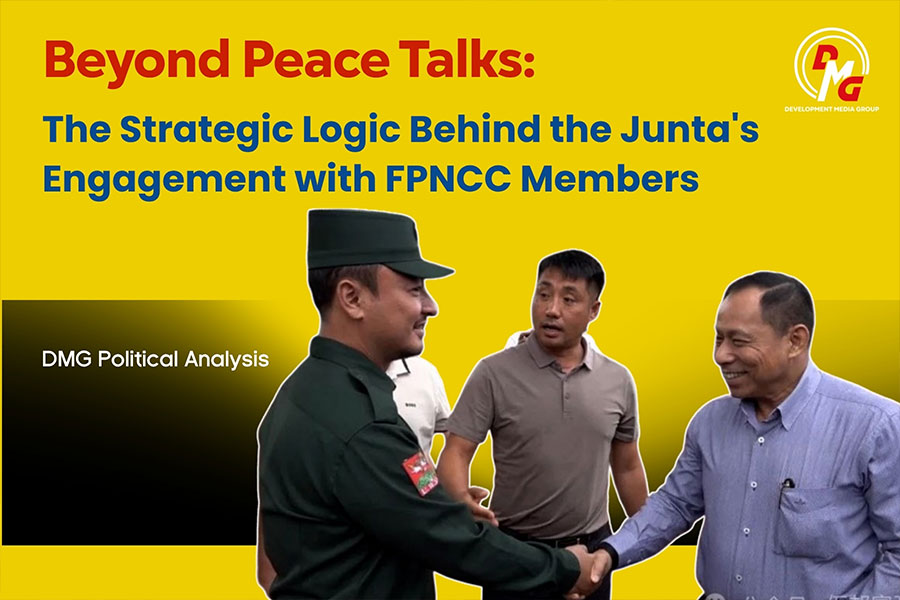
Beyond Peace Talks: The Strategic Logic Behind the Junta's Engagement with FPNCC Members
Rather than signaling a genuine breakthrough in Myanmar's peace process, the junta's engagement with FPNCC members appears aimed at reducing military pressure on multiple fronts and creating strategic space for a long and difficult conflict that shows little sign of ending.
01 Jul 2026
DMG Political Analysis
The Myanmar military regime's recent meetings with several members of the Federal Political Negotiation and Consultative Committee (FPNCC) are being presented as part of a renewed effort to promote peace and stability. Throughout June, the junta's National Solidarity and Peacemaking Negotiation Committee (NSPNC), led by Lt-Gen Yar Pyae, held talks with the United Wa State Army (UWSA), National Democratic Alliance Army (NDAA-Mong La), and Shan State Progress Party (SSPP).
Official statements emphasized trust-building, regional stability, and peace. Yet behind this diplomatic language lies a broader strategic calculation shaped by battlefield realities, regional geopolitics, and the military regime's increasingly constrained position.
Rather than signaling a genuine breakthrough in Myanmar's peace process, the junta's engagement with FPNCC members appears aimed at reducing military pressure on multiple fronts and creating strategic space for a long and difficult conflict that shows little sign of ending.
A Search for Strategic Breathing Space
Since Operation 1027 transformed the military landscape in northern Shan State, Myanmar's armed forces have suffered some of their most significant territorial losses since the 2021 coup.
The Myanmar National Democratic Alliance Army (MNDAA) consolidated control of the Kokang region, while the Ta'ang National Liberation Army (TNLA) expanded its influence across northern Shan State. The Kachin Independence Army (KIA) intensified operations in Kachin State, while resistance forces continue to challenge military control in Sagaing, Magway, Chin, Karenni, and Karen areas.
The military now faces simultaneous conflicts across multiple regions. Under these circumstances, reducing pressure in one theater becomes a strategic necessity in another.
The junta's outreach to the UWSA, NDAA, and SSPP should therefore be viewed less as a peace initiative and more as an effort to stabilize parts of northern and eastern Myanmar so that military resources can be concentrated elsewhere.
As military defector Captain Zin Yaw observed, the regime appears to be focusing on organizations that have maintained ceasefires or limited engagement with junta forces while avoiding direct negotiations with groups actively engaged in major offensives.
This suggests an effort to create strategic breathing space rather than achieve comprehensive conflict resolution.
Why the FPNCC Matters
The significance of these meetings lies not only in the individual organizations involved but also in their membership within the FPNCC.
The alliance includes some of Myanmar's most influential ethnic armed organizations, including the UWSA, KIA, MNDAA, TNLA, SSPP, NDAA, and the Arakan Army (AA). Together, these groups represent substantial military, political, and territorial influence across large parts of Myanmar's borderlands.
Although the FPNCC is not a unified military alliance, its members collectively possess significant leverage in shaping the country's conflict dynamics.
The junta's engagement with selected FPNCC members may therefore be intended to reduce tensions, improve communication channels, and prevent further coordination among resistance forces at a time when the military is facing growing battlefield pressure.
The China Factor
The timing of these engagements is notable.
They come shortly after Min Aung Hlaing's visit to China and amid Beijing's growing concern about instability along the China-Myanmar border.
For China, border stability is closely linked to economic and strategic interests. Armed conflict in northern Shan State has disrupted trade routes, threatened Chinese investments, complicated border commerce, and created uncertainty around major Belt and Road Initiative (BRI) projects.
China is also increasingly concerned about cyber-scam operations, cross-border crime, and the security of infrastructure linked to the China-Myanmar Economic Corridor (CMEC).
Against this backdrop, the junta's engagement with FPNCC members helps demonstrate to Beijing that it remains willing to pursue dialogue and manage conflict. It also allows the regime to project an image of political relevance despite continuing battlefield setbacks.
At the same time, China's influence should not be overstated. While Beijing can encourage stability and facilitate dialogue, it cannot easily reverse the military and political realities that have emerged across Myanmar over the past two years.
Why Arakan Matters Most
Perhaps the most important question raised by these negotiations is why the junta appears increasingly interested in reducing tensions elsewhere.
The answer may lie in Arakan.
Among all current battlefronts, Arakan represents one of the most significant strategic challenges facing the military regime.
Unlike many other resistance movements, the Arakan Army has demonstrated an ability not only to win battles but also to establish governance structures across large territories. Administrative systems, judicial mechanisms, healthcare services, taxation structures, and local governance networks have expanded under ULA/AA administration.
At the same time, the military's ability to project power on the ground has steadily declined.
Unable to regain lost territory through conventional offensives, the junta has increasingly relied on airstrikes, artillery attacks, economic blockades, and restrictions on the movement of goods and people.
Recent airstrikes on Kyauktaw illustrate this pattern. According to reports from the Arakan Army, junta aircraft killed at least eight civilians, including a four-year-old child, and injured nineteen others during attacks on civilian areas on June 17.
These incidents reflect a broader trend. As the military loses territorial control, it increasingly relies on airpower to impose costs on areas beyond its authority.
If the junta succeeds in reducing military pressure in northern and eastern Myanmar, it may seek to redirect greater resources toward Arakan and other active battlefronts.
For this reason, developments in Shan State could have significant implications for the future trajectory of the conflict in Arakan.
India, China, and Regional Calculations
The diplomatic context extends beyond China.
Min Aung Hlaing's recent visits to both India and China suggest that the regime is actively seeking to reassure regional powers about stability and the future of strategic infrastructure projects.
For India, priorities include the Kaladan Multi-Modal Transit Transport Project, border security, and connectivity to its northeastern states. For China, priorities include the Kyaukphyu Deep-Sea Port, CMEC, oil and gas pipelines, and access to the Indian Ocean.
While China and India pursue different strategic objectives, both have an interest in preventing instability from disrupting major infrastructure and trade corridors.
The junta's renewed emphasis on dialogue may therefore serve not only military objectives but also diplomatic ones, allowing it to demonstrate engagement with ethnic armed organizations while seeking support from key regional partners.
The Limits of the Peace Narrative
Despite official rhetoric, major obstacles to nationwide peace remain.
The National Unity Government (NUG), many People's Defence Forces (PDFs), the KIA, the AA, and numerous other armed organizations continue to reject the regime's political roadmap.
Meanwhile, military operations continue across multiple regions. Airstrikes, arrests, artillery attacks, village destruction, and displacement remain common features of the conflict landscape.
Under such conditions, trust remains extremely limited.
Comprehensive nationwide peace negotiations therefore appear unlikely in the near future.
A more realistic outcome may be a fragmented landscape of localized ceasefires, tactical accommodations, and temporary arrangements designed to manage conflict rather than resolve it.
Possible Scenarios
Several outcomes could emerge from the junta's current approach.
The first is limited stabilization in northern and eastern Shan State through informal understandings with selected FPNCC members.
A second scenario involves strategic redeployment, allowing the military to concentrate greater resources on Arakan, Kachin State, or resistance strongholds in central Myanmar.
A third possibility is continued fragmentation, with some regions experiencing ceasefires while others remain active war zones.
The least likely outcome remains comprehensive national reconciliation, given the deep political divisions that continue to shape Myanmar's conflict.
Beyond Peace Talks
The junta's recent engagement with FPNCC members should not be interpreted primarily as evidence of a strengthening peace process.
Rather, it reflects an effort to manage an increasingly difficult strategic environment. Faced with multiple resistance forces, declining territorial control, economic challenges, and growing humanitarian crises, the regime appears to be seeking localized stability where possible while preserving its ability to continue fighting elsewhere.
For Arakan, the implications may be particularly significant. If the military succeeds in reducing pressure in parts of northern and eastern Myanmar, it may seek to redirect greater attention and resources toward a battlefield that it increasingly views as central to its future.
Whether such a strategy can alter realities on the ground remains uncertain.
What is clear is that Myanmar's conflicts are becoming increasingly interconnected. Developments in northern Shan State influence military calculations in Arakan, while events in Arakan affect broader regional dynamics involving China, India, Bangladesh, and other stakeholders.
The meetings in Pangsang, Mong La, and Nay Pyi Taw therefore represent more than routine peace discussions. They are part of a broader struggle over how Myanmar's future political and military landscape will be shaped, and who will ultimately determine its outcome.

Opinion
Arakan Army’s Gains and the Changing Geopolitics of Arakan
By Admin 29 Sep 2026
Beyond Military Victory: What Is Myanmar’s Ultimate Political Objective?
By Admin 26 Sep 2026
UN at a Crossroads: Six Priorities for a Shared Future
By Admin 23 Sep 2026
.jpg)
How Can Myanmar’s Political Crisis Be Brought to an End?
By Admin 13 Sep 2026

By Cutting Trees, We Are Killing Ourselves
By Admin 06 Sep 2026
POLITICS

BUSINESS
Industry to manufacture finished goods from coconut starting in early 2020
By Aung Kaung Zaw 20 Nov 2019