
- Telenor charged in Norway over alleged complicity in crimes against humanity in Myanmar
- Junta launches multi-front offensive at five locations in Kyaukphyu
- Heavy fighting enters second week along Sittwe-Ponnagyun border
- 16-year-old sentenced to 10 years for child rape and murder in Maungdaw
- Civilian casualties rise in southern Arakan amid relentless junta bombardments
Editorial : Can Sasakawa’s Peace Effort Open a Door in Arakan?
Since renewed fighting began in late 2023, the United League of Arakan/Arakan Army (ULA/AA) has gained control over most of Arakan and established administrative, judicial, policing and public-service structures in areas under its authority. The military, meanwhile, is attempting to push back into territory it has lost.
17 Sep 2026
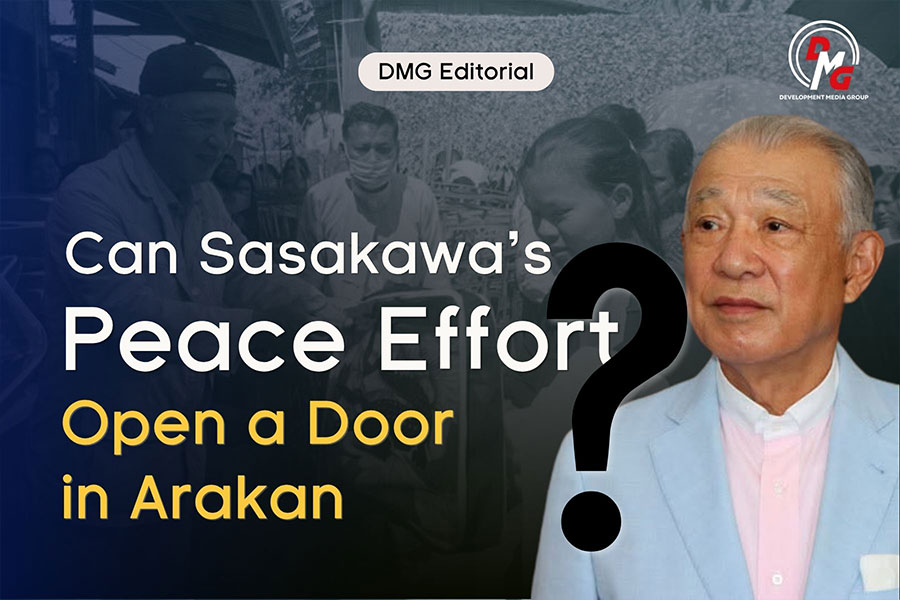
Nippon Foundation Chairman Yohei Sasakawa’s latest effort to facilitate talks between the Myanmar military and the Arakan Army (AA) comes at a critical moment in the Arakan conflict.
Sasakawa has said he is seeking to facilitate unconditional talks between the two sides amid escalating fighting, although neither side has yet agreed to meet. His involvement is significant because he has played a similar role before, helping facilitate a ceasefire in 2020 and brokering a humanitarian ceasefire between the military and AA in 2022.
But Arakan today is very different from Arakan in 2020 or 2022.
Since renewed fighting began in late 2023, the United League of Arakan/Arakan Army (ULA/AA) has gained control over most of Arakan and established administrative, judicial, policing and public-service structures in areas under its authority. The military, meanwhile, is attempting to push back into territory it has lost.
Those competing military and political objectives are now playing out on several fronts.
Since September 4, fighting has intensified along the Sittwe-Ponnagyun border. DMG reported on September 15 that clashes had continued for more than 10 days. The military is also conducting offensives in at least five areas of Kyaukphyu Township, with ground forces backed by naval and air power. Fighting is also taking place along approaches to Arakan from neighbouring Ayeyarwady, Bago and Magway regions.
Under these circumstances, achieving the kind of understanding Sasakawa helped facilitate in 2020 and 2022 will be considerably more difficult. The balance of power on the ground has fundamentally changed, and both sides continue to pursue their respective military and political objectives.
Yet this does not make mediation irrelevant. On the contrary, the worsening humanitarian situation makes communication between the two sides increasingly important.
DMG documented 602 civilians killed and 1,211 injured in airstrikes in Arakan between April 2024 and September 12, 2026. The figures are not exhaustive, but they illustrate the enormous price civilians have paid during the conflict.
The consequences extend far beyond casualties. Fighting, airstrikes and shelling are forcing people from their homes, disrupting transportation and trade, preventing farmers from reaching their fields and making food and medicine increasingly difficult to obtain.
In Kyaukphyu and Ramree alone, tens of thousands of displaced people are facing food shortages. DMG reported that approximately 30,000 displaced people in eight camps in Kyaukphyu and nearly 10,000 in Ramree were experiencing shortages, with about 5,100 people in urgent need of assistance.
This humanitarian reality may offer the most practical starting point for mediation.
If the two sides are not ready for broader political negotiations, dialogue could initially focus on reducing civilian harm, facilitating humanitarian assistance and protecting access to food, healthcare and other essential services. The experience of 2022 showed that humanitarian concerns can provide space for dialogue even when deeper political differences remain unresolved.
Any new mediation effort must also recognise how much Arakan has changed. The ULA/AA’s territorial gains have brought greater authority, but greater authority also brings greater responsibility for protecting civilians, maintaining essential services and facilitating humanitarian assistance.
At the same time, civilians and civilian infrastructure must not become instruments of military pressure. Hospitals, schools, religious and cultural sites, markets and residential communities require protection regardless of which side holds the military advantage.
Sasakawa therefore faces a much harder task than he did in 2020 or 2022. A comprehensive ceasefire or political settlement may remain difficult under present conditions. But diplomacy should not be measured only by whether it can end the entire conflict at once.
Opening channels of communication, facilitating humanitarian access and reducing harm to civilians would themselves be meaningful steps.
Arakan’s future will not ultimately be determined only by who controls which town or wins which battle. For ordinary people, the more immediate questions are whether they can live safely, find food and medicine, send their children to school, work their farms and rebuild their lives.
At this stage of the conflict, any meaningful peace effort should begin there: with the protection and survival of Arakan’s civilians.

Opinion
.jpg)
How Can Myanmar’s Political Crisis Be Brought to an End?
By Admin 13 Sep 2026
By Cutting Trees, We Are Killing Ourselves
By Admin 06 Sep 2026
A Modern August We Must Never Forget
By Admin 31 Aug 2026
Arakan’s Political Shifts and the Debate Over Rights and Governance
By Admin 27 Aug 2026
Securing Rights for Bangladesh's Indigenous Peoples is Indispensable
By Admin 09 Aug 2026
POLITICS
BUSINESS
Industry to manufacture finished goods from coconut starting in early 2020
By Aung Kaung Zaw 20 Nov 2019