

- Magway records most airstrikes since new military chief took command: ISP-Myanmar
- Junta warship destroys two fishing boats, seizes another off Werathani
- Junta jet fighters drop 500-pound bombs on former junta battalions in Mrauk-U
- Junta deploys fighter jets to bomb Ponnagyun
- Rathedaung villagers set up night watches amid Sittwe clashes, ARSA threat
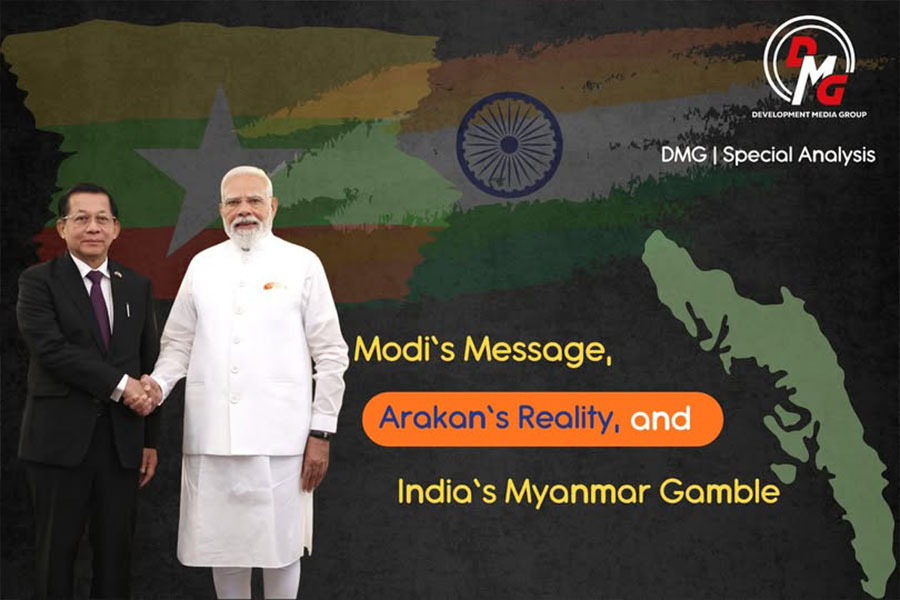
Modi’s Message, Arakan’s Reality, and India’s Myanmar Gamble
Indian Prime Minister Narendra Modi’s public message following his meeting with Min Aung Hlaing was more than a diplomatic courtesy. It was a political signal to Myanmar, to India’s neighbours, to China, and to the wider international community.
13 Jun 2026
DMG | Special Analysis
Indian Prime Minister Narendra Modi’s public message following his meeting with Min Aung Hlaing was more than a diplomatic courtesy. It was a political signal to Myanmar, to India’s neighbours, to China, and to the wider international community.
By describing the meeting as “productive,” referring to Min Aung Hlaing as “President,” and stating that India was “honoured” that he chose India for his first foreign visit in that role, Modi sent a clear message: New Delhi intends to continue engaging Myanmar’s military-backed authorities despite criticism from Western governments and opposition from many of Myanmar’s democratic and revolutionary forces.
For India, however, this is not primarily about supporting Min Aung Hlaing. It is about protecting long-term strategic interests.
Modi’s statement placed Myanmar firmly within India’s “Neighbourhood First,” “Act East,” and “Indo-Pacific” frameworks. This indicates that New Delhi views Myanmar not merely as a crisis-ridden neighbour, but as a critical component of its regional security, economic, and geopolitical strategy. The areas highlighted by Modi, trade, rare earth minerals, healthcare, connectivity, heritage restoration, capacity building, maritime security, and cyber security, reveal the real priorities behind the visit.
For Arakan, these priorities carry significant implications.
Arakan occupies a central position in India’s regional connectivity ambitions through the Kaladan Multi-Modal Transit Transport Project, which is designed to connect India’s northeastern states to the Bay of Bengal. Yet the political and military realities on the ground have changed dramatically. Today, much of Arakan is under the control and administration of the Arakan Army (AA) and the ULA-led administration, while the military regime retains only limited footholds supported largely by airpower and remaining military positions.
This creates a fundamental contradiction in India’s Myanmar policy. While New Delhi may negotiate formally with Naypyidaw, many of the territories, transport corridors, and communities that matter most to India’s long-term interests are no longer under junta control. The future of the Kaladan Project, border trade, maritime access, and regional stability increasingly depends on actors beyond the military regime.
Modi’s reference to rare earth minerals is equally significant. Myanmar’s borderlands, particularly parts of Kachin State and other conflict-affected regions, contain strategically important mineral resources that are increasingly vital for technology, renewable energy, and defense industries. India’s growing interest in rare earths reflects broader efforts to diversify supply chains and reduce dependence on China. Yet many of these resource-rich areas are now influenced or controlled by ethnic armed organizations rather than the central government.
Perhaps the most sensitive aspect of Modi’s message concerns maritime security, cyber security, and broader security cooperation.
For the junta, these areas offer opportunities to seek greater intelligence sharing, closer border monitoring, and enhanced diplomatic engagement with India. For revolutionary forces operating along the India-Myanmar frontier including the AA, Chin resistance organizations, KIA-linked forces, NUG-aligned groups in Sagaing Region, and others, this could translate into tighter restrictions, increased surveillance, and reduced freedom of movement.
Recent DMG reporting has already highlighted these concerns. Political analyst U Myo Kyaw warned that the junta may seek to replicate in western Myanmar a strategy similar to that employed by China along the northern Shan border, where pressure has been applied to ethnic armed organizations in pursuit of broader security objectives. CDM Captain Zin Yaw likewise assessed that while India is unlikely to impose restrictions comparable to those seen along the China-Myanmar border, revolutionary groups could nevertheless face growing constraints and a shrinking operational environment.
This represents the most immediate risk arising from the visit.
India is unlikely to intervene militarily on behalf of the junta. However, increased intelligence cooperation, enhanced border controls, and stricter regulation of cross-border activities could create operational challenges for resistance groups that depend on frontier mobility, supply networks, and informal cross-border connections.
At the same time, India cannot ignore realities on the ground. A complete disruption of border trade would adversely affect communities in Arakan, Chin State, and Sagaing Region that rely heavily on Indian routes for food, medicine, and essential goods. Such a move would also undermine India's own strategic influence in western Myanmar.
Consequently, New Delhi is likely to continue pursuing a dual-track approach: maintaining formal engagement with the military authorities while quietly preserving channels of communication with ethnic and local actors who exercise effective authority in border regions.
This reflects a long-standing feature of India’s foreign policy: pragmatism.
By publicly embracing Min Aung Hlaing, Modi has provided the junta with a measure of diplomatic legitimacy at a time when the regime remains internationally contested. The visit allows the military leadership to present itself as an accepted regional partner. Yet diplomatic symbolism cannot alter battlefield realities. The junta has lost control over large parts of Myanmar, including most of Arakan, and its capacity to secure infrastructure, administer territory, and guarantee stability remains increasingly constrained.
For the AA, Modi’s message is therefore both a warning and an opportunity. It is a warning because India may intensify security cooperation and border monitoring. Yet it is also an opportunity because India’s long-term interests in Arakan cannot realistically be protected without engaging, directly or indirectly, with the forces that exercise authority on the ground.
Arakan today is no longer merely a conflict zone. It has become a strategic crossroads linking South Asia and Southeast Asia through maritime trade, infrastructure corridors, natural resources, and border commerce. As the AA consolidates its authority across much of the state, regional actors increasingly face a practical reality: sustainable stability and economic cooperation in Arakan will require engagement with the political and administrative structures that have emerged there.
The message from Modi is clear: India will continue engaging Myanmar’s military-backed authorities in pursuit of national interests.
But the message from the ground is equally clear: Myanmar has entered a new political reality. Authority is fragmented, power is increasingly decentralized, and actors such as the Arakan Army have become unavoidable political and security stakeholders.
The future of India-Myanmar relations will therefore be shaped not only by diplomacy in New Delhi and Naypyidaw, but by how effectively regional powers adapt to the changing realities emerging across Myanmar’s borderlands. In Arakan, that reality is already reshaping the strategic landscape of the Bay of Bengal.
Whether India chooses to acknowledge it openly or not, the future of many of its interests in western Myanmar will increasingly depend on how it navigates this new reality.

Opinion
.jpg)
How Can Myanmar’s Political Crisis Be Brought to an End?
By Admin 13 Sep 2026
By Cutting Trees, We Are Killing Ourselves
By Admin 06 Sep 2026
A Modern August We Must Never Forget
By Admin 31 Aug 2026
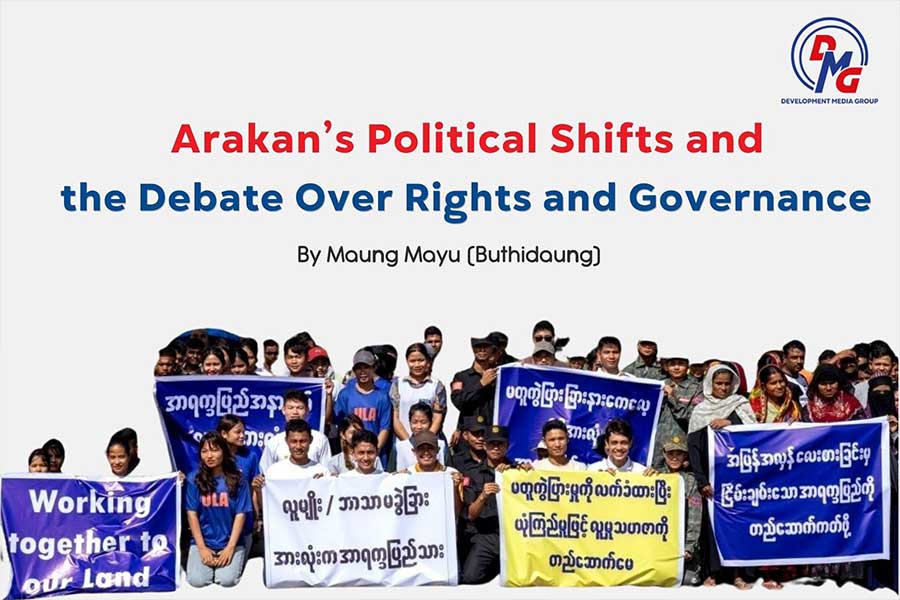
Arakan’s Political Shifts and the Debate Over Rights and Governance
By Admin 27 Aug 2026
Securing Rights for Bangladesh's Indigenous Peoples is Indispensable
By Admin 09 Aug 2026
POLITICS


BUSINESS
Industry to manufacture finished goods from coconut starting in early 2020
By Aung Kaung Zaw 20 Nov 2019